Introduction
For over a decade, Rule 506(c) existed on paper as a powerful fundraising tool — one that most fund managers passed over in practice. The rule permits issuers to advertise private securities offerings broadly, but its verification requirements were so cumbersome that the vast majority of private funds stuck with the older, more familiar Rule 506(b).
That changed on March 12, 2025, when the SEC's Division of Corporation Finance issued a no-action letter responding to a request from Latham & Watkins.
The letter accepted a new streamlined verification approach built around minimum investment thresholds and written investor self-certifications: a meaningful shift that reduces the administrative friction long discouraging 506(c) adoption.
This guide covers what Rule 506(c) is, what the 2025 guidance actually changed (and what it didn't), how it compares to Rule 506(b), and what it means for accredited investors evaluating private fund opportunities like those offered through mortgage note funds.
Key Takeaways
- Rule 506(c) permits broad advertising of private offerings — social media, websites, events — unlike Rule 506(b), which permits broad advertising of private offerings — social media, websites, and public events — a right Rule 506(b) explicitly prohibits
- The March 2025 no-action letter introduced a streamlined verification method: $200,000 minimum for individuals, $1 million for legal entities, plus written self-certification
- Every purchaser must be a verified accredited investor — no exceptions and no sophisticated non-accredited investors allowed
- Antifraud rules, Form D filings, and state blue sky notice obligations all remain fully in force
- Self-directed IRAs can invest in 506(c) funds — IRA-specific tax and prohibited transaction rules still apply
What Is SEC Rule 506(c)? Background and Core Requirements
Rule 506(c) is an exemption under Regulation D of the Securities Act of 1933, implemented in September 2013 following Congress's passage of the JOBS Act. It allows issuers to raise an unlimited amount of capital without SEC registration, with one defining feature: it lifts the longstanding prohibition on general solicitation.
Under prior law, private fund managers had to rely on pre-existing relationships to find investors. Rule 506(c) changed that: issuers can advertise openly across websites, social media, events, and other public channels.
The Two Core Conditions
Every 506(c) offering must satisfy two requirements:
- All purchasers must be accredited investors — unlike Rule 506(b), there is no allowance for sophisticated non-accredited investors
- The issuer must take "reasonable steps" to verify each purchaser's accredited investor status — self-certification alone is insufficient
The Adoption Gap
Despite these advantages, 506(c) saw limited use for over a decade. According to SEC Regulation D data, 2024 Form D filings reported $2,007.6 billion raised under Rule 506(b) versus $139.6 billion under Rule 506(c) — a roughly 14-to-1 disparity. The verification burden was a primary deterrent: issuers had to collect and review third-party documentation for every investor, adding time, cost, and compliance friction that 506(b) offerings avoided entirely.
Form D and Resale Restrictions
Issuers must file Form D electronically with the SEC within 15 calendar days of the first sale. Investors receive restricted securities subject to Rule 144 holding periods: reporting issuers impose a minimum six-month hold, while non-reporting issuers require one year before investors can resell under the safe harbor.
The March 2025 SEC No-Action Letter: What Changed
A no-action letter is a statement from SEC staff agreeing not to recommend enforcement action if an issuer follows a described approach. On March 12, 2025, the SEC's Division of Corporation Finance issued such a letter in response to a request from Latham & Watkins, accepting a new fact pattern for satisfying the 506(c) verification requirement.
The Historical Problem
Before this guidance, "reasonable steps" verification for individual investors typically meant:
- Reviewing two years of IRS tax returns, W-2s, or 1099s
- Examining bank or brokerage statements, certificates of deposit, or appraisal reports
- Obtaining a credit report to confirm liabilities
- Securing written confirmation from a registered broker-dealer, investment adviser, attorney, or CPA
This process required investors to hand over sensitive financial documents to fund managers they may have encountered through an advertisement — a friction point that deterred participation on both sides.
The Three-Condition Framework
The 2025 no-action letter accepted a streamlined approach when all three of the following conditions are met:
| Condition | Requirement |
|---|---|
| Minimum investment | $200,000 for natural persons; $1 million for specified legal entities; $200,000 per natural-person owner for qualifying look-through entities with fewer than 5 owners |
| Written self-certification | Investor represents in writing that they are accredited and that the investment amount is not financed by a third party for the specific purpose of making that investment |
| No contrary knowledge | The issuer has no actual knowledge of facts indicating the investor is not accredited or that the minimum investment was financed contrary to the representation |
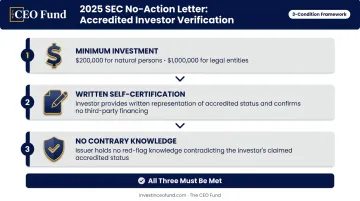
When all three conditions are satisfied, the issuer can reasonably conclude it has met the reasonable steps verification requirement, without collecting tax returns or financial statements.
What the Letter Did Not Change
This is staff guidance tied to a specific fact pattern, not a Commission rule or universal safe harbor. The older verification methods remain fully valid alternatives, including:
- Tax returns and W-2s
- Bank or brokerage statements
- Written confirmation from a licensed attorney, CPA, or broker-dealer
Issuers may continue using any approach they consider reasonable given the circumstances.
How Accredited Investor Verification Works Under the New Guidance
Who Qualifies as an Accredited Investor
Under SEC Rule 501, accredited investors include:
- Natural persons with individual income exceeding $200,000 (or $300,000 jointly with a spouse) in each of the prior two years, with reasonable expectation of the same in the current year
- Natural persons with individual or joint net worth exceeding $1 million, excluding the value of the primary residence
- Entities with total assets exceeding $5 million not formed for the specific purpose of acquiring the offered securities
- Entities where all equity owners are accredited investors
- Holders of qualifying FINRA licenses (Series 7, 65, or 82) in good standing — added in the SEC's 2020 amendments
Old vs. New Verification: A Practical Comparison
| Approach | What's Required from the Investor |
|---|---|
| Old method (tax/income review) | Two years of tax returns, W-2s, brokerage statements, credit report, plus written income expectation |
| Old method (professional letter) | Written confirmation from a broker-dealer, RIA, attorney, or CPA |
| New method (2025 guidance) | Meet the $200,000 minimum investment threshold + sign a written self-certification |
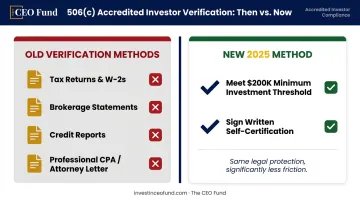
For investors, the difference is significant: no tax returns, no credit reports, no CPA letters. A written self-certification and meeting the investment minimum is sufficient — provided the issuer has no reason to doubt the representation.
That said, the streamlined approach has one firm limit built into the rule itself.
The "No Actual Knowledge" Guardrail
The SEC's "no actual knowledge" condition prevents issuers from relying on self-certification when red flags exist. If the investor has communicated information inconsistent with accredited status, the issuer must revert to traditional verification. Disqualifying signals include:
- Stated inability to meet the investment minimum without significant financial strain
- Disclosed debts, bankruptcies, or financial distress that contradict claimed net worth
- Prior communications suggesting income or assets fall below the thresholds
- Any facts that give the issuer reasonable cause to question the investor's eligibility
If any of these are present, self-certification alone cannot satisfy the issuer's verification obligation under Rule 506(c).
Rule 506(c) vs. Rule 506(b): Key Differences
These two exemptions serve different fundraising strategies. Neither is universally superior — the right choice depends on how a fund plans to market itself and who it wants to reach.
| Feature | Rule 506(b) | Rule 506(c) |
|---|---|---|
| General solicitation | Prohibited | Permitted |
| Investor eligibility | Unlimited accredited + up to 35 non-accredited sophisticated | All purchasers must be accredited |
| Verification requirement | Issuer needs reasonable belief; self-certification generally sufficient | Issuer must take active, reasonable verification steps |
| Marketing approach | Pre-existing relationships only | Open advertising across any channel |
| Capital raise limit | Unlimited | Unlimited |
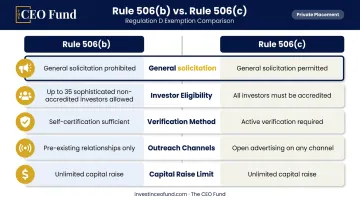
The most consequential difference for fund managers is advertising. Under 506(b), posting about an active offering on social media or a public website violates the general solicitation prohibition. Under 506(c), that same post is permitted — which is why the 2025 verification simplification matters. It makes the public advertising option practically viable for the first time.
For funds considering a transition from 506(b) to 506(c), three steps are required:
- File an updated Form D with the SEC
- Revise offering materials to remove any representations about no general solicitation
- Update internal compliance procedures to reflect the new marketing approach
Remaining Compliance Requirements for 506(c) Offerings
The 2025 no-action letter addressed verification only. Every other compliance obligation remains.
Antifraud Rules
All securities transactions — exempt or not — are subject to Rule 10b-5, which prohibits materially false or misleading statements in connection with the purchase or sale of securities. Broad advertising makes this more relevant, not less — every public statement about an offering is a potential enforcement target.
The Marketing Rule
Rule 206(4)-1 under the Investment Advisers Act applies to SEC-registered investment advisers. For funds managed by registered advisers, marketing materials distributed to a mass audience face specific restrictions — including limits on hypothetical performance projections such as targeted return figures. The SEC has noted that advisers generally cannot establish the audience-specific conditions required to include hypothetical performance data in broadly distributed advertisements.
State Blue Sky Filings
Rule 506(c) securities are federally preempted from state registration requirements. That federal shield doesn't eliminate state-level obligations, however. States where advertising reaches prospective investors can still require:
- Notice filings with the state securities regulator
- Consent to service of process
- State-specific fee payments
The wider the advertising footprint, the longer that list becomes. Issuers should track every state where solicitation materials are distributed and confirm applicable filing deadlines before launching a campaign.
What Rule 506(c) Means for Accredited Investors Today
The 2025 guidance makes it easier for accredited investors to participate in broadly advertised private offerings. Rather than surrendering sensitive financial documents upfront, investors can now rely on written self-certification or minimum investment thresholds to satisfy verification requirements.
What to Evaluate Before Investing
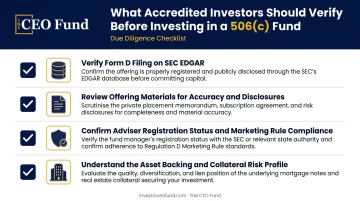
When reviewing any 506(c) fund, accredited investors should:
- Verify the Form D filing on the SEC's EDGAR database — this confirms the offering is properly noticed and identifies which exemption the issuer is relying on
- Review offering materials for factual accuracy and compliance disclosures — antifraud rules apply regardless of exemption type
- Confirm the fund's adviser registration status — registered advisers are subject to the Marketing Rule, which adds guardrails on advertised performance claims
- Understand the asset backing — mortgage note funds secured by real estate collateral carry a very different risk profile than equity-based venture offerings
Self-Directed IRA Access
506(c) funds — including mortgage note investment offerings — can be held through self-directed IRAs or solo 401(k) accounts, providing potential tax-advantaged exposure to real estate-backed private placements. The CEO Fund, for example, positions its mortgage note investments as well-suited for self-directed retirement accounts, where monthly borrower payments can be deposited directly into an IRA.
Before committing retirement account capital, confirm these points:
- The retirement account itself must qualify as an accredited investor under Rule 501, and the fund must accept IRA capital
- UBIT (unrelated business income tax) may apply — particularly if the investment involves debt-financed property
- Prohibited transaction rules restrict certain dealings between a plan and disqualified persons
- Consult a tax advisor before proceeding — IRA investing rules carry real consequences if misapplied
Frequently Asked Questions
How must fund sponsors verify accredited investor status under Rule 506(c)?
Under the March 2025 no-action guidance, fund sponsors can satisfy verification by setting minimum investments of $200,000 for individuals ($1 million for most entities), obtaining a written self-certification of accredited status, and confirming they have no actual knowledge of facts contradicting that certification. Prior methods — such as reviewing tax returns, bank statements, or obtaining professional letters — remain valid alternatives.
What is the difference between a 506(b) and a 506(c) fund?
General solicitation is what separates these two exemptions. Rule 506(b) prohibits public advertising and allows up to 35 sophisticated non-accredited investors via self-certification; Rule 506(c) permits broad advertising but requires every investor to be accredited and mandates active, reasonable verification by the issuer.
What is a sophisticated investor under Rule 506?
Under Rule 506(b), up to 35 non-accredited "sophisticated" investors may participate — meaning individuals with sufficient financial and business knowledge to evaluate the investment's merits and risks. Rule 506(c) does not permit sophisticated non-accredited investors; every purchaser must be a verified accredited investor.
What is the difference between Rule 504, Rule 506(b), and Rule 506(c)?
Rule 504 permits raises up to $10 million in a 12-month period with fewer restrictions but generally prohibits general solicitation. Rule 506(b) allows unlimited raises without general solicitation and permits up to 35 sophisticated non-accredited investors. Rule 506(c) also allows unlimited raises but permits general solicitation while requiring all investors to be accredited and verified.
Can I invest in a 506(c) fund through a self-directed IRA?
Yes, accredited investors can use a self-directed IRA or solo 401(k) to invest in Rule 506(c) private placements, provided the fund accepts IRA capital and the custodian supports alternative assets. UBIT, prohibited transaction rules, and IRS retirement account rules still apply — consult a tax advisor before proceeding.
What happens if an issuer fails to properly verify accredited investor status under Rule 506(c)?
Failing to take reasonable verification steps causes the issuer to lose the 506(c) exemption, making the offering an unregistered securities sale under the Securities Act of 1933. Consequences include SEC enforcement action, civil liability to investors, and a potential obligation to rescind the offering and return all investor funds.