

The truth is more nuanced. There's no income limit preventing you from contributing to a traditional IRA. What phases out at higher income levels is the deduction — a meaningful distinction with significant strategic implications. Once you understand the difference, a traditional IRA remains relevant even for earners well above the phaseout ranges.
This guide covers the 2025 deduction rules, the strategies that fill the gap when deductibility disappears, and one often-overlooked option for accredited investors: the self-directed IRA.
Key Takeaways
- High-income earners can contribute to a traditional IRA at any income level — only the deduction phases out above IRS thresholds
- Non-deductible contributions still grow tax-deferred and serve as the foundation for the backdoor Roth IRA strategy
- The pro-rata rule can create unexpected tax bills when pre-tax and after-tax IRA balances mix
- SEP IRAs, Solo 401(k)s, and Roth 401(k)s offer larger contribution room for self-employed earners
- A self-directed IRA lets accredited investors hold real estate-backed assets like mortgage notes for tax-deferred alternative income
Traditional IRA Basics: What High-Income Earners Need to Know
How the Account Works
A traditional IRA's core mechanics are straightforward: contributions go in pre-tax (if deductible), the money grows tax-deferred, and withdrawals in retirement are taxed as ordinary income. This differs from a Roth IRA, where you contribute after-tax dollars and qualified withdrawals come out tax-free.
The deductible traditional IRA works best for earners in high current tax brackets who expect lower income — and lower tax rates — in retirement. The front-loaded deduction is the primary financial benefit. Once income disqualifies you from that deduction, the account still has strategic uses — but they work differently than most high earners assume.
The Rule High Earners Conflate
Many people believe there's an income limit on contributing to a traditional IRA. There isn't. The income-based restriction applies only to claiming the deduction. These are two separate rules, and conflating them leads to unnecessarily abandoning a useful account.
2025 Contribution Limits
The IRS sets these limits regardless of income:
- Under age 50: $7,000 per year
- Age 50 or older: $8,000 per year (includes $1,000 catch-up)
- Ages 60–63: The enhanced SECURE 2.0 catch-up applies to 401(k) plans, not IRAs — the IRA catch-up remains $1,000
Contributions cannot exceed your taxable compensation for the year.
RMD Consideration
Traditional IRAs require required minimum distributions (RMDs) starting at age 73. For high earners building large tax-deferred balances, forced withdrawals in retirement can push income into higher brackets. A Roth conversion strategy, executed before RMDs begin, can reduce that exposure significantly.
2025 Income Limits: When Your Traditional IRA Deduction Phases Out
The Two-Tier Phaseout Structure
Whether your traditional IRA contribution is deductible depends on two things: your modified adjusted gross income (MAGI) and whether you (or your spouse) participate in a workplace retirement plan.
Without workplace retirement plan coverage, the deduction is fully available at any income level — no phaseout applies.
If you or your spouse are covered by a workplace plan, the following 2025 MAGI phaseout ranges apply:
| Filing Status | Full Deduction | Partial Deduction | No Deduction |
|---|---|---|---|
| Single / Head of Household (covered at work) | Up to $79,000 | $79,001–$88,999 | $89,000+ |
| Married Filing Jointly (contributor covered at work) | Up to $126,000 | $126,001–$145,999 | $146,000+ |
| Married Filing Jointly (contributor NOT covered, spouse IS covered) | Up to $236,000 | $236,001–$245,999 | $246,000+ |
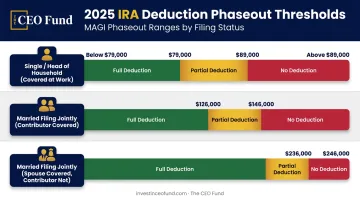
The spousal IRA phaseout matters: a non-working or non-plan-covered spouse can still claim a deduction up to $236,000 MAGI — well above the standard phaseout. Before applying any of these thresholds, you need to know exactly what counts toward your MAGI.
What Counts as MAGI
For traditional IRA deduction purposes, MAGI starts with your adjusted gross income and adds back certain items — including the student loan interest deduction, foreign earned income exclusion, and employer adoption benefit exclusions. It does not include Roth IRA conversions or qualifying rollovers.
Compensation, self-employment income, and rental income all factor in. Calculate your MAGI before assuming you're fully phased out.
Phaseout Math: A Practical Example
For a single filer covered by a workplace plan, the 2025 phaseout range is $10,000 wide ($79,000 to $89,000). The partial deduction formula is:
Maximum deductible contribution × ($89,000 − your MAGI) ÷ $10,000
Say your MAGI is $84,000. That puts you $5,000 into the phaseout window:
$7,000 × ($89,000 − $84,000) ÷ $10,000 = $3,500 partial deduction
Per IRS Publication 590-A, the result rounds up to the nearest $10, and a minimum $200 deduction applies if you're below the upper threshold.
Single filers above $89,000 lose the deduction entirely — but the contribution itself is still allowed. Those dollars go in as a non-deductible contribution and grow tax-deferred until withdrawal.
Track non-deductible contributions on IRS Form 8606. This form establishes your cost basis and prevents double taxation when you eventually withdraw.
Strategies for High-Income Earners When the Traditional IRA Falls Short
Backdoor Roth IRA
The backdoor Roth is the most widely used workaround for high earners locked out of direct Roth IRA contributions. The two-step process:
- Make a non-deductible traditional IRA contribution (up to $7,000 in 2025)
- Convert the balance to a Roth IRA
Done cleanly, this sidesteps the Roth IRA income limits and delivers tax-free growth — with one important caveat.
The pro-rata rule treats all your traditional, SEP, and SIMPLE IRA balances as a single pool when calculating the taxable portion of any conversion. You can't pick and choose which dollars convert. If you hold $100,000 in a pre-tax rollover IRA and contribute $7,000 non-deductible, roughly 93% of any conversion is taxable — not 0%.
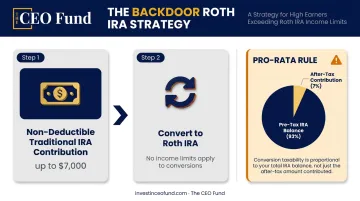
Earners with large pre-tax IRA balances need to plan carefully before executing this strategy.
Roth 401(k) and Mega Backdoor Roth
For earners whose employers offer a Roth 401(k), this is worth prioritizing: no income limits apply. The 2025 employee deferral limits:
- Standard limit: $23,500 (shared between pre-tax and Roth deferrals)
- Age 50+ catch-up: $7,500, for a total of $31,000
- Ages 60–63 catch-up (SECURE 2.0): $11,250, for a total of $34,750
For plans that permit after-tax employee contributions beyond the standard deferral, the mega backdoor Roth takes this further. The IRC 415(c) overall annual additions limit is $70,000 in 2025 (before catch-ups). After accounting for your deferrals and employer contributions, remaining room can be filled with after-tax contributions and rolled to a Roth IRA.
SEP IRA and Solo 401(k) for Self-Employed Earners
Self-employed high earners operate under a different set of rules — contribution limits that dwarf what a traditional IRA offers:
SEP IRA (2025)
- Contribute up to 25% of compensation or $70,000, whichever is less
- For self-employed individuals, the effective maximum rate is closer to 20% of net self-employment income after the SE tax deduction
- Traditional SEP contributions are generally deductible; starting in 2023, Roth SEP contributions are also permitted
Solo 401(k) (2025)
- Employee deferral: up to $23,500 (plus catch-ups for age 50+)
- Total annual additions limit: $70,000 (before catch-ups)
- Roth contribution option available if the plan document allows it
- 401(k) balances are excluded from the pro-rata rule — a key structural advantage over SEP IRAs for backdoor Roth planning
Is a Non-Deductible Traditional IRA Still Worth It for High-Income Earners?
The Case For It
Even without the deduction, a non-deductible traditional IRA still delivers tax-deferred growth — no annual capital gains taxes, no dividend drag while the money compounds. For a high-bracket earner, eliminating that drag on a compounding investment over decades has real value, even if it's smaller than the full deductible scenario.
That said, the strongest use case is straightforward: make the non-deductible contribution, then convert it to a Roth IRA quickly. The backdoor Roth strategy treats the traditional IRA as a brief intermediate step — contribute, then convert before meaningful earnings accumulate.
The Case Against Long-Term Holding
Several complications make long-term non-deductible IRA holding less attractive:
- Form 8606 tracking — You must file this form every year you make a non-deductible contribution and carry basis forward indefinitely. Gaps in filing can result in double taxation.
- Pro-rata rule exposure — If you accumulate pre-tax IRA balances (from rollovers, for example), future conversions become partially taxable in proportion to the pre-tax balance.
- Withdrawal tax treatment — Earnings still come out as ordinary income, not at preferential capital gains rates.
A Simple Decision Framework
| Situation | Recommended Approach |
|---|---|
| No pre-tax IRA balances, plan to convert quickly | Use non-deductible IRA as backdoor Roth stepping stone |
| Large pre-tax IRA rollover balance exists | Consider alternative vehicles; pro-rata rule adds complexity |
| Self-employed with high income | SEP IRA or Solo 401(k) offers more room and cleaner structure |
The Self-Directed Traditional IRA: A Higher-Yield Path for Accredited Investors
What a Self-Directed IRA Actually Is
A self-directed IRA (SDIRA) isn't a different tax classification — it's a traditional IRA held by a custodian that permits a broader investment menu. The same contribution limits, deduction rules, and RMD requirements apply. What changes is what you can hold inside it.
Per IRS and SEC guidance, SDIRAs can hold real estate, mortgages and promissory notes, private equity, tax lien certificates, precious metals, and other alternative assets — investments unavailable inside a conventional brokerage IRA.
Mortgage Notes as a Tax-Deferred Income Strategy
For accredited investors, an SDIRA creates a meaningful structural opportunity: tax-deferred growth on assets that generate real income — not just price appreciation.
In mortgage note investing, the investor acts as the lender — receiving monthly principal and interest payments from borrowers, with real estate serving as collateral. Those payments flow directly into the SDIRA, compounding tax-deferred rather than generating annual taxable income.
The CEO Fund's mortgage note model is built for self-directed IRA and 401(k) accounts. Monthly cash flow from performing notes — backed by residential, multifamily, and commercial real estate — deposits directly into the retirement account.
With 500+ loans acquired across 50+ states over a 10+ year track record, the fund delivers passive real estate income without property management responsibilities.

For investors holding $500,000 or more in a retirement account currently sitting in low-yield bonds or volatile equities, redirecting a portion into a real estate-backed strategy inside an SDIRA can improve risk-adjusted returns.
That opportunity, however, depends on getting the structure right.
Compliance Requirements
SDIRAs require careful structuring:
- The custodian must be IRS-approved — either a bank or a qualified nonbank trustee listed under Treasury Regulation 1.408-2(e)
- Prohibited transaction rules under IRC 4975 apply strictly — no self-dealing, no transactions with disqualified persons (including yourself, your spouse, or entities you control)
- If a prohibited transaction occurs, the IRS treats the entire IRA as distributed as of January 1 of that tax year — a severe consequence
- IRS approval of a custodian is not an endorsement of any investment — due diligence on the underlying asset remains the investor's responsibility
Work with a qualified tax advisor or ERISA attorney before directing retirement funds into any alternative investment structure.
Frequently Asked Questions
Can high-income earners contribute to a traditional IRA?
Yes — there is no income limit on traditional IRA contributions. Income restrictions apply only to the deductibility of those contributions, not the ability to contribute. High earners can make non-deductible contributions up to the annual limit ($7,000 in 2025, or $8,000 if age 50+) at any income level.
What can I do if my income is too high to contribute to a traditional IRA?
Income doesn't block contributions — it eliminates the deduction. For earners whose deduction phases out, options include non-deductible contributions (as a backdoor Roth precursor), a Roth 401(k), SEP IRA, or Solo 401(k), depending on your employment situation.
Which IRA is best for high-income earners?
Your employment situation and goals determine the best fit. A Roth 401(k) or backdoor Roth IRA suits most W-2 earners with workplace plans. A SEP IRA or Solo 401(k) offers the highest contribution room for the self-employed. A self-directed IRA adds access to alternative investments — including real estate-backed mortgage notes — for accredited investors.
Is a traditional IRA worth it for high-income earners?
A non-deductible traditional IRA has limited standalone value at high income but works well as a backdoor Roth stepping stone. For accredited investors, a self-directed traditional IRA can be compelling — offering tax-deferred growth on alternative assets with stronger return potential than conventional holdings.
What is the income limit for a traditional IRA deduction in 2025?
For single filers covered by a workplace plan, the deduction phases out between $79,000 and $89,000 MAGI. For married filing jointly with the contributor covered at work, the range is $126,000 to $146,000. Above the top of each range, no deduction is available.
What is the pro-rata rule and how does it affect traditional IRA conversions?
Per IRC 408(d)(2), the IRS treats all traditional, SEP, and SIMPLE IRA balances as a single pool when calculating the taxable portion of any conversion. A high earner with large pre-tax IRA funds cannot isolate and convert only after-tax contributions tax-free — the taxable percentage is determined proportionally across the entire IRA balance.