This guide covers both audiences: homebuyers who want to understand what they signed, and investors exploring mortgage notes as income-generating assets.
Here's what you'll find below: the definition, what the document actually contains, how it differs from related documents, what happens to it over the life of the loan, and how it functions as an investment vehicle.
Key Takeaways
- A mortgage note is the legally binding written promise to repay a home loan under specific terms — signed at closing
- It differs from the mortgage/deed of trust (which places the lien on the property) and from a mortgage statement (a periodic billing document)
- Lenders can sell the note on the secondary market without borrower consent — loan terms remain unchanged
- Investors who purchase a mortgage note receive the borrower's monthly payments directly — they become the lender
- Performing notes generate steady, predictable income for investors
- Non-performing notes trade at a discount — higher risk, but higher upside for experienced buyers
What Is a Mortgage Note?
A mortgage note is a legal document recording the formal agreement between a borrower and lender: the borrower's signed promise to repay a specific loan amount, at a stated interest rate, over a defined term. It's executed at the closing of a real estate transaction.
It does not, however, secure the lender's claim on the property. That function belongs to a separate instrument — the mortgage or deed of trust.
The Two-Document System at Closing
Borrowers typically sign two distinct documents at closing, and the distinction matters:
| Document | What It Does | Recorded Publicly? |
|---|---|---|
| Mortgage Note | Creates the debt — the borrower's personal promise to repay | No — held by the lender/custodian |
| Mortgage or Deed of Trust | Creates the lien on the property as collateral | Yes — recorded in county land records |
In short, the note creates the debt obligation; the mortgage backs it with the property as collateral. Both work together but serve separate legal functions. Per the CFPB's closing documents guide, the signed note is the borrower's legal repayment document, while the security instrument creates the lender's foreclosure rights.
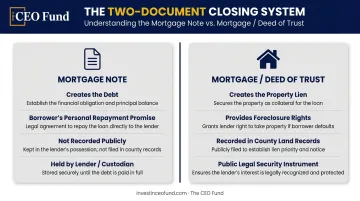
Because the note itself is not recorded in public county records, it remains a private instrument. Fannie Mae and Freddie Mac require document custodians to retain the original notes — they don't end up in the public land records database.
Common Names for a Mortgage Note
You'll encounter several terms used interchangeably:
- Promissory note — the broader legal category
- Mortgage note — a promissory note specific to real estate
- Real estate note or house note — informal variations
Technically, every mortgage note is a promissory note, but not every promissory note is a mortgage note.
Key Components of a Mortgage Note
Formats vary by lender and state, but all mortgage notes contain the same core elements. Borrowers should review each before signing.
Loan Amount, Interest Rate, and Loan Term
The note specifies:
- The exact principal borrowed
- Whether the rate is fixed (constant throughout the loan) or adjustable (tied to a market index and subject to change)
- The repayment term — typically 15 or 30 years for residential mortgages
These three factors determine every other number in the document. The Fannie Mae uniform fixed-rate note specifies the payment amount, first payment date, maturity date, and place of payment — all standardized across conforming loans.
Payment Schedule and Prepayment Terms
This section covers:
- How often payments are due (almost always monthly)
- How each payment splits between principal and interest
- Whether a prepayment penalty applies if the loan is paid off early
Prepayment penalties are tightly regulated. Under Regulation Z, they're generally prohibited except on qualifying fixed-rate Qualified Mortgages, where any permitted penalty cannot extend beyond three years and is capped at 2% in years one and two, and 1% in year three. If you're considering refinancing, check the note for this clause before running the numbers.
Late Payment Penalties and Default Terms
The note spells out:
- The grace period before a payment is considered late
- The late fee amount or percentage
- The lender's right to accelerate the loan — meaning demand full repayment immediately — after an uncured default
- The path to foreclosure proceedings
These are enforceable terms, not boilerplate — they dictate exactly what happens when payments stop.
Borrower and Lender Information
Beyond the financial terms, the note records identifying information for both parties. This typically includes:
- Full legal names of the borrower(s) and lender
- The property address and legal description
- Signature lines for all parties
Some notes also carry additional conditions — occupancy requirements (the borrower must use the property as a primary residence) or restrictions on how the property may be used are the most common.
Mortgage Note vs. Promissory Note vs. The Mortgage Document
Three terms that cause consistent confusion:
Promissory note vs. mortgage note: A promissory note is the broad legal category covering any written promise to repay a debt — car loans, business loans, personal lines of credit. A mortgage note is a specific type of promissory note that includes real-estate-specific terms. In the context of home loans, the terms are functionally interchangeable. Under UCC Article 3, a promissory note meeting the statutory definition is a negotiable instrument — meaning it can be transferred.
Mortgage note vs. mortgage/deed of trust: The note creates the debt obligation. The mortgage (or deed of trust, used in states like California and Texas) creates the lien on the property. They're two separate documents with separate legal purposes. The CFPB's closing forms guide covers this distinction in detail.
Mortgage note vs. mortgage statement: A mortgage statement is the periodic billing document — typically monthly — sent by the loan servicer. It shows your balance, payment due, and transaction history. Regulation Z (12 CFR 1026.41) requires servicers to send one per billing cycle. It is not a legal contract. It carries no binding obligation.
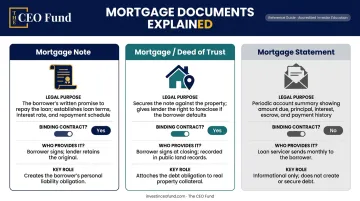
Here's how the three documents compare at a glance:
| Document | Legal Purpose | Binding Contract? | Sent By |
|---|---|---|---|
| Mortgage Note | Creates the debt obligation | Yes | Signed at closing |
| Mortgage / Deed of Trust | Creates the lien on the property | Yes | Signed at closing |
| Mortgage Statement | Periodic billing and account summary | No | Loan servicer (monthly) |
What Happens to a Mortgage Note Over Time
Who Holds the Mortgage Note?
After closing, the original signed note is held by the lender — specifically, by a document custodian under rules set by Fannie Mae and Freddie Mac. Lenders routinely sell notes on the secondary mortgage market to institutions, other banks, or private investors. The Federal Reserve's March 2026 Financial Accounts reported $13.8 trillion in outstanding household home-mortgage liabilities — a figure that underscores why the secondary mortgage market is one of the most active investment arenas in the country.
Federal law requires borrowers to receive written notice of any transfer. Two separate rules apply:
- Servicing transfers: Notice generally required at least 15 days before the effective date (Regulation X)
- Ownership transfers: New owner must disclose within 30 days (Regulation Z)
The borrower's loan terms — rate, payment amount, maturity date — never change as a result of a sale.
What Happens at Payoff or Refinance?
Once the loan is fully repaid, the lender is required to release the lien on the property. The note is marked "Paid in Full" or "Satisfied." Per the CFPB, state property records will reflect whether the lien was released, and the lender should return the original note. Store the payoff letter permanently — it's proof the debt is cleared.
In a refinance, the original note is retired and replaced by a new note reflecting the updated loan terms.
What Happens in Default?
If payments stop, the note's default and acceleration clauses activate. The party holding the note — whether the original lender or an investor who purchased it — can initiate foreclosure. The MBA reported a seasonally adjusted 4.44% delinquency rate for one-to-four-unit residential mortgages in Q1 2026, up from 4.26% in Q4 2025.
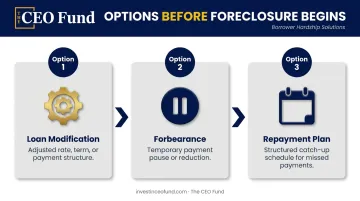
Borrowers facing hardship should contact their servicer early. Most servicers offer options before proceedings begin:
- Loan modification: Adjusted rate, term, or payment structure
- Forbearance: Temporary payment pause or reduction
- Repayment plan: Structured catch-up schedule for missed payments
Mortgage Notes as Investment Assets
When an investor purchases a mortgage note on the secondary market, they step into the lender's position. The borrower's monthly principal-and-interest payments flow to the investor instead. No property ownership, no tenants, no maintenance — just the income stream.
Performing vs. Non-Performing Notes
| Note Type | Borrower Status | Risk Profile | Investor Appeal |
|---|---|---|---|
| Performing | Current on payments | Lower risk | Steady, predictable income |
| Non-Performing | Delinquent or defaulted | Higher risk | Available at discount; upside through modification or property acquisition |
Investors typically evaluate notes based on borrower credit history, loan-to-value ratio, payment track record, and remaining term. Non-performing notes require more active management — negotiating with borrowers, pursuing reinstatement, or in some cases initiating foreclosure.
Why Investors Are Attracted to Mortgage Notes
Mortgage notes offer several structural advantages over direct property ownership:
- No property management — no tenant calls, no vacancy risk, no repair bills
- Real estate collateral backs the investment even without property ownership
- Geographic diversification — a portfolio can span multiple states and property types
- IRA and 401(k) compatibility — notes can be held in self-directed retirement accounts for tax-advantaged growth (subject to IRS prohibited transaction rules under IRC 4975)
The accredited investor standard for accessing most private mortgage note funds: net worth over $1 million (excluding primary residence), or individual income over $200,000 ($300,000 joint), per SEC Rule 501.
How Investors Access Mortgage Notes
Main acquisition channels include:
- Banks and financial institutions — typically sell in bulk portfolios
- Note brokers — intermediaries who package and resell individual notes
- Online note marketplaces — direct access for individual buyers
- Private lenders — relationship-driven sourcing
- Professionally managed funds — hands-off exposure to diversified note portfolios
Accredited investors who prefer a hands-off approach can invest through a managed fund rather than sourcing and servicing notes independently. The CEO Fund operates on exactly this model — Carlo Turner, a Certified Note Investing Specialist, leads acquisition and underwriting across a portfolio of 500+ loans in 50+ states, handling collateral valuation and borrower risk assessment on investors' behalf.
Key Due Diligence Factors
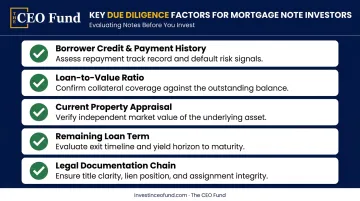
Before purchasing any mortgage note, evaluate:
- Borrower credit and payment history — has the borrower been consistent?
- Loan-to-value ratio — lower LTV means stronger collateral protection if things go wrong
- Current property appraisal — collateral value should support the note balance
- Remaining loan term — affects income duration and reinvestment risk
- Legal documentation chain — proper assignment history is essential for enforceability
For investors using a managed fund, this due diligence is conducted at the fund level — meaning you benefit from institutional-grade underwriting without having to review every note yourself.
Frequently Asked Questions
What is in a mortgage note?
A mortgage note contains the loan amount, interest rate (fixed or adjustable), repayment term, payment schedule, late payment penalties, prepayment terms, and identifying information for both parties. Some notes also include special clauses — such as occupancy requirements or property-use restrictions.
What is another name for a mortgage note?
A mortgage note is commonly called a promissory note, real estate note, or house note. Technically, a promissory note is the broader legal category — a mortgage note is simply a specific type tied to real estate financing.
Is a mortgage note different than a mortgage statement?
Yes. The mortgage note is the legal contract signed at closing that establishes the borrower's repayment obligation. A mortgage statement is a periodic billing document from the loan servicer showing your balance, payment due date, and transaction history — it carries no legal binding function.
How can I get my mortgage note?
Borrowers receive a copy at closing. If it's been misplaced, contact your current loan servicer or lender to request a copy. The note itself is typically not recorded in public county records, so county offices may not have it — but the servicer's records will.
Can a mortgage note be sold without the borrower's consent?
Yes. Lenders are legally permitted to sell or transfer mortgage notes without borrower consent. The borrower must receive written notice, but loan terms remain completely unchanged — only the entity receiving payments may change.
What happens to a mortgage note when the loan is fully paid off?
Once satisfied, the lender releases the lien on the property and marks the note "Paid in Full." The borrower typically receives a payoff letter or satisfaction statement confirming the debt is cleared. Keep this document with your permanent financial records — it's your proof of debt clearance.