
According to Capgemini's 2025 World Wealth Report, there are 8.7 million HNWIs in the United States — individuals with at least $1 million in investable assets. Each of those households faces planning decisions that standard retirement advice simply doesn't address.
This guide covers the five pillars of HNW retirement planning: defining your income needs, maximizing tax-advantaged accounts, accessing income-generating alternatives, implementing smart withdrawal sequencing, and protecting wealth through estate planning.
Key Takeaways
- HNWIs typically need to replace 55–80% of pre-retirement income and must plan for 30+ years of withdrawals
- Backdoor Roth conversions, Mega Backdoor Roth strategies, and self-directed IRAs remain underused by most high earners
- Mortgage note funds and other income-generating alternatives deliver consistent passive income without direct property ownership responsibilities
- Withdrawal sequencing, Roth conversion timing, and charitable giving strategies all reduce tax drag on a large portfolio
- Estate planning requires regular review, given the current $13.61M federal exemption and the $19,000 annual gift exclusion per recipient
What Is Considered a High-Net-Worth Retiree?
The standard definition focuses on investable (liquid) assets, not total net worth. A primary residence, collectibles, and consumer goods don't count.
| Tier | Investable Assets | Planning Complexity |
|---|---|---|
| HNWI | $1M – $5M | Estate planning begins, Roth phase-outs apply |
| Very High Net Worth | $5M – $30M | RMD traps, Medicare surtaxes, irrevocable trusts |
| Ultra-High Net Worth | $30M+ | Dynastic trust planning, family office structures |

Crossing the HNWI threshold activates planning complexities that standard retirement frameworks don't address:
- Roth IRA income phase-outs begin at $153,000 (single) and $242,000 (married filing jointly) in 2026
- Medicare IRMAA surcharges add hundreds of dollars monthly in Part B and Part D premiums above certain income thresholds
- RMD complexity — large tax-deferred balances force taxable withdrawals at age 73 that can push retirees into higher brackets
- Federal estate tax exposure for estates approaching or exceeding $15M per individual
Each tier introduces qualitatively different risks. The strategies that work at $2M — straightforward Roth conversions, basic estate planning — break down at $20M, where RMD exposure, IRMAA brackets, and irrevocable trust structures require a fundamentally different approach.
How Much Retirement Income Does a High-Net-Worth Individual Actually Need?
The Income Replacement Framework
Fidelity's research suggests most retirees need to replace 55–80% of pre-retirement income, with the range varying by lifestyle and income level. Higher earners often land on the lower end — savings rates drop, commuting costs disappear, and payroll taxes end.
A household earning $300,000 annually, for example, likely needs $180,000–$240,000 in annual retirement income in today's dollars.
The 25x Rule — and Its Limits
The "multiply by 25" rule (annual income need × 25 = approximate portfolio required) derives from the 4% withdrawal rate benchmark in William Bengen's historical research. Morningstar's 2025 analysis puts the safe starting rate at 3.9% for a 30-year horizon at 90% success probability — close to 4%, but not identical.
For HNWIs planning a 35–40 year retirement, the 25x rule is a starting point, not a guarantee. Consider:
- Longer life expectancy (high earners in the top quartile can expect to live 3–4 years longer than average earners, per SSA research)
- Higher lifestyle costs that resist compression
- Healthcare inflation that outpaces general CPI
The Inflation Problem
At a 3% average inflation rate, a $200,000 annual income need grows to $361,222 in 20 years and $418,756 in 25 years. Build every retirement projection in inflation-adjusted terms — static-dollar planning understates the real income gap by six figures or more.
Liquidity vs. Total Net Worth
Total net worth on paper tells only part of the story. A $5M figure means little when $3M is locked in a private business, $1M sits in illiquid real estate partnerships, and $500K is in a non-traded REIT. What drives retirement cash flow is liquid net worth — assets accessible within days, without penalties or significant discounts.
HNWIs should inventory every income source and model cash flow explicitly:
- Social Security (delay to 70 to maximize lifetime benefit)
- Pension distributions
- Investment account withdrawals
- Rental income and business distributions
- Annuity payments
- Alternative income streams
Once you've mapped that income inventory, the gap between what's coming in and what you need reveals exactly where your portfolio allocation has to compensate — and by how much.
Maximizing Tax-Advantaged Retirement Accounts as a High Earner
2026 Contribution Limits at a Glance
| Account Type | 2026 Limit | Catch-Up (50+) |
|---|---|---|
| 401(k)/403(b)/457 employee deferral | $24,500 | $8,000 |
| Enhanced catch-up (ages 60–63) | $24,500 | $11,250 |
| Total defined-contribution limit (employee + employer) | $72,000 | — |
| Traditional or Roth IRA | $7,500 | $1,100 |
| HSA (self-only / family) | $4,400 / $8,750 | $1,000 (age 55+) |
Source: IRS Notice 2025-67 and Rev. Proc. 2025-19
Always capture the full employer 401(k) match first — it's an immediate 50–100% return on that capital. Then max every available account type.
Backdoor Roth IRA
If your income exceeds the Roth IRA phase-out ($153,000 single / $242,000 married in 2026), the Backdoor Roth remains available:
- Make a non-deductible contribution to a traditional IRA
- Convert the traditional IRA to a Roth IRA
- Report on Form 8606
Critical caveat: The pro-rata rule aggregates all of your traditional, SEP, and SIMPLE IRA balances. If you have pre-tax IRA money elsewhere, the conversion becomes partly taxable. Rolling pre-tax IRAs into a current employer 401(k) first can sidestep this.
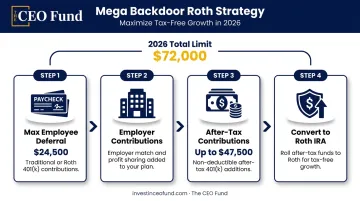
Mega Backdoor Roth
If your 401(k) plan allows after-tax contributions and either in-plan Roth conversions or rollovers:
- The total 401(k) limit is $72,000 in 2026
- After maxing the $24,500 employee deferral and receiving employer contributions, the remaining room allows up to $47,500 in after-tax contributions (less any employer match)
- Convert those after-tax contributions to a Roth IRA for tax-free growth
This is one of the most powerful strategies available to high earners. Many employer plans already support it — check your plan documents or ask your HR administrator.
Self-Directed IRAs for Alternative Assets
A self-directed IRA follows the same contribution limits and tax rules as a standard IRA but opens the investment universe considerably. HNWIs can hold:
- Real estate mortgage notes
- Private credit funds
- Real estate syndications
- Tax liens
The CEO Fund, for example, accepts self-directed IRA investments, allowing accredited investors to deploy retirement capital into diversified performing mortgage notes and earn monthly interest — within a tax-advantaged wrapper. This aligns particularly well with Roth IRAs, where that interest compounds tax-free.
The RMD Trap
Too much wealth in traditional tax-deferred accounts creates a forced-distribution problem at age 73. Large RMDs push AGI higher, triggering IRMAA Medicare surcharges and potentially pushing retirees into the 32–37% brackets.
The fix is controlling which accounts you draw from — and that requires maintaining three distinct tax buckets from which to selectively distribute:
- Tax-deferred — traditional 401(k)/IRA
- Tax-free — Roth accounts
- Taxable — standard brokerage accounts
Balancing across all three gives you flexibility to manage taxable income in retirement.
Diversifying with Alternative Investments for Passive Retirement Income
Traditional stock/bond portfolios carry sequence-of-returns risk — a sharp early-retirement downturn can drain a large portfolio faster than returns can recover it. Income-generating alternatives provide a different return profile that doesn't depend on daily market valuations.
Mortgage Note Investing
Rather than buying a property, mortgage note investors purchase the debt secured by real estate. The underlying property owner makes monthly principal and interest payments; those payments become the investor's cash flow.
Key advantages for retirement income:
- No tenants, maintenance calls, or property taxes — landlord responsibilities disappear entirely
- Secured by a tangible real estate asset, giving the note real collateral value
- Monthly payments are contractual, not tied to occupancy or rent collection
- Compatible with self-directed IRAs, making tax-advantaged access straightforward
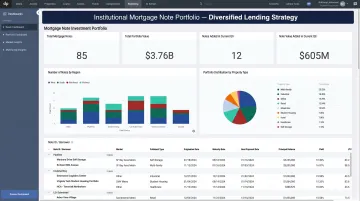
The CEO Fund takes this model further by pooling notes across multiple property types (single-family, multifamily, commercial, mobile home parks) and across states nationwide. Accredited investors access a diversified performing note portfolio rather than sourcing individual loans, targeting returns in the 8–12% range with quarterly cash distributions. The fund has purchased 500+ loans across 50+ states since inception.
Other Income-Generating Alternatives to Consider
- Real estate syndications — including construction syndications like The CEO Fund's $20M SUNRISE project in Florida
- Private credit funds — direct lending to businesses at higher yields than public bonds
- Commercial real estate — NNN leases and industrial properties with long-term tenants
Spreading capital across income source types, collateral categories, and geographic markets reduces concentration risk. No single alternative should dominate a retirement portfolio — and that discipline starts with understanding who can access these investments in the first place.
Who Qualifies
Alternative investments of this type are restricted to accredited investors: individuals with income above $200,000 annually ($300,000 with a spouse), or net worth exceeding $1M excluding the primary residence. Per the SEC's 2023 review, approximately 24.3 million U.S. households — 18.5% — met at least one accredited investor criterion using 2022 data.
Before committing retirement capital to any alternative fund, review manager credentials, portfolio diversification, track record, and the fund's offering documents carefully.
Smart Tax and Withdrawal Strategies in Retirement
Withdrawal Sequencing
The general rule: draw taxable accounts first (letting tax-advantaged accounts compound), then traditional IRA/401(k), then Roth last. For HNWIs, the sequencing requires active modeling tailored to your specific tax picture — not a default order applied blindly.
The critical window is between retirement and age 73, when income may dip before RMDs begin and before Social Security starts. That gap is the optimal time for Roth conversions. The general withdrawal sequence to model:
- Taxable accounts first — capital gains rates typically apply; lets tax-advantaged accounts keep compounding
- Traditional IRA/401(k) second — ordinary income rates apply; Roth conversions here reduce future RMD burden
- Roth accounts last — tax-free growth preserved as long as possible
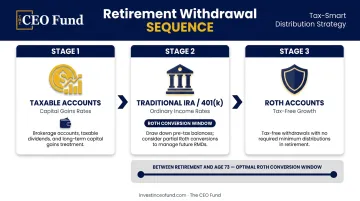
Filling lower brackets with conversions during this window also shrinks the traditional account balance that will otherwise be forced out as RMDs.
Medicare Surtaxes and IRMAA
Two tax costs that surprise many HNWI retirees:
- Net Investment Income Tax (NIIT): 3.8% on investment income above $200,000 (single) or $250,000 (married filing jointly)
- Medicare IRMAA surcharges: Part B premiums range from $202.90/month at the base level up to $689.90/month for incomes above $500,000 (single) in 2026
All three of these levers — Roth distributions, qualified charitable distributions, and tax-loss harvesting — reduce AGI and, in turn, reduce these costs. Charitable strategies in particular offer some of the most flexible AGI management tools available to high-net-worth retirees.
Charitable Giving Strategies
Bank of America's 2024 Study of Philanthropy found that 81% of affluent households gave to charity. For those who do give, the tax mechanics matter:
- Qualified Charitable Distributions (QCDs): Donors 70½+ can transfer up to $111,000 per year directly from an IRA to charity. The distribution counts toward the RMD but escapes taxable income entirely.
- Donor-Advised Funds (DAFs): Bunch multiple years of giving into one large contribution for a single large deduction, then distribute to charities over time.
- Appreciated asset donations: Donors contributing securities held more than one year claim a fair-market-value deduction while avoiding the capital gains tax a sale would trigger.
Estate Planning and Generational Wealth Transfer
The Current Federal Estate Tax Framework
Under current law, the federal estate and gift basic exclusion stands at $15 million per individual — verify the current figure with your estate attorney, as Congress periodically revisits these thresholds. Key figures for 2025–2026:
- Lifetime exemption: $15M per individual ($30M per married couple with portability)
- Annual gift exclusion: $19,000 per recipient
- Estate tax rate above the exemption: 40%
Historically, only a tiny fraction of estates — approximately 0.07% of decedents, per Congressional Research Service data from 2019 — paid federal estate tax. But for estates approaching $15M, the coordination of gifting, trust structures, and account types becomes consequential.
Understanding the tax framework is the starting point. The real work lies in how you structure assets to minimize exposure — and that's where the following tools come in.
Key Estate Planning Tools
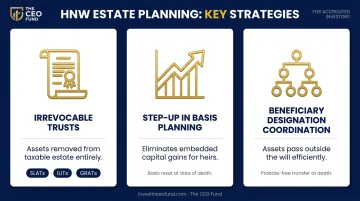
- Irrevocable trusts (SLATs, ILITs, GRATs): Transfer assets outside the taxable estate while retaining some indirect benefit; GRATs are particularly effective in low-interest-rate environments
- Step-up in basis planning: Appreciated taxable account assets inherited at death receive a stepped-up cost basis, eliminating embedded capital gains. Traditional IRA assets do not get this treatment — heirs pay ordinary income tax on distributions, making asset sequencing decisions meaningfully different for HNW estates.
- Beneficiary designation coordination: Retirement accounts, life insurance, and annuities pass outside the will through beneficiary designations — misaligned designations can undermine an otherwise well-structured estate plan
Estate plans need active maintenance, not just a one-time setup. Review yours after any major legislation, a significant change in asset values, or a family event — divorce, remarriage, or the birth of a grandchild can all shift who benefits and how much they keep.
Frequently Asked Questions
What is considered a high-net-worth retiree?
A high-net-worth retiree is generally defined as someone with at least $1 million in investable liquid assets, excluding the primary residence. The tiers run from HNWI ($1M–$5M) through Very High Net Worth ($5M–$30M) to Ultra-High Net Worth ($30M+), each carrying progressively more complex tax and estate planning implications.
What is the net worth of the top 5% of retirees?
Based on the Federal Reserve's 2022 Survey of Consumer Finances, households aged 65–74 have a mean net worth of approximately $1.79 million. To reach the top 5% of retirees, most estimates place the threshold between $3.5M and $5M in total net worth, depending on age cohort and how primary residence equity is counted.
Is $2 million in a 401(k) enough to retire at 60?
For many retirees, $2M is workable — but early retirement at 60 creates real pressure. A 35+ year drawdown period, healthcare costs before Medicare kicks in at 65, and the cost of delaying Social Security all strain the math. At a 4% withdrawal rate, $2M generates $80,000/year — leaving limited cushion for large, unexpected expenses.
What is the best retirement strategy for high-net-worth individuals?
HNW retirement planning requires layering several strategies together:
- Max tax-advantaged accounts using backdoor and mega backdoor Roth contributions
- Diversify into income-generating alternatives alongside public market assets
- Sequence withdrawals with active Roth conversion planning before RMDs begin
- Coordinate tax, estate, and financial advisors working as one team
How do high-net-worth individuals minimize taxes in retirement?
Several tools work together to reduce the tax burden in retirement: strategic Roth conversions during low-income years before RMDs begin, qualified charitable distributions to satisfy RMDs tax-free, careful asset location (bonds in tax-deferred accounts, equities in taxable), and tax-loss harvesting to offset gains. Drawing from Roth accounts and municipal bonds also helps keep AGI below IRMAA and NIIT thresholds.