

Introduction
Every year, local governments across the U.S. deal with an estimated $22 billion in unpaid property taxes — and that delinquency creates an investment opportunity most people have never considered. Tax lien investing lets private investors step in, pay those overdue taxes, and earn interest when property owners repay the debt. No tenants. No property management. Just a legal claim backed by real estate.
The appeal is real. But so are the risks.
This article gives accredited investors and real estate-focused investors a clear breakdown of how tax lien investing actually works — covering certificate mechanics, auction formats, realistic return expectations, and the risks that trip up first-timers. It also compares this strategy to other real estate debt approaches, including mortgage note investing.
Key Takeaways
- Tax lien certificates are legal claims on properties with unpaid taxes — investors pay the debt and earn interest when owners repay
- Statutory interest rates vary by state (commonly 9–18%), but competitive auctions typically drive actual returns well below the ceiling
- Tax lien investing is not available in every state; some states conduct tax deed sales instead
- Risks include property condition issues, legal complexity, institutional auction competition, and capital illiquidity for 1–3+ years
- This strategy requires active due diligence — it is not passive investing
What Is a Tax Lien and How Do Tax Lien Certificates Work?
When a property owner fails to pay their property taxes, the local government places a legal claim — a tax lien — on that property. Rather than waiting years to collect, the government issues a tax lien certificate documenting the amount owed, plus applicable interest and penalties, and sells it to private investors.
The government gets its money immediately. The investor steps into the role of creditor.
What the investor actually owns is not the property itself, but the right to collect repayment of the delinquent tax debt, plus statutory interest. The homeowner retains the property and can reclaim clear title by repaying the investor within a set redemption period.
Foreclosure, where the investor could eventually take title, is rare in practice. According to the National Tax Lien Association (NTLA), approximately 98% of property owners redeem before foreclosure begins, with only about 0.5% ultimately failing to redeem.
Tax Liens vs. Tax Deeds vs. Mortgage Liens
These three instruments are often confused, but they're distinct:
| Instrument | What Investor Receives | Origin |
|---|---|---|
| Tax lien certificate | Right to collect delinquent tax debt + interest | Government (unpaid property taxes) |
| Tax deed | Actual title to the property | Government (after failed redemption) |
| Mortgage lien | Contractual security interest in property | Private lender (loan collateral) |
Under Florida and Arizona statutes, property tax liens hold senior priority over most private mortgage liens — meaning a tax lienholder's claim generally ranks ahead of a bank's mortgage claim on the same property.
How Tax Lien Investing Works: A Step-by-Step Breakdown
Step 1: Delinquency and Lien Creation
A property owner misses their tax payment. The county or municipality places a lien on the property and issues a certificate stating the full amount owed, including applicable penalties and fees.
Step 2: Public Auction
Governments auction certificates to private investors — either online or in person, typically on an annual cycle. There are two primary bidding formats:
- Bid-down interest: Investors compete by accepting progressively lower rates. Florida, Arizona, and Alabama use this format. Pima County, Arizona, starts bidding at 16% and accepts bids down to 0% — meaning a competitive auction can eliminate an investor's return entirely.
- Premium bidding: Used in New Jersey after rates are bid to the statutory floor. Investors then bid premium amounts above the lien face value; that premium does not earn the certificate interest rate.
- Bid-down penalty: Illinois uses a penalty-based system with a maximum 9% penalty per statutory period.
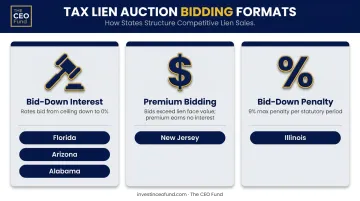
The gap between the statutory ceiling and the actual winning rate is critical — investors who assume the advertised maximum is their guaranteed return routinely overbid and underperform.
Step 3: Certificate Purchase and Investor Responsibilities
The winning investor pays the delinquent tax amount directly to the government. At that point, they become the lienholder and must:
- Track the redemption period (typically 1–3 years depending on state law)
- Monitor deadlines for any required legal filings
- Stay current on certificate expiration dates
Missing a deadline can void the lien entirely.
Step 4: Redemption (Most Common Outcome)
The property owner repays the investor the original amount plus accrued interest and penalties — this is how the vast majority of tax lien investments resolve, with the investor's return equal to the interest earned during the holding period.
Florida provides a 5% mandatory minimum return at redemption, regardless of the winning bid rate (though this minimum does not apply to certificates bid at 0%).
Step 5: Foreclosure (Rare)
If the homeowner fails to repay within the redemption period, the investor may initiate foreclosure proceedings. This is uncommon, comes with additional legal costs, and can expose the investor to the property's condition at that point. Acting before the certificate's expiration date is essential: failing to do so forfeits the investor's rights entirely.
Benefits and Risks of Tax Lien Investing
Benefits
Higher potential returns than traditional fixed income. State-set interest rate ceilings are substantially above savings accounts, CDs, or most bond yields:
| State | Statutory Ceiling | Bidding Mechanism |
|---|---|---|
| Florida | 18% per year | Bid-down interest |
| New Jersey | 18% per year | Bid-down + premium |
| Arizona | 16% per year | Bid-down (to 0%) |
| Alabama | 12% per year | Bid-down |
| Illinois | 9% penalty per period | Bid-down penalty |
Again — these are ceilings. Actual realized yields depend heavily on auction competition.
Real estate-backed collateral. Unlike unsecured bonds or notes, tax liens are secured by the underlying property. The lien often holds senior priority over private mortgage claims under state law.
No landlord responsibilities. Investors earn returns without managing tenants, maintenance, or repairs — a meaningful advantage over direct rental property ownership.
Risks
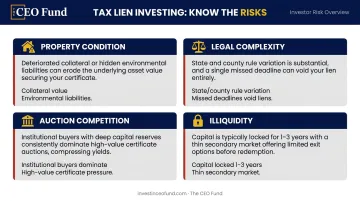
Key risks to evaluate before bidding:
Property condition and value. If foreclosure proceeds, the investor may inherit a property in poor condition, carrying environmental liabilities, or worth less than the outstanding balance. The OCC's guidance on tax lien certificates specifically warns certificate holders to conduct due diligence on collateral value before participating.
Legal and administrative complexity. Rules, redemption periods, bidding formats, and foreclosure procedures differ by state and county. A single missed deadline can void the entire investment — making local legal counsel essential, not optional.
Auction competition and compressed returns. Institutional investors regularly participate in tax lien auctions, particularly on higher-value properties. Research presented at the 2023 American Economic Association conference found institutional buyers concentrate on the most valuable certificates — leaving individual investors competing for lower-yield or riskier inventory.
Illiquidity. Tax lien certificates cannot be easily sold. Capital is typically locked for 1–3 years — longer if foreclosure is involved. The secondary market for certificates is thin and largely informal.
How to Get Started in Tax Lien Investing
Research State Laws First
Not every state conducts tax lien sales. Some use tax deed sales instead, where the investor acquires the property outright rather than the lien. According to NTLA's 2020 Market Research Report, roughly 30 states sold certificates to private investors — though that number can shift, so always verify current rules before committing capital.
States with established tax lien certificate programs include Florida, Arizona, Alabama, New Jersey, Illinois, Colorado, Indiana, Maryland, and roughly two dozen more. Verify your target state's current rules by contacting the local county treasurer or tax collector directly before bidding.
Find Auctions and Conduct Property Due Diligence
Once you've confirmed your state's program, locate active auctions. They typically appear on:
- County government websites and treasurer's offices
- Local newspapers (Orange and Marion Counties in Florida, for example, advertise delinquent taxes weekly for three consecutive weeks before the sale)
- Online platforms such as RealAuction, which Yavapai County, Arizona uses for its online certificate auction
Before bidding on any certificate, evaluate:
- Estimated market value of the underlying property
- Physical condition and any environmental concerns
- Existing liens (mortgages, HOA fees, federal tax liens)
- The neighborhood's foreclosure history
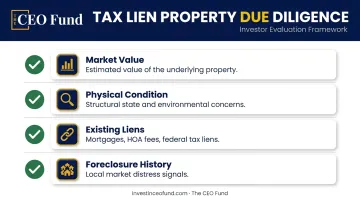
Thorough due diligence here directly determines whether the certificate becomes a profitable return or a costly recovery problem.
Bid Strategically and Track Deadlines Post-Purchase
Enter auctions with a clear maximum bid and minimum acceptable return threshold. After winning:
- Track all redemption deadlines and filing requirements by jurisdiction
- Know your certificate's expiration date — acting after it voids your rights
- Consider working with an attorney familiar with that specific county's rules, especially for first-time purchases
Tax Lien Investing vs. Other Real Estate Investment Strategies
Compared to Direct Property Ownership
Tax lien investing avoids the operational headaches of owning property — no tenants, no maintenance, no insurance obligations. The trade-off: returns are capped at the certificate's interest rate. There's no equity building, no appreciation upside, and no cash flow during the redemption period.
Compared to REITs
REITs are publicly traded, liquid, and require no direct management. Tax lien certificates offer potentially higher interest returns but with far greater administrative complexity and near-zero liquidity — better suited to investors who prioritize yield over simplicity.
Compared to Mortgage Note Investing
Both tax lien certificates and mortgage notes are real estate-backed debt investments that avoid direct property ownership. The mechanics differ:
| Factor | Tax Lien Certificate | Mortgage Note |
|---|---|---|
| Asset | Statutory claim on delinquent taxes | Existing borrower loan obligation |
| Return timing | Paid at redemption (lump sum) | Scheduled monthly payments |
| Cash flow during hold | None until redemption | Regular income from borrower |
| Liquidity | Very limited secondary market | Broader secondary market options |
| Management burden | Significant (deadlines, legal filings) | Varies by structure |
| Priority | Often senior to mortgage liens | Generally junior to tax claims |
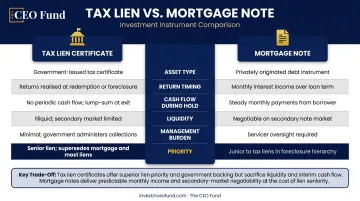
The table above makes one thing clear: tax lien certificates trade liquidity and cash flow for yield potential and seniority. For accredited investors who want real estate debt exposure without managing auction deadlines and legal filings, a professionally managed mortgage note fund is worth considering. The CEO Fund, for example, acquires diversified portfolios of performing and non-performing first-lien mortgage notes across 50+ states — delivering real estate-backed income through professional underwriting and portfolio-level due diligence, with no direct certificate management required.
Frequently Asked Questions
Is tax lien investing legal in all states?
No. Some states conduct tax deed sales instead, where investors acquire property directly rather than purchasing a debt certificate. Rules differ significantly by jurisdiction. Verify your target state's current structure through the county treasurer's office before pursuing this strategy.
What tax advantages do tax lien certificates offer?
Tax lien certificates themselves don't provide a direct tax deduction, but holding them inside a self-directed IRA can enable tax-deferred or tax-free growth on earned interest. Some investors pair lien strategies with tax-advantaged accounts to offset ordinary income exposure. A tax advisor can identify the structure that fits your situation.
Do you pay taxes on yield from tax lien certificates?
Interest income earned from tax lien certificates is generally treated as ordinary income and taxable at the federal level. If a lien results in property acquisition and eventual sale, different rules may apply based on holding period and use. A tax professional can clarify the treatment specific to your circumstances.
What happens tax-wise if a tax lien leads to property acquisition?
If a lien matures into property ownership and you eventually sell, the gain is taxed as short-term (ordinary income rates) or long-term (0%, 15%, or 20%) depending on your holding period. The property's cost basis and any carrying costs also affect the taxable amount. Consult a tax professional before pursuing lien-to-ownership outcomes.
Can you invest in tax liens through a self-directed IRA?
Self-directed IRAs can generally be used to purchase tax lien certificates, potentially enabling tax-deferred or tax-free growth. The IRS does not publish an explicit approval list, but custodians experienced with alternative assets regularly administer these investments. Prohibited transaction rules — including restrictions on self-dealing with disqualified persons — must be followed carefully.
How does tax lien investing compare to mortgage note investing?
Both are real estate-backed debt strategies that avoid direct property ownership. Tax lien investing involves purchasing delinquent tax certificates directly through county auctions, with returns paid at redemption. Mortgage note investing involves buying existing loan obligations, typically generating scheduled monthly income. Managed mortgage note funds can offer more predictable income streams and broader diversification than individual lien purchases.