

Introduction
Pension funds collectively hold an extraordinary amount of capital. According to WTW's Global Pension Assets Study 2026, estimated assets across 22 major pension markets reached $68.274 trillion at year-end 2025 — roughly 74% of those markets' combined GDP. That's not just a large number; it means pension funds are among the most consequential investors on the planet.
So where does this capital go? And why does so much of it flow toward private equity?
Decades of yield pressure and shifting investment philosophy have pushed pension managers toward private markets — where the return potential, and the risks, look very different from public equities.
This article covers how pension-PE relationships actually work, what performance data shows, the risks funds often downplay, and what recent regulatory changes mean for accredited investors seeking similar private market exposure.
Key Takeaways
- Pension funds invest in PE as limited partners — committing capital to funds managed by general partners, not operating investments directly
- More than half of global pension funds now allocate at least 10% of their portfolios to private markets
- CalPERS has reported 11.8% annualized PE returns over 20 years, versus 7.8% for public equities
- Buyout funds show modest positive risk-adjusted returns; venture capital has underperformed on average
- Illiquidity, fee drag, and governance risk are the primary hazards, particularly for underfunded plans
- Regulatory changes are expanding private market access beyond institutions to accredited individual investors
What Are Pension Funds and How Do They Invest?
Pension funds are pooled, long-term investment vehicles that collect contributions from workers and employers and invest them to generate retirement income. Two primary structures exist:
- Defined benefit (DB) plans promise a fixed payout at retirement, regardless of investment performance
- Defined contribution (DC) plans — such as 401(k)s — place investment risk on the participant; outcomes depend on contributions and returns
Traditionally, pension managers allocated across public equities, bonds, and real estate. But their defining structural advantage is time. With liabilities stretching decades into the future, pension funds can hold assets that shorter-horizon investors — retail accounts, hedge funds with quarterly redemptions — cannot touch. Private equity and mortgage-backed assets, for instance, now represent 20–30% of many major pension portfolios precisely because of this long runway.
How Major Markets Compare
The US dominates global pension assets by a wide margin. Using year-end 2024 figures from WTW:
| Market | Pension Assets | Assets as % of GDP |
|---|---|---|
| United States | $37.992T | 130% |
| Japan | $3.300T | 81% |
| Canada | $3.267T | 148% |
| United Kingdom | $3.139T | 88% |
The US figure includes IRAs and occupational pensions, so it's broader than DB funds alone — but even with that caveat, the scale is striking. American pension capital is a force that shapes global asset markets, including private equity.
The Relationship Between Pension Funds and Private Equity
Pension funds don't run private equity operations. They are limited partners (LPs) that commit capital to PE funds managed by general partners (GPs) — buyout firms, venture capital managers, and growth equity specialists. The fund structure typically locks up capital for 8–12 years, with returns distributed as underlying portfolio companies are sold.
How This Started
Pension participation in PE became institutionally viable around 1979, when the U.S. Department of Labor clarified that ERISA's "prudent man" standard should be assessed at the portfolio level, not investment by investment. That single regulatory shift opened the door for pension managers to commit capital to venture and buyout funds without violating their fiduciary duties.
The Yale Model's Influence
David Swensen, Yale's Chief Investment Officer from 1985 until his death in 2021, developed what became known as the Endowment Model: a framework that moved institutional portfolios away from traditional stocks and bonds toward illiquid alternatives including private equity, real estate, and hedge funds. The CFA Institute credits Swensen directly with pioneering this approach.
Public pension funds adopted it broadly in subsequent decades. Allocations to illiquid alternatives reached roughly 27% of assets among institutional investors, according to NBER research.
What Pension Funds Actually Invest In
PE strategies vary significantly in risk and return:
- Buyout funds target mature businesses for acquisition and restructuring; historically the strongest performers for pension plans
- Venture capital backs early-stage companies; higher variance and weaker average outcomes for most pension portfolios
- Growth equity bridges the gap between VC and buyout, focusing on later-stage companies not yet at acquisition scale
- Real estate PE deploys capital into property acquisition and development through private fund structures
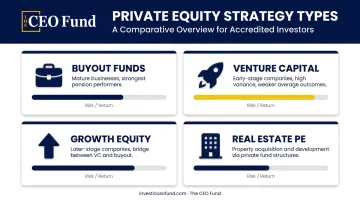
These strategies are not interchangeable. Academic research finds meaningfully different outcomes across each category, which matters when evaluating whether a pension fund's PE allocation is actually delivering.
Why Pension Funds Allocate Capital to Private Equity
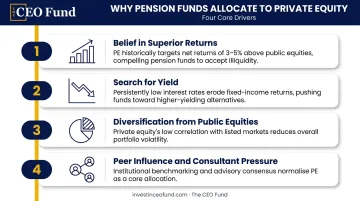
Understanding why pension funds move capital into private equity matters for any institutional allocator evaluating alternatives. Research from Begenau, Liang, and Siriwardane (HBS Working Paper 25-016) identifies several forces that explain the industry-wide shift — and simple underfunding pressure isn't the main one:
1. Belief in superior returns Fund managers and their consultants increasingly believed alternatives outperform public markets on a risk-adjusted basis. That conviction — independent of funding status — drove allocation growth more than financial pressure alone.
2. The search for yield The Aon-supported NIRS study shows that median fixed-income targets among US public plans fell from 30% in 2001 to 23% in 2023, as a decade of near-zero interest rates made bonds insufficient for meeting pension obligations. Funds rotated toward alternatives — including PE — to compensate.
3. Diversification away from public equities Research by Lopez-Villavicencio and Rigot, analyzing 464 US and 183 Canadian DB plans, found a strong negative relationship between public equity and PE allocations. Funds treat them as partial substitutes: PE offers exposure to companies and sectors that public markets don't carry, giving allocators genuine diversification rather than correlated risk.
4. Peer influence and consultant pressure The Begenau et al. study found pension funds invest similarly to geographically nearby peers — a pattern consistent with herding through shared industry networks. Consultants with more bullish views on alternatives were correlated with larger client allocations, even after controlling for fund size and financial health. In short, who you talk to shapes what you hold.
How Much Do Pension Funds Invest in Private Equity?
The numbers have shifted substantially. Alternatives rose from 14% of public pension "risky" investments in 2001 to 39% by 2021, according to the Begenau et al. research — a structural transformation of institutional portfolios over two decades.
At the fund level, the Aviva Investors 2025 Private Markets Study found that 56% of global institutional investors now allocate at least 10% of their portfolios to private markets, up from 48% previously.
CalPERS: The Most-Cited Case Study
CalPERS is the largest US public pension fund and the clearest documented example of the PE allocation trend:
- Raised its PE target allocation from 13% to 17% in March 2024
- Holds $119.3 billion in PE net asset value as of March 31, 2025
- Reports PE as its top-performing asset class over 20 years
| Asset Class | 20-Year Annualized Return |
|---|---|
| Private equity | 11.8% |
| Public equity | 7.8% |
| Fixed income | 4.5% |
These are time-weighted returns from one fund — a useful benchmark, not a universal guarantee. Still, a spread of nearly 4 percentage points over public equity, sustained across 20 years, reflects a consistent structural advantage worth taking seriously.
What Research Says About Performance Across Funds
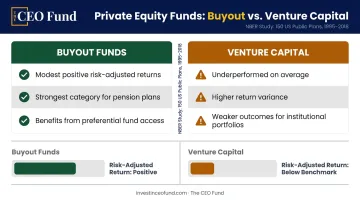
A 2024 NBER study (Korteweg, Panageas, and Systla) covering 150 US public plans and 1,303 PE funds from 1995–2018 found:
- Buyout funds showed modest positive risk-adjusted returns for pension plans
- Venture capital underperformed on average
- Apparent outperformance was largely tied to preferential access to top-performing funds — not pure manager selection skill
CalPERS' returns partly reflect its scale and long-standing GP relationships. A smaller fund with less negotiating leverage may not replicate those results.
Risks and Challenges in Pension Fund Private Equity Investments
Illiquidity and Lock-Up Periods
Capital committed to PE funds is typically inaccessible for 8–12 years. For most pension funds with long-dated liabilities, this is manageable. But market dislocations — unexpected spikes in benefit payments, funding ratio deterioration — can expose plans that over-allocated to illiquid assets without adequate liquid reserves.
Fee Structures and Cost Drag
The traditional PE fee model runs approximately 2% annual management fee plus 20% carried interest. Preqin's 2024 data shows average fees have edged down — 1.74% for buyout, 1.93% for growth equity — but the drag on net returns remains material.
Large funds like CalPERS have responded by pursuing co-investments alongside PE managers, which typically carry lower fees. Co-investing has become central to major public pension PE programs, generating meaningful savings that compound over a fund's 10-year life.
Governance Risk and Underfunding
The Korteweg et al. study found that underfunded pension plans tend to choose riskier PE investments — a pattern consistent with "gambling for resurrection" to close funding gaps. The study identified several structural factors that consistently correlated with weaker risk-adjusted PE returns:
- Higher representation of government-appointed board members
- In-state investment mandates driven by political rather than financial priorities
- Funding gaps that incentivize outsized risk-taking over disciplined allocation
Where political pressure shapes investment decisions, governance quality — and ultimately beneficiary outcomes — tends to suffer.
Emerging Trends and What They Mean for Individual Investors
Regulatory Democratization
Recent US Department of Labor guidance has expanded pathways for 401(k) plans to include PE through professionally managed asset-allocation vehicles. A 2025 Federal Register notice directed agencies to facilitate alternative-asset access for 401(k) investors. The UK's FCA authorized its first Long-Term Asset Fund in 2023, designed specifically for DC pension access to illiquid investments. The EU's revised ELTIF regime, applicable from January 2024, broadened eligible assets and retail access.
These measures don't eliminate illiquidity or complexity. They create regulated pathways — and that distinction matters for any investor evaluating access to private markets.
Co-Investments and Direct Strategies
Major pension funds are increasingly investing directly alongside PE managers rather than exclusively through blind-pool funds. This reduces fees, increases deal visibility, and gives large LPs more control over deployment. The trend is reshaping how PE firms access institutional capital and structure their offerings.
What This Means for Accredited Individual Investors
That institutional shift has a direct read-through for individual investors. The broader move toward private market alternatives confirms that the "private market premium" — the potential return advantage over public assets — is increasingly recognized across investor types.
For accredited individuals who don't have access to CalPERS-scale GP relationships or multi-year lock-up tolerance, alternatives like mortgage note investing follow a structurally similar logic: real estate-backed returns, passive income, and diversification outside public markets.
The CEO Fund, for example, acquires first-lien performing and non-performing mortgage notes across 50+ states, targeting 8–12% annualized returns backed by tangible real estate collateral. Key structural advantages over traditional PE include:
- No property management burden — income flows through monthly mortgage payments, not tenant oversight
- No decade-long wait — the fund avoids the extended lock-up periods typical of blind-pool PE structures
- Tax-advantaged access — self-directed IRA and 401(k) compatibility adds a layer pension funds access by default
- Tangible collateral — first-lien positions on real assets provide a security layer that purely financial instruments don't

For accredited investors exploring private market exposure, that combination addresses many of the structural reasons pension funds favor alternatives in the first place.
Frequently Asked Questions
Are pension funds considered private equity?
No. Pension funds are institutional investors — limited partners — that allocate a portion of their portfolios to PE funds managed by general partners such as buyout or venture capital firms. The PE fund itself is the investment vehicle; the pension fund is the capital source.
How much do pension funds invest in private equity?
More than half of global institutional investors now allocate at least 10% to private markets, per Aviva's 2025 study. Major funds like CalPERS hold over $100 billion in PE alone. Across US public plans, alternative allocations have grown from 14% of risk assets in 2001 to 39% by 2021.
Why do pension funds invest in private equity?
Pension funds allocate to PE for three primary reasons: the belief that PE delivers superior risk-adjusted returns over long horizons, diversification away from public equities and bonds, and the structural advantage of long-dated liabilities that can absorb PE's illiquidity without disrupting near-term obligations.
What are the risks of pension funds investing in private equity?
The main risks are illiquidity from 8–12 year lock-ups, fee drag from management fees and carried interest, limited transparency compared to public markets, and the risk that underfunded plans take on excessive PE exposure to chase returns — often with worse outcomes.
What is the difference between a pension fund and a private equity fund?
A pension fund pools workers' retirement savings and invests across many asset classes to meet future obligations. A private equity fund is a specialized vehicle that acquires, manages, and exits private companies. Pension funds are among the largest investors in PE funds.
Can individual investors access private equity or similar alternatives like pension funds do?
Access was once limited to institutions. Regulatory changes are expanding 401(k) pathways, and accredited investors can now access private market vehicles — including mortgage note funds — that offer real estate-backed returns and passive income. These alternatives provide diversification benefits structurally similar to what pension funds seek from private allocations.