
2026 makes this more complicated. The SECURE 2.0 Act's Roth catch-up mandate takes effect, new contribution ceilings apply, and the IRS compensation cap shifts how employer matching works for six-figure earners. If you haven't reviewed your retirement strategy this year, you're likely leaving money on the table — or worse, facing an unexpected tax bill.
This guide covers who qualifies as an HCE in 2026, the updated contribution limits, the new Roth-only catch-up requirement, and the strategies high earners use to build wealth beyond what the standard 401(k) allows.
Key Takeaways
- The 2026 employee deferral limit rises to $24,500; total plan contributions can reach $72,000 (or $83,250 for ages 60–63)
- Employees earning over $150,000 from their plan sponsor in 2025 must direct all catch-up contributions to Roth starting in 2026
- HCEs face nondiscrimination testing that can claw back contributions if lower-paid employees don't contribute enough
- Strategies like the Mega Backdoor Roth, HSA, and backdoor Roth IRA help high earners save beyond standard limits
- Self-directed retirement accounts let accredited investors hold alternative assets — such as mortgage note funds — within a tax-advantaged account
Who Qualifies as a Highly Compensated Employee in 2026?
The IRS uses the HCE classification to identify employees subject to additional 401(k) restrictions. Two separate tests apply:
- Compensation test: Earned more than $160,000 in 2025 (the threshold holds unchanged from 2025 per IRS Notice 2025-67)
- Ownership test: Owned more than 5% of the business at any point during the current or prior plan year
Employers may also elect to apply the compensation test only to the top 20% of earners by pay — known as the top-paid-group election. This can reduce the number of employees classified as HCEs, but the ownership test still applies regardless of that election.
Two Limits HCEs Must Know
| Figure | 2026 Amount |
|---|---|
| HCE income threshold (based on 2025 pay) | $160,000 |
| Compensation cap for employer match calculations | $360,000 |
Under IRC Section 401(a)(17), only the first $360,000 of your salary counts for contribution formula purposes — including employer matching. An employee earning $600,000 and a colleague earning $360,000 receive identical employer matches if the formula is percentage-based.
Being classified as an HCE doesn't block you from contributing to a 401(k). It triggers nondiscrimination testing — and that testing determines whether your contributions stay put or get refunded at year-end.
2026 401(k) Contribution Limits for High Earners
Standard Deferral and Catch-Up Amounts
The IRS confirmed these figures for 2026:
| Limit | 2025 | 2026 |
|---|---|---|
| Employee elective deferral | $23,500 | $24,500 |
| Catch-up, ages 50–59 and 64+ | $7,500 | $8,000 |
| Catch-up, ages 60–63 (SECURE 2.0 "super catch-up") | $11,250 | $11,250 |
| Section 415(c) annual additions | $70,000 | $72,000 |
| Total with standard catch-up (age 50+) | $77,500 | $80,000 |
| Total with age 60–63 catch-up | $81,250 | $83,250 |
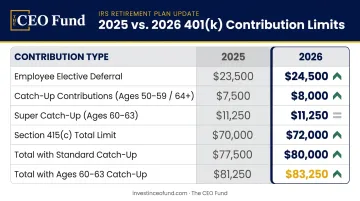
The $72,000 Section 415(c) limit covers all sources combined: employee deferrals, employer matching, profit-sharing, and after-tax contributions. Catch-up contributions sit outside that ceiling, producing the $80,000 and $83,250 calculated totals. No combination can exceed 100% of your compensation.
How the Compensation Cap Affects Your Employer Match
Say you earn $500,000 with a 5% employer match:
- Without the cap: 5% × $500,000 = $25,000 match
- With the IRS compensation cap: 5% × $360,000 = $18,000 actual match
That $7,000 gap compounds over a career. High earners need to account for this shortfall when projecting retirement income, because the match alone won't close it.
If your employer offers a SIMPLE 401(k) — common at smaller firms — different limits apply: $17,000 deferral and $4,000 standard catch-up for 2026.
The 2026 Roth Catch-Up Requirement: What Changes and Why It Matters
Who the Rule Applies To
Starting in 2026, if your 2025 W-2 Box 3 wages (Social Security wages) from your plan-sponsoring employer exceeded $150,000, all catch-up contributions must go into a Roth 401(k) — not a pre-tax traditional account. Exactly $150,000 does not trigger the mandate; the threshold is "exceeded."
This comes from SECURE 2.0 Section 603, with a transition period that expired December 31, 2025, making 2026 the first year of full compliance.
The FICA Wage vs. MAGI Distinction
The test uses IRC Section 3121(a) Social Security wages — the figure in W-2 Box 3 — not your Modified Adjusted Gross Income. Two points worth clarifying:
- MAGI includes investment income, rental income, and other sources. Box 3 wages exclude all of these.
- If you have income from multiple employers, only wages from the plan-sponsoring employer count toward the $150,000 threshold.
The Trade-Off in Plain Terms
| Pre-Tax Catch-Up | Roth Catch-Up | |
|---|---|---|
| Upfront tax benefit | ✅ Tax deduction now | ❌ No deduction |
| Withdrawal tax treatment | Taxable as ordinary income | Tax-free (qualified withdrawals) |
| Better when... | You expect lower rates in retirement | You expect higher rates in retirement |
For most HCEs still in peak earning years, the Roth outcome is favorable over a long time horizon — but the loss of the immediate deduction hits hard in the year of contribution.
One Critical Gap to Check Now
If your employer's plan does not offer a Roth 401(k) option, affected employees cannot make any catch-up contributions at all under that plan. This is a compliance gap, not a loophole. Verify with your HR department or plan administrator whether your plan includes a qualified Roth contribution program before year-end planning.
Employees whose 2025 wages were $150,000 or below are unaffected. They may continue making pre-tax or Roth catch-up contributions as their plan permits.
Nondiscrimination Testing and What It Means for Your Contributions
How ADP and ACP Testing Works
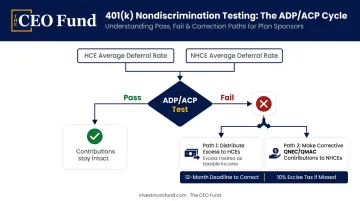
All 401(k) plans with HCE participants must pass two annual tests:
- ADP test: Measures whether HCEs' average elective deferral rates stay within IRS-set limits relative to non-highly compensated employees (NHCEs)
- ACP test: Applies the same comparison to employer matching and after-tax contribution rates
A plan passes when the HCE average doesn't exceed the greater of 125% of the NHCE average, or the NHCE average plus 2 percentage points (capped at 200% of the NHCE average).
The practical risk: If NHCEs contribute at low rates, the IRS can force HCEs to reduce their own contributions — regardless of how much they want to save.
What Happens When a Plan Fails
The IRS allows two correction paths:
- Distribute excess contributions back to HCEs — these become taxable ordinary income in the year distributed, and the funds lose their tax-deferred growth potential
- Make corrective contributions (QNECs or QMACs) to NHCEs to bring their average up
Corrective distributions must generally occur within 12 months of plan-year end. Waiting beyond 2.5 months to distribute can trigger a 10% employer excise tax on the employer.
The Safe Harbor Solution
A Safe Harbor 401(k) design automatically satisfies nondiscrimination testing. The two common formulas:
- 3% nonelective contribution to all eligible employees, regardless of whether they defer
- Basic match: 100% of the first 3% deferred + 50% of the next 2% (maximum 4% employer contribution)
If you're an HCE worried about contribution clawbacks, ask your HR team whether your plan is a Safe Harbor design. A confirmed Safe Harbor structure means your full contribution stays put — no year-end surprises, no clawbacks.
Strategies to Maximize Retirement Savings Beyond Standard Limits
Mega Backdoor Roth
After maxing standard deferrals, some plans allow additional after-tax (non-Roth) contributions up to the $72,000 Section 415(c) ceiling. Those contributions can then be converted through an in-plan Roth conversion or rolled into a Roth IRA — creating far larger Roth accumulations than direct contributions allow.
The math: $72,000 − $24,500 (your deferral) − employer contributions = your available after-tax room.
Catch: Not all plans allow after-tax contributions or in-plan Roth conversions. This feature is more common in large corporate plans. Confirm with your plan administrator before counting on it.
Backdoor Roth IRA
High earners above the Roth IRA income phase-out ($242,000–$252,000 for married filing jointly in 2026) can still access Roth through the backdoor:
- Make a nondeductible contribution to a traditional IRA ($7,500 limit; $8,600 if age 50+, using a $1,100 catch-up)
- Convert the balance to a Roth IRA
Watch for the pro-rata rule: If you hold pre-tax IRA balances elsewhere, the conversion becomes partially taxable. Form 8606 allocates basis across your aggregate traditional, SEP, and SIMPLE IRA balances. Talk to a tax advisor before executing if you have existing pre-tax IRA assets.
Health Savings Account (HSA)
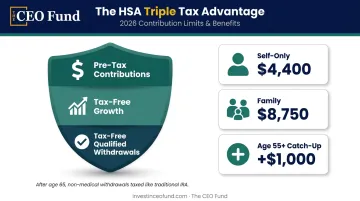
The HSA is one of the most tax-efficient accounts available — contributions are pre-tax, growth is tax-free, and withdrawals for qualified medical expenses are tax-free. After age 65, withdrawals for any purpose are taxed like a traditional IRA (no penalty).
2026 HSA limits:
- Self-only: $4,400
- Family: $8,750
- Age 55+ catch-up: additional $1,000
Requires enrollment in a high-deductible health plan. If you're eligible and not contributing, you're leaving one of the few accounts with pre-tax contributions, tax-free growth, and tax-free qualified withdrawals on the table.
Nonqualified Deferred Compensation (NQDC)
NQDC plans let eligible executives defer salary and bonuses beyond the 401(k) ceiling, to be taxed when received in retirement — potentially at a lower rate.
Unlike 401(k)s, however, NQDC balances are unsecured employer promises. The assets remain on the company's books, subject to general creditors in bankruptcy. Rabbi trust arrangements provide some protection but not absolute security. Vet the plan design carefully before committing significant deferrals.
Building Wealth Beyond Your 401(k): Alternative Options for High Earners
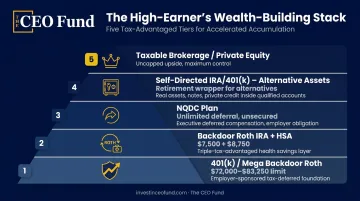
Even after fully utilizing a Mega Backdoor Roth, HSA, and backdoor Roth IRA, the 401(k) system imposes structural ceilings. So where does capital go once all tax-advantaged accounts are exhausted?
Self-directed 401(k) and self-directed IRA accounts allow accredited investors to hold alternative assets — real estate, mortgage notes, private funds — inside a tax-advantaged wrapper. This is where the strategy shifts from tax optimization to portfolio construction.
The CEO Fund's mortgage note strategy is built for self-directed retirement accounts. Investors act as the lender rather than the property owner, receiving monthly mortgage payments deposited directly into their IRA or 401(k).
The fund acquires Grade A–C performing and non-performing notes secured by real estate collateral across 50+ states: single-family, multifamily, commercial, and mobile home park properties, with target returns of 8–12% annually.
One case study illustrates the model: a note purchased for $80,900 on a Florida townhome valued at $115,000 generated monthly payments of $764.39 at a 10% ROI, with a total payback of $197,212 over the note's remaining term.
Beyond self-directed accounts, high earners commonly build wealth through:
- Taxable brokerage accounts — no contribution limits, full investment flexibility
- Real estate direct ownership — depreciation benefits and leverage, though active management is required
- **Private equity and private credit funds** — higher return potential, with longer lock-ups and higher minimums
The 401(k) is one layer in a diversified wealth stack. High earners who max it out and stop there are leaving real accumulation on the table — the accounts above are where compounding continues.
Frequently Asked Questions
What is the 401(k) contribution limit for 2026?
The employee elective deferral limit is $24,500. Catch-up contributions add $8,000 for ages 50–59 and 64+, or $11,250 for ages 60–63. The total plan limit from all sources combined is $72,000 for those under 50.
What income qualifies someone as a high income earner for 401(k) purposes?
The IRS classifies employees as HCEs if their 2025 compensation exceeded $160,000 or they owned more than 5% of the business at any point during the current or prior year. Employers may also designate the top 20% of earners as HCEs.
Is a 401(k) worth it for high income earners?
Yes. Tax-deferred growth, employer matching, and strategies like the Mega Backdoor Roth make it valuable. That said, contribution limits mean it should be one component of a broader wealth strategy, not the entire plan.
How many Americans have $1,000,000 in their 401(k)?
Fidelity's Q2 2025 Retirement Analysis reported 595,000 401(k) millionaires — an all-time high for Fidelity-administered accounts.
What happens if a 401(k) plan fails nondiscrimination testing?
The IRS requires either a refund of excess contributions to HCEs (which become taxable income) or corrective contributions to NHCEs. Repeated failures can jeopardize the plan's qualified status and trigger employer excise taxes.
Can high earners invest in alternative assets through a self-directed 401(k)?
Yes. Self-directed 401(k) accounts allow accredited investors to hold real estate, mortgage notes, private funds, and other alternative assets within a tax-advantaged structure. You'll need a custodian that supports self-directed accounts, and all investments must comply with IRS prohibited transaction rules under IRC Section 4975.