This guide is for accredited investors, passive income seekers, self-directed IRA holders, and real estate investors exploring fixed-income alternatives. We'll cover the main types of investment notes, their core benefits, and the risks every investor must evaluate before committing capital.
Key Takeaways
- Investment notes are debt instruments where the investor acts as the lender, earning interest payments and receiving principal at maturity
- Note types span from ultra-safe Treasuries to higher-yield mortgage notes, each carrying a distinct risk-return profile
- Core benefits include predictable income, asset-backed security, portfolio diversification, and tax advantages
- Default, interest rate sensitivity, and illiquidity are the key risks — all controllable through due diligence and portfolio diversification
- Mortgage notes let investors "act as the bank," collecting monthly payments backed by real property — no landlord duties required
What Are Investment Notes?
An investment note is a written debt instrument in which a borrower legally promises to repay a lender a specified principal amount plus interest over a set time period. Notes sit between short-term bills (under one year) and long-term bonds (20–30 years) by maturity. Unlike stocks, they carry no ownership stake in the issuing entity — the investor is purely a creditor.
The Three Core Components
Every investment note contains three contractually defined elements:
- Principal — the amount invested or loaned
- Interest rate — the return the investor earns on that capital
- Maturity date — when the borrower returns the full principal
Because these terms are locked in by contract, notes create a level of income predictability that equity investments simply cannot match.
Secured vs. Unsecured Notes
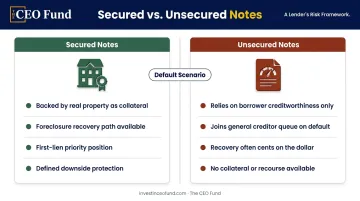
This distinction matters enormously when a borrower defaults:
- Secured notes are backed by collateral — real estate in the case of mortgage notes. If the borrower stops paying, the note holder has legal recourse to recover value through foreclosure or note sale.
- Unsecured notes (debentures) rely solely on the borrower's creditworthiness. As FINRA notes, unsecured bonds have no specific collateral and depend entirely on the issuer's general credit — meaning recovery in default is far less certain.
In a default scenario, secured note holders have a defined recovery path; unsecured holders join a queue of general creditors — often recovering cents on the dollar.
Types of Investment Notes
Treasury Notes (T-Notes)
Treasury notes are U.S. government-issued securities with maturities of 2, 3, 5, 7, and 10 years. They pay fixed interest every six months and return full face value at maturity. According to TreasuryDirect, all Treasury marketable securities are backed by the full faith and credit of the U.S. government.
As of December 31, 2024, par yields ranged from 4.25% on 2-year notes to 4.58% on 10-year notes — a dated snapshot, but useful context for benchmarking against riskier instruments. T-Notes set the baseline for low-risk, fixed-income investing — and because they're considered virtually risk-free, their yields also serve as the benchmark rate against which spreads on corporate and mortgage notes are measured.
Key characteristics at a glance:
- Maturities of 2, 3, 5, 7, and 10 years
- Fixed semiannual interest payments
- Full face value returned at maturity
- Backed by the U.S. government — no default risk
Municipal Notes
Municipal notes are short-term debt obligations issued by state and local governments, typically maturing in one year or less. They fund capital projects, bridge revenue gaps, or finance construction pending longer-term bond issuance.
The primary appeal: interest income is often exempt from federal taxes and, in some cases, state taxes too. The MSRB's tax-equivalent yield formula illustrates the impact — a 3.00% tax-exempt yield converts to 4.62% at a 35% tax rate. That differential matters significantly for investors in higher brackets. Note that arbitrage bonds and certain private-activity bonds may not qualify for federal exemption, so the tax benefit is conditional, not universal.
Promissory Notes
Promissory notes are private, two-party lending agreements documenting the amount borrowed, interest rate, repayment schedule, and maturity date. They appear frequently in private real estate deals, business financing, and family lending arrangements.
Terms are negotiated directly between the parties, offering flexibility unavailable in public markets. That flexibility cuts both ways — without standardized documentation or regulatory oversight, due diligence on the borrower and underlying terms becomes the investor's responsibility entirely.
Corporate Notes
Companies issue corporate notes to raise capital without pledging specific collateral. Because they rely solely on the issuer's creditworthiness, they carry higher default risk than secured instruments.
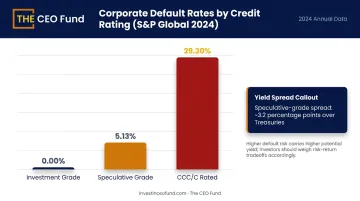
The numbers quantify that risk clearly. S&P Global's 2024 U.S. corporate default study found a 0.00% default rate for investment-grade issuers versus 5.13% for speculative-grade and a striking 29.30% for CCC/C-rated issuers. Investors are compensated for that risk through higher yields — Federal Reserve data from March 2024 showed speculative-grade spreads of roughly 3.2 percentage points over comparable Treasuries. That spread is worth reading carefully: wider spreads signal that the market is pricing in meaningful default probability, not just rewarding yield-seekers.
Mortgage Notes (Real Estate Notes)
When a homeowner takes out a mortgage, they sign two documents: the mortgage note (the legal promise to repay) and the security instrument (which grants foreclosure rights to the lender). Investors can purchase existing mortgage notes on the secondary market, stepping directly into the lender's position and receiving the borrower's monthly principal and interest payments.
Two categories shape how investors approach this asset class:
| Note Type | Borrower Status | Risk-Return Profile |
|---|---|---|
| Performing | Current on payments | Steady, predictable income — lower risk |
| Non-Performing | Defaulted or delinquent | Purchased at discount — higher upside, more expertise required |
Each presents a distinct investment thesis. Performing notes suit income-focused investors; non-performing notes appeal to those with the expertise — or access to professional management — to execute resolution strategies.
Key Benefits of Investing in Notes
Predictable, Contractual Income Stream
Unlike dividends (which boards can cut) or rental income (which depends on occupancy), note payments are contractual obligations. The borrower is legally bound to make scheduled payments. That legal enforceability creates a reliable cash flow — particularly appealing for passive income seekers and those building toward retirement.
Asset-Backed Security
Secured notes — particularly mortgage notes — carry a collateral layer that unsecured instruments don't. If a borrower defaults, the note holder has legal standing to recover value through foreclosure or note resale. That protection materially reduces downside exposure compared to unsecured debt or equity positions, where recovery in default is far less certain.
Portfolio Diversification
Real estate-backed debt instruments tend to behave differently from public equities. BlackRock's 2025 private credit analysis found that replacing 10 percentage points of public fixed income with private credit reduced modeled annualized portfolio volatility from approximately 11.2% to 10.7% — a meaningful reduction, even if modest in isolation. Adding non-correlated income-producing assets creates a buffer during equity market downturns.
Diversification addresses portfolio-level risk — but note investing also offers structural tax advantages that compound returns over time.
Tax Advantages
Two note categories offer meaningful tax efficiency:
- Municipal notes may provide federally tax-exempt interest income (subject to bond type and state rules)
- Mortgage notes held inside a self-directed IRA or Solo 401(k) allow investment income to grow tax-deferred (traditional) or tax-free (Roth), depending on account type
The IRA angle is particularly compelling for long-term wealth building. The CEO Fund actively supports self-directed IRA investing in mortgage notes, including educational resources and events specifically focused on tax-advantaged note strategies for accredited investors.
No Active Management Required
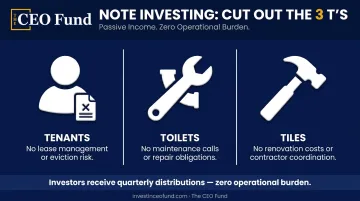
This is the defining advantage for investors who want real estate exposure without landlord responsibilities. Note investing eliminates the friction of direct ownership — no tenants, no maintenance calls, no property insurance headaches. The CEO Fund frames this as cutting out the "3 T's":
- Tenants — no lease management or eviction risk
- Toilets — no repair calls or maintenance obligations
- Tiles — no renovation costs or contractor coordination
Investors in a professionally managed note fund receive quarterly distributions from a performing loan portfolio — with none of the operational burden of owning physical property.
Risks to Understand Before Investing in Notes
Credit and Default Risk
Default risk is the probability that a borrower stops making payments or cannot repay principal at maturity. This risk is most acute in unsecured and corporate notes where no collateral exists.
For mortgage notes, the underlying real estate provides partial protection — but due diligence still matters. Before investing, review:
- Borrower payment history and credit profile
- Current loan-to-value ratio relative to market value
- Property condition and any outstanding liens
First-lien position matters too: first lienholders have priority claim over collateral, placing them structurally ahead of junior creditors in any default scenario.
Interest Rate Risk
Fixed-rate notes lose relative attractiveness when market rates rise. FINRA's duration framework illustrates the mechanics: a bond with a duration of 10 would be expected to lose approximately 10% of value if rates rose by 1 percentage point. The 2022 rate cycle made this concrete — the Federal Reserve's November 2022 Financial Stability Report noted that corporate-debt valuations fell below historical medians as rates climbed. Longer-duration notes carry more of this risk; shorter-term notes reduce it.
Liquidity Risk
Most mortgage notes and corporate notes are not traded on public exchanges. If an investor needs capital before a note matures, finding a buyer may take time or require selling at a discount. FDIC's whole-loan sales process — conducted through competitive sealed bids — takes approximately 120 days, a useful benchmark for private note transactions. Investors must ensure their note allocation aligns with their actual liquidity timeline.
Inflation and Reinvestment Risk
Fixed payments lose purchasing power in inflationary environments. The BLS reported CPI-U rose 9.1% in the 12 months ended June 2022 — the largest annual increase since 1981. A $500 monthly payment buys less each year inflation persists. When notes mature and capital needs to be redeployed, prevailing rates may be lower than the original note's yield. Staggering maturities across a portfolio helps manage both inflation erosion and reinvestment shortfall at once.
Mortgage Notes: The "Act as the Bank" Investment Strategy
When an investor purchases a mortgage note, they don't buy property — they buy the debt secured by that property. The borrower makes monthly principal and interest payments to the note holder (or to a loan servicer on their behalf). Income flows from the note, not from managing tenants or maintaining buildings.
How a Real Performing Note Works
The CEO Fund shares concrete case studies to illustrate this model. One Florida townhome note carries the following profile:
| Metric | Value |
|---|---|
| Market Value | $115,000 |
| Unpaid Balance | $92,100 |
| Investor Price | $80,900 |
| Monthly Payment | $764.39 |
| Remaining Term | 21.5 Years |
| Total Payback | $197,212 |
| ROI | 10% |
That's over $197,000 in total payback on an $80,900 investment — with real estate collateral providing a concrete layer of downside protection that a market index can't offer.

Professional Management vs. Going It Alone
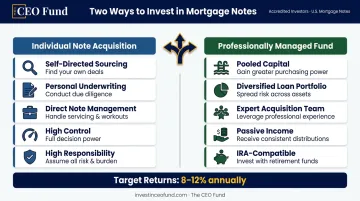
Investors have two paths into mortgage notes:
- Individual note acquisition — requires sourcing, underwriting, and managing notes directly. High control, high responsibility.
- Professionally managed note funds — pools investor capital across diversified portfolios of performing and non-performing first-lien notes. Suitable for investors who want exposure without the operational burden.
The CEO Fund, for example, has built a 10+ year track record acquiring loans across 50+ states. Fund Manager Carlo Turner, a Certified Mortgage Investing Specialist, oversees acquisition and management. Notes can be held inside self-directed IRAs for tax-advantaged growth, and the fund targets annual returns of 8–12%, with potential up to 15% in certain note categories.
Non-performing notes operate differently. Purchased at a steep discount, they offer higher upside through loan modification, deed-in-lieu arrangements, or foreclosure. The tradeoff is complexity — executing these strategies well requires specialized experience in distressed asset resolution, or a managed fund with that expertise already in place.
How to Evaluate an Investment Note
Assess Collateral and Loan-to-Value Ratio
For secured notes, the LTV ratio signals how much equity cushion exists between the loan balance and the property's market value. FDIC interagency guidance classifies residential loans at 90% LTV or higher as high-LTV — meaning a lower LTV leaves more recovery room if a borrower defaults. A conservative first-lien note typically carries an LTV well below 80%, providing a substantial equity buffer.
Evaluate Borrower Creditworthiness and Payment History
For performing notes, verify that payments have been consistent and that the borrower demonstrates the ability to sustain the obligation over the note's remaining term. For non-performing notes, understand what caused the default and which exit strategies are viable. Payment history is the most direct screening criterion available — it tells you whether the borrower has treated the obligation as a priority, not a suggestion.
Match the Note's Terms to Your Investment Goals
Consider how interest rate, maturity date, payment frequency, and liquidity constraints align with your personal financial timeline:
- Income-focused investors benefit most from performing notes with strong monthly cash flow and longer terms
- Flexibility-conscious investors may prefer shorter maturities that return capital sooner
- Tax-advantaged account holders should prioritize notes compatible with self-directed IRA custodian requirements
No note is universally the right choice — suitability comes down to how well the note's structure maps to your actual financial goals and timeline.
Frequently Asked Questions
How does note investing work?
Note investing involves purchasing a debt instrument where the investor acts as the lender, earning scheduled interest payments from the borrower and receiving the principal at maturity. For mortgage notes specifically, the loan is backed by real property as collateral, giving the investor legal recourse if the borrower defaults.
Are notes a good investment?
Notes are a strong fit for income-focused or risk-conscious investors due to their contractual payment structure and, for secured notes, collateral backing. Suitability depends on the note type, your liquidity needs, and your risk tolerance around credit and default exposure.
How much money do I need to invest to make $3,000 a month?
At an 8% annual return, an investor would need approximately $450,000 in principal to generate $3,000/month ($36,000/year). At 10%, that drops to roughly $360,000. Results vary by note type, yield, and structure — a financial professional can run projections specific to your portfolio.
What is the difference between a performing and non-performing note?
A performing note is current on payments, delivering steady monthly income. A non-performing note involves a borrower in default — typically purchased at a discount, with higher return potential through resolution strategies like loan modification or foreclosure.
Can I invest in mortgage notes through my IRA?
Yes. Mortgage notes can be held inside a self-directed IRA, with income growing tax-deferred or tax-free depending on account type. The SEC confirms that SDIRA custodians may permit promissory notes as allowable assets — making this a popular strategy for accredited investors seeking tax-advantaged passive income.
What is the minimum investment for mortgage note investing?
Minimums vary widely. Purchasing individual notes directly can require tens of thousands of dollars per note. Investing through a professionally managed fund — like The CEO Fund — may offer lower entry points with built-in diversification across a portfolio of loans. Call (888) 508-1143 or reach out to The CEO Fund directly for current minimums and structure details.