
Mortgage note investing flips the model entirely. Instead of being the landlord, you become the bank — collecting monthly principal and interest payments secured by real property. No tenants, no maintenance calls, no property tax bills.
This guide covers everything accredited investors need to evaluate this strategy: what mortgage notes are, how the investing mechanism works, the types available, the risks, a due diligence framework, and how to use tax-advantaged accounts to maximize returns.
Key Takeaways
- A mortgage note is a legal debt instrument secured by real estate; buying one makes you the lender collecting monthly payments
- Notes fall into two categories: performing (borrower current) and non-performing (borrower defaulted), each with distinct risk-return profiles
- Delivers passive monthly income, real estate-backed collateral, zero property management, and built-in diversification
- Key risks — borrower default, property value decline, and illiquidity — are managed through thorough due diligence before acquisition
- Holding notes inside a self-directed IRA or 401(k) allows income to grow tax-deferred or tax-free
What Is a Mortgage Note and How Does Mortgage Note Investing Work?
A mortgage note is a legally binding promissory note documenting a borrower's obligation to repay a real estate loan. It specifies the loan amount, interest rate, repayment schedule, and the lender's rights — including foreclosure — if the borrower defaults.
Every mortgage note investment rests on two documents:
- The promissory note — records the borrower's repayment promise
- The mortgage or deed of trust — grants the lender a lien on the property as collateral
The CFPB confirms that the security instrument gives the lender a foreclosure right after default, while the promissory note evidences the debt itself.
The Investing Mechanism
An investor purchases an existing mortgage note from the original lender or note holder — often at a discount to the remaining loan balance — and steps into the lender role. Once that transfer completes, the borrower's monthly payments flow directly to the investor.
Here's how the numbers break down on a real deal from The CEO Fund's portfolio:
| Detail | Amount |
|---|---|
| Property Value (Florida Townhome) | $115,000 |
| Unpaid Loan Balance | $92,100 |
| Investor Purchase Price | $80,900 |
| Monthly Payment | $764.39 |
| Effective ROI | ~10% |
| Total Payback (21.5-yr term) | $197,212 |
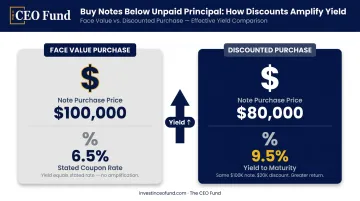
Buying below the unpaid balance pushes your actual yield above the note's stated rate. A $100,000 balance note purchased at $80,000, for example, produces approximately 9.5% yield to maturity — well above its 6.5% stated coupon rate.
Key Components Every Investor Should Review
Before acquiring any note, examine these elements:
- Principal balance — the remaining loan amount
- Interest rate — fixed or adjustable, and the current rate
- Loan term and repayment schedule — remaining months and payment frequency
- Borrower and lender information — identities of all parties
- Late payment and default terms — what triggers default and what notice is required
- Collateral property details — address, property type, and condition
- Lien position — first or subordinate lien on the property
Types of Mortgage Notes Investors Should Know
Performing Notes
A performing note is current on payments. The borrower makes scheduled payments, the note generates predictable monthly cash flow, and the risk profile is relatively lower. For investors seeking steady passive income with minimal complexity, performing notes are the most accessible entry point.
Non-Performing Notes
A non-performing note involves a borrower who has missed payments — typically 90 or more days past due, the threshold at which the OCC notes interest accrual generally stops unless the loan is both well-secured and in collection. Because the default risk is elevated, non-performing notes can be purchased at steep discounts.
According to Paperstac's 2025 marketplace data, first-position non-performing note transactions averaged 56.71% of unpaid principal balance, with a general range of 30%–60% of UPB. That discount creates room for multiple exit strategies:
- Renegotiate terms through loan modification to restore regular payments
- Accept a deed-in-lieu of foreclosure, where the borrower voluntarily transfers the property
- Pursue foreclosure and sell the property through the applicable state process
First-Lien vs. Second-Lien Notes
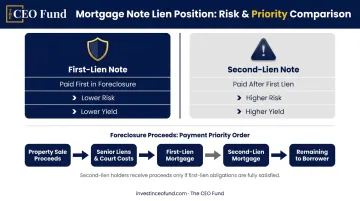
Lien position determines payment priority in a default scenario. The CFPB confirms that in foreclosure, the first-lien lender collects before any subordinate claim.
| Feature | First-Lien Notes | Second-Lien Notes |
|---|---|---|
| Priority | Paid first from foreclosure proceeds | Paid only after first lien is satisfied |
| Risk Level | Lower | Higher |
| Typical Yield | Lower | Higher |
Asset Class and Ownership Structures
Notes can be backed by single-family homes, multifamily properties, mobile home parks, or commercial real estate — each with distinct borrower behaviors and return profiles. A portfolio spread across property types and geographies — like The CEO Fund's Grade A–C notes spanning 50+ states — reduces concentration risk that comes with single-property investing.
How investors hold notes varies just as much as what backs them:
- Buy a whole note outright for direct, individual ownership
- Purchase a partial note to receive a defined slice of the income stream
- Invest through a fund or syndication for fully passive, professionally managed exposure
Why Investors Choose Mortgage Notes Over Traditional Real Estate
Becoming the Bank
Note investors earn the same type of contractual, interest-bearing income that banks collect — without owning, managing, or maintaining any physical property. The CEO Fund describes this as eliminating the "three T's": tenants, toilets, and tiles. That means no midnight maintenance calls, no vacancy risk, and no surprise capital expenditures.
Passive Income With Competitive Yields
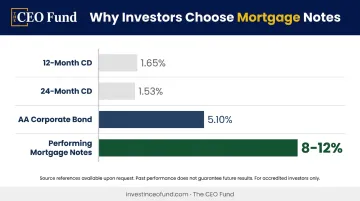
Monthly payments of principal and interest flow directly to the note holder — or into a savings or IRA account — without active involvement. Paperstac cites an 8%–12% typical annual return range for performing mortgage notes, a marketplace claim rather than an audited benchmark.
The numbers put that return range in context:
| Instrument | Current Rate |
|---|---|
| 12-month CD national average | 1.65% |
| 24-month CD | 1.53% |
| ICE BofA AA Corporate Bond yield | 5.10% |
| Performing note range (marketplace claim) | 8%–12% |
CD rates from FDIC national averages, June 2026; bond yield from FRED.
The yield gap is substantial — though note investing carries risks that CDs and investment-grade bonds do not.
Collateral-Backed Security
Higher yields come with higher risk — which is where collateral changes the equation. Unlike stocks or unsecured bonds, mortgage notes are secured by real property. If a borrower defaults, the note holder holds a legal claim to the underlying asset through the security instrument. That backstop doesn't guarantee full recovery — property values and foreclosure costs matter — but it provides downside protection absent from most income instruments.
Portfolio Diversification
Mortgage notes have low correlation to equity markets, making them a useful buffer during stock market volatility. Geographic diversification across multiple states and property types — as The CEO Fund deploys across its 50+ state portfolio — further reduces risk compared to concentrating capital in a single market.
Risks of Mortgage Note Investing and How to Mitigate Them
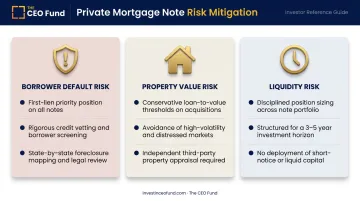
Mortgage note investing offers real advantages — but like any asset class, it carries specific risks that informed investors need to plan for. Here are the three primary risks and how to manage them:
Borrower Default Risk
If a borrower stops paying, the note holder must initiate foreclosure — a process that varies dramatically by state. ATTOM reports a national average of 577 days for properties completing foreclosure in Q1 2026, with Louisiana averaging 3,140 days and Texas completing the process in as few as 165 days. State selection matters.
To reduce exposure:
- Prioritize first-lien notes, which hold senior claim on the property
- Vet borrower creditworthiness thoroughly before acquisition
- Map foreclosure timelines in target states before committing capital
Property Value and Market Risk
If the underlying property declines below the outstanding loan balance, a foreclosure may not fully recover the investment.
To protect against downside:
- Target notes with conservative loan-to-value ratios at purchase — The CEO Fund's documented case study shows a note acquired at $80,900 against a $115,000 property (roughly 70% LTV), building in a meaningful equity cushion
- Avoid over-leveraged notes in markets with volatile price histories
- Verify independent appraisals, not just seller-provided valuations
Liquidity Risk
Mortgage notes are not publicly traded. Selling a note on short notice is possible but not guaranteed, and secondary market depth is limited.
To manage liquidity constraints:
- Size note positions as one component of a broader portfolio, not the whole
- Plan for medium-to-long holding periods — 3–5 years is a reasonable baseline
- Avoid investing capital you may need on short notice
How to Evaluate a Mortgage Note Before Investing
A sound due diligence process covers three areas:
Borrower Creditworthiness
Pull and review:
- Credit history and current score
- Payment track record on the existing note
- Income documentation and debt-to-income ratio
Higher credit quality correlates with lower default probability. For non-performing notes, you're already pricing in the default — so the focus shifts to collateral value and exit strategy.
Collateral Property Value
Order an independent appraisal or broker price opinion (BPO) — a market value estimate prepared by a licensed real estate professional using comparable sales and neighborhood analysis. Then calculate the loan-to-value (LTV) ratio and review recent property condition records to confirm the collateral supports the note's outstanding balance.
Loan Documentation and Title
Have a real estate attorney confirm the promissory note is a valid, enforceable instrument. Then conduct a title search covering:
- The recorded mortgage and any assignments or releases
- Lien position (first lien vs. subordinate)
- Any superior claims that could impair your rights as the note holder
According to ALTA, a lender's title policy directly addresses whether the lien is valid and whether another claimant holds priority. Securing that policy before committing capital is a non-negotiable step.
Tax Advantages: Investing Through a Self-Directed IRA or 401(k)
Income from performing mortgage notes is typically treated as ordinary interest income, subject to regular tax. But when held inside a self-directed IRA (Traditional or Roth) or a self-directed Solo 401(k), that income grows tax-deferred or tax-free — compounding returns without annual tax drag.
The IRS confirms that Traditional IRA earnings are generally not taxed until distributed, while qualified Roth IRA distributions are entirely tax-free. One important caveat: income from debt-financed property inside an IRA can trigger Unrelated Debt-Financed Income (UDFI) tax — pure mortgage note fund investing typically avoids this, but investors should confirm with a tax professional.
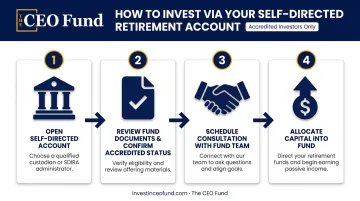
The CEO Fund is structured to accommodate both SDIRA and Solo 401(k) capital. For qualified investors, participation follows four steps:
- Open a self-directed account with a qualified U.S. custodian approved for alternative investments
- Review fund documents and confirm accredited investor status
- Schedule a consultation with the fund's management team
- Allocate capital into the pooled mortgage note fund — the fund handles sourcing, underwriting, and servicing
All transactions flow through the IRA custodian, keeping the account's tax-advantaged status intact. The fund targets a 7–9%+ annual yield with an average holding period of 3–5 years and a $100,000 minimum investment.
For accredited investors sitting on substantial retirement savings, this structure offers a direct path to real estate-backed yield — without the due diligence burden of sourcing individual notes.
Frequently Asked Questions
How do you make money from mortgage notes?
Investors profit by purchasing notes (often at a discount) and collecting the borrower's monthly principal and interest payments. Additional profit can come from selling the note at a gain or, for non-performing notes, acquiring the property through foreclosure at a price below market value.
Are mortgage notes a good investment?
They can be a strong fit for accredited investors seeking passive income backed by real estate collateral — particularly with thorough due diligence in place. Suitability depends on your liquidity needs, risk tolerance, and investment horizon; they are not ideal for capital you may need on short notice.
Can I buy my own mortgage note?
Yes. A borrower can purchase their own mortgage note from the lender or current note holder — often at a negotiated discount — which effectively retires the debt early. This is entirely separate from investing in third-party mortgage notes as a lender.
What is the difference between performing and non-performing mortgage notes?
Performing notes are current on payments and offer steady, lower-risk income. Non-performing notes involve borrowers who have defaulted and can be acquired at deeper discounts (typically 30%–60% of unpaid balance), but require active resolution strategies such as loan modification or foreclosure.
Can I invest in mortgage notes through my IRA or 401(k)?
Yes — self-directed IRAs and Solo 401(k)s allow investment in mortgage notes and mortgage note funds, enabling tax-deferred or tax-free growth on interest income. All transactions must flow through a qualified custodian, and prohibited transaction rules apply. Funds like The CEO Fund are structured to accommodate self-directed retirement accounts and can coordinate directly with your custodian.
How much money do I need to start investing in mortgage notes?
Entry points vary widely. Individual note purchases on secondary marketplaces can start well below $100,000, while professionally managed funds carry higher minimums — The CEO Fund's minimum is $100,000. Accredited investor status is required for most fund-based vehicles.