

What Are Asset-Backed Securities?
Somewhere between a homeowner making a monthly mortgage payment and a pension fund collecting yield, a financial structure converts that individual loan into a tradeable investment. Most investors never see this machinery. Understanding it opens a distinct asset class — one that accredited investors and institutional allocators have used for decades to generate steady, collateral-backed income.
Asset-backed securities (ABS) are financial instruments created by pooling income-generating loans, leases, or receivables and issuing bonds or notes backed by their cash flows. Investors receive periodic income as the underlying borrowers make payments — until maturity or payoff.
The core problem ABS solves is a liquidity mismatch. A bank holding thousands of individual mortgage or auto loans can't easily sell them one by one. Securitization converts that illiquid pool into tradeable securities, freeing capital for new lending while giving investors diversified access to loan-level income streams they couldn't otherwise reach.
This article breaks down how securitization works mechanically, the main ABS types, genuine investment benefits, and the risks worth understanding — including how post-2008 reforms reshaped the market.
Key Takeaways
- ABS are created by pooling loans or receivables and issuing securities backed by their cash flows
- Types include mortgage-backed securities (MBS), auto loan ABS, credit card ABS, CDOs/CLOs, and student loan ABS
- Investors gain portfolio diversification, predictable income, yield premiums over comparable bonds, and structural credit protection
- Key risks include credit risk, prepayment risk, and liquidity risk — each capable of material losses in volatile conditions
- Post-2008 Dodd-Frank reforms tightened transparency, disclosure standards, and originator accountability across the ABS market
How Asset Securitization Works
The SPV Structure
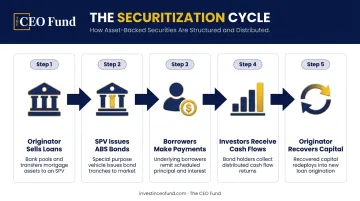
Securitization begins when an originator (a bank, auto lender, or mortgage company) sells a pool of contractual payment obligations to a special purpose vehicle (SPV). The SPV is a legally separate entity created solely to hold those assets and issue debt against them.
This separation matters. If the originating bank fails, the SPV's assets are legally ring-fenced — bankruptcy remoteness in legal terms. Investors in the ABS are exposed to the performance of the loan pool, not the financial health of whoever originated the loans.
The basic flow:
- Originator sells a pool of loans to the SPV
- SPV issues ABS bonds to investors
- Borrowers make monthly payments → servicer collects and remits
- Investors receive cash flows minus servicing fees
- Originator recovers capital to underwrite new loans
Tranching and the Payment Waterfall
Most securitizations issue multiple tranches, each with different risk and yield profiles. This structure lets investors at different risk tolerances participate in a single underlying pool:
| Tranche | Priority | Risk Level | Yield Profile |
|---|---|---|---|
| A (Senior) | Paid first | Lowest | Lower yield |
| B (Mezzanine) | Paid second | Moderate | Moderate yield |
| C (Junior) | Absorbs losses first | Highest | Higher potential yield |
Credit Enhancement Mechanisms
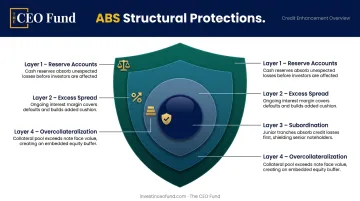
Structural protections buffer investors from losses:
- Overcollateralization: the SPV holds more asset value than the debt it issues, creating a hard cushion
- Excess spread: interest from underlying loans typically exceeds the coupon paid to investors, providing a soft buffer
- Reserve accounts: cash set aside against unexpected losses
- Performance triggers: automatic mechanisms that redirect cash flows if collateral deteriorates
One critical distinction: the primary collateral in securitization is the contractual obligation to pay — mortgages, leases, loan agreements — not the physical asset itself. The 2008 crisis made this painfully clear when MBS backed by poorly underwritten mortgages failed. That history underscores why underwriting standards and borrower cash flow quality are the real foundation of any ABS investment.
Main Types of Asset-Backed Securities
Mortgage-Backed Securities (MBS)
MBS are created by pooling residential or commercial mortgages. They predate most other ABS types and typically pay interest monthly rather than semiannually.
Two broad categories:
- Agency MBS — issued or guaranteed by government-sponsored entities (Fannie Mae, Freddie Mac, Ginnie Mae), carrying implicit or explicit government support. Agency MBS outstanding stood at $9.3 trillion in June 2025, with Fannie Mae at $3.6T, Freddie Mac at $3.1T, and Ginnie Mae at $2.6T
- Non-agency (private-label) MBS — no government backing, higher yield potential, higher credit risk; outstanding at approximately $0.5T in Q1 2025
Collateralized Mortgage Obligations (CMOs) are a MBS subset that divide the mortgage pool into tranches with different average lives. This structure was designed to address a specific problem: the unpredictable prepayment timing that makes standard pass-through MBS difficult to model.
Consumer ABS
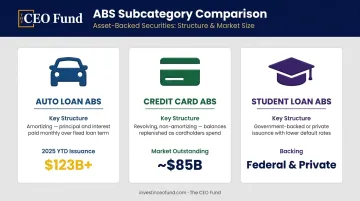
Three main subcategories:
| Type | Structure | Key Feature |
|---|---|---|
| Auto Loan ABS | Backed by monthly car loan payments (principal + interest) | 2025 YTD issuance exceeded $123B |
| Credit Card ABS | Revolving, non-amortizing — new balances replace paid-off ones during a lockout period | ~$85B outstanding |
| Student Loan ABS | Backed by government-guaranteed or private student loans | Government-backed loans historically show lower default rates |
Collateralized Debt Obligations (CDOs) and CLOs
CDOs are ABS issued by an SPV backed by a diversified portfolio of debt instruments — bonds, loans, other ABS, or mortgages. The most active subsector today is CLOs (Collateralized Loan Obligations), backed by corporate bank loans.
U.S. broadly syndicated loan CLOs had more than $930 billion outstanding in June 2025, making them one of the largest active securitization sectors.
CDOs gained notoriety during the 2008 financial crisis. Post-crisis reforms overhauled underwriting standards and transparency requirements, and both CDOs and CLOs remain legal, actively issued, and regularly rated today.
Key Benefits of Investing in ABS
Portfolio Diversification
ABS gives investors exposure to asset classes — auto lending, consumer credit, commercial real estate — that are difficult to access through stocks or traditional bonds. Within a single ABS pool, the diversity of thousands of individual borrowers means no single default can derail the investment. A pool of 10,000 auto loans behaves very differently from a handful of corporate bonds.
Predictable Income Streams
ABS backed by amortizing loans — mortgages, auto loans — generate consistent monthly or periodic cash flows from borrower repayments. This predictability suits pension funds, insurance companies, and high-net-worth investors targeting consistent passive income.
U.S. life insurers held $212 billion of CLO exposure at year-end 2023, with the Federal Reserve identifying them as the largest investors in non-senior CLO tranches — a concrete signal of how institutional income-seeking capital views this market.
Higher Yields Versus Comparable Fixed Income
ABS typically offers a yield premium over similarly rated corporate bonds or Treasuries. As of October 2025, prime auto ABS spreads ranged from 75 basis points (AA) to 130 basis points (BBB), while AAA credit card ABS spread was approximately 32 basis points. These premiums exist largely due to structural complexity and perceived secondary market constraints — not necessarily greater underlying credit risk — which means investors are often compensated for complexity, not for taking on materially higher default exposure.
Credit Enhancement and Historical Performance
Investment-grade ABS carries several structural protections that have historically kept losses low:
- Overcollateralization — collateral value exceeds the securities issued
- Excess spread — interest income above what's paid to investors absorbs early losses
- Subordination — junior tranches take losses first, shielding senior investors
- Reserve accounts — cash buffers covering shortfalls in borrower payments
Fitch's analysis of global investment-grade ABS from 1990 to 2019 shows an average annual impairment rate of just 0.08% and a three-year cumulative rate of 0.57% — a track record most fixed-income categories can't match at comparable ratings.
Access to Otherwise Inaccessible Investments
No individual investor can assemble a portfolio of 5,000 mortgages or 20,000 auto loans. ABS makes that diversification achievable in a single instrument, broadening options well beyond traditional equities and corporate debt.
Understanding ABS Risks
Credit Risk and Prepayment Risk
If enough borrowers default, cash flows to investors are disrupted. That's credit risk. Prepayment risk runs in the opposite direction: borrowers repaying early — most commonly when interest rates fall and homeowners refinance — shortens the investment horizon and reduces total interest income. In MBS specifically, prepayment behavior can dramatically alter expected duration and yield.
Different tranches carry different exposure. Senior tranches absorb prepayments differently than subordinated ones, and the tranche structure determines who bears which risk first.
Market and Liquidity Risk
ABS trade over the counter, not on exchanges. In normal markets, this is manageable. Under stress, it can be severe. Two historical episodes show just how fast spreads can move:
- March 2020: AAA non-QM RMBS spreads widened from roughly 80 to 450 basis points in days
- 2008 financial crisis: Short-dated AAA credit card and prime auto ABS spreads exceeded 600 basis points from near zero
Both were liquidity events, not credit events. Market stress can impair ABS prices long before actual defaults occur.
Post-2008 Regulatory Improvements
Dodd-Frank Sections 941–945 introduced structural reforms that addressed the root causes of the 2008 failure:
- Section 941 — Credit risk retention: issuers must generally retain at least 5% of collateral credit risk ("skin in the game")
- Section 942 — Standardized asset-level disclosure and reporting
- Section 943 — Representations and warranties
- Section 945 — Mandatory issuer due diligence and disclosure
Regulation AB II added asset-level disclosure requirements for registered ABS backed by residential mortgages, commercial mortgages, auto loans, and auto leases. The market is more transparent and better regulated than it was pre-2008, though structural risks remain.
Real Estate-Backed ABS: From MBS to Mortgage Notes
The Scale of Real Estate Securitization
Real estate-backed securities — agency MBS, non-agency RMBS, CMBS, and CMOs — represent the largest and most established segment of the securitized credit market. Agency MBS alone totaled $9.3 trillion outstanding in June 2025. Ginnie Mae issued $526.4 billion in FY2025 alone, with $2.834 trillion outstanding as of September 30, 2025. These are not niche instruments — they are foundational to how the U.S. housing market is funded.
How Individual Mortgage Notes Work
A mortgage note is the private, direct equivalent of what MBS do at institutional scale. When an investor holds a mortgage note, they own the contractual right to receive monthly principal and interest payments from a specific borrower — secured by real property. They step into the role of the bank, without owning the property itself. No tenants, no maintenance calls, no property management overhead.
The note investor's return comes from the borrower's payment obligation, backed by real estate collateral. If the borrower defaults, the note holder — if in a first lien position — retains the right to foreclose and recover from the underlying asset.
How The CEO Fund Accesses This Market
For accredited investors who want real estate-backed, asset-secured cash flow without navigating individual securitizations, The CEO Fund offers a professionally managed alternative. The fund acquires performing and non-performing first lien mortgage notes across 50+ states, deploying capital through a $50M fund structure managed by a Certified Mortgage Investing Specialist.
The model differs from traditional MBS in a few important ways:
| Feature | Agency MBS | The CEO Fund Model |
|---|---|---|
| Instrument | Tradeable bond | Fund interest (non-tradeable) |
| Pooling | Securitization trust | Managed investment fund |
| Access | Open market | Accredited investors only |
| Management | Servicers within trust | Active fund management team |
| Default recourse | Tranched loss absorption | Direct foreclosure rights |
| Income | Bond coupon | Monthly preferred return |
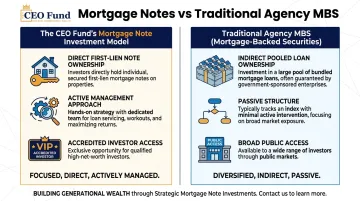
Rather than holding a bond derived from pooled mortgages, CEO Fund investors hold interests in a fund that directly owns the notes, with a first lien claim on the underlying real estate if a borrower fails to pay.
The fund has acquired 500+ loans across 50+ states since inception. That geographic spread gives the portfolio diversification comparable to what institutional securitized pools achieve structurally — built through active acquisition rather than automated pooling.
Frequently Asked Questions
What is the difference between ABS and MBS?
MBS is a specific type of ABS backed by pools of mortgage loans. ABS is the broader category that also includes auto loans, credit card receivables, student loans, CDOs, and more. In U.S. markets, MBS and ABS are often treated as separate investment categories, even though MBS technically falls under the ABS umbrella.
Are mortgage-backed securities still used?
Yes. MBS remain one of the largest fixed-income segments in the world. Fannie Mae, Freddie Mac, and Ginnie Mae actively issue agency MBS, with combined H1 2025 gross issuance of $571.8 billion. Post-2008 reforms substantially tightened underwriting standards and disclosure requirements.
Are CDOs still legal?
CDOs are legal and actively issued, particularly CLOs backed by corporate bank loans. Post-2008 Dodd-Frank reforms imposed risk retention, disclosure, and underwriting requirements that eliminated the most opaque pre-crisis structures, with Fitch continuing to rate new CLO issuances as recently as late 2025.
How do investors earn returns from asset-backed securities?
ABS investors receive periodic payments — typically monthly or quarterly — derived from the cash flows of the underlying loan or lease pool. Payments comprise interest income and principal repayment, distributed according to each tranche's priority in the payment waterfall.
What makes real estate-backed ABS different from other types?
Real estate-backed ABS (MBS, RMBS, CMBS) are secured by mortgage loans on physical property, giving investors additional collateral backing beyond the borrower's contractual payment obligation. They tend to carry longer durations and are more sensitive to prepayment risk tied to interest rate movements.
How has ABS regulation changed since the 2008 financial crisis?
Dodd-Frank introduced four major reforms:
- Mandatory risk retention (issuers must hold at least 5% of credit risk)
- Standardized asset-level disclosure requirements
- Removal of exclusive reliance on credit ratings for shelf eligibility
- Enhanced due diligence obligations
These changes directly addressed the misaligned originator-investor incentives that the 2008 crisis exposed.