Introduction
Most investors know their way around public stocks and bonds. But a substantial — and often overlooked — share of private capital formation happens entirely outside public markets. According to SEC data, Regulation D offerings raised $2.148 trillion in 2024 alone, based on over 32,500 new filings. That's not a niche corner of finance.
Yet for many investors, Reg D remains unfamiliar territory — full of legal jargon, qualification hurdles, and real risk if you don't know what you're evaluating.
This guide covers:
- How Regulation D works and its three active rules (504, 506(b), and 506(c))
- Who qualifies as an accredited investor
- The key risks every investor should understand
- What to examine before committing capital to any private placement
Key Takeaways
- Reg D lets companies raise capital privately without full SEC registration, though specific rules govern each offering type.
- Rule 506 offerings have no fundraising cap and are the most common; most require accredited investors only.
- Accredited investors must show $200K+ annual income ($300K+ with a spouse) for two consecutive years, or $1M+ net worth excluding their primary residence.
- Issuers must file Form D within 15 days of first sale — but this is a notice, not SEC approval.
- Reg D investments are typically illiquid, lightly regulated on disclosure, and demand independent due diligence.
How Regulation D Works: The Framework
The Legal Foundation
Under the Securities Act of 1933, companies must register securities with the SEC before offering them to the public — unless they qualify for an exemption. Section 4(a)(2) carves out "transactions by an issuer not involving any public offering." Regulation D formalizes that carve-out, giving issuers objective standards to confirm their offering qualifies.
Reg D functions as a safe harbor: issuers who meet its requirements can raise capital from private investors without the registration cost and disclosure burden of a public offering.
What a Private Placement Actually Looks Like
In practice, a private placement means securities are offered to a limited, pre-qualified pool of investors rather than the general public. The standard documentation package includes:
- Private Placement Memorandum (PPM) — the primary disclosure document investors review before committing capital; covers offering terms, material risks, use of proceeds, and issuer financials
- Subscription Agreement — the investor's binding commitment to purchase; includes representations on accredited investor status and suitability
- Operating or partnership agreement — defines investor rights, distribution priorities, management authority, and exit provisions
Form D: Notice, Not Approval
All Reg D issuers must electronically file Form D with the SEC within 15 calendar days of the first security sold. Form D contains basic issuer details, executive names, the exemption claimed, offering size, amounts sold, and sales compensation.
A filed Form D is not an approval, endorsement, or registration. The SEC does not review the offering itself. Filing simply notifies regulators that a private offering is underway — compliance responsibility stays entirely with the issuer.
Blue Sky Laws Still Apply
Federal exemption doesn't mean state exemption. The two major Reg D rules treat state requirements differently:
- Rule 506 offerings are "federally covered" — exempt from state registration, though states can still require notice filings, collect fees, and enforce antifraud laws
- Rule 504 offerings are not federally covered and may face state-level registration requirements or need a separate state exemption depending on the jurisdiction
Reg D Rules Explained: 504, 506(b), and 506(c) Compared
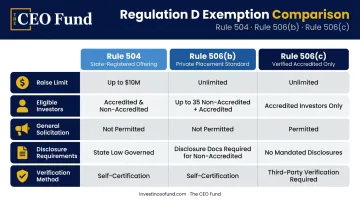
Choosing the wrong Reg D exemption can limit your investor pool, trigger disclosure obligations, or block advertising — all before you've raised a dollar. Three rules are active today (Rule 505 was eliminated in 2017, its features absorbed into an updated Rule 504), and each one makes different trade-offs between fundraising flexibility and compliance requirements.
| Feature | Rule 504 | Rule 506(b) | Rule 506(c) |
|---|---|---|---|
| Raise limit | $10M per 12 months | Unlimited | Unlimited |
| Investor types | Any (accredited or not) | Unlimited accredited + up to 35 non-accredited sophisticated | Accredited only |
| General solicitation | Generally prohibited | Prohibited | Permitted |
| Disclosure required | No specific mandate | Required if non-accredited investors participate | Issuer discretion (all accredited) |
| Accredited verification | Not required | Self-certification acceptable | Reasonable steps to verify required |
Rule 504: Smaller Raises, Broader Access
Rule 504 permits raises up to $10 million in any 12-month period and places no restrictions on investor type — accredited or not. There's no mandated disclosure format, though securities remain restricted unless additional conditions are met.
Companies disqualified from Rule 504 include investment companies, Exchange Act reporting companies, blank-check shell companies, and those subject to "bad actor" disqualification.
Rule 506(b): The Private Network Standard
Rule 506(b) is the most widely used private placement exemption. It allows:
- Unlimited capital raised
- Unlimited accredited investors
- Up to 35 non-accredited investors — provided each is "sophisticated" (sufficient financial knowledge to evaluate the investment independently, or represented by a qualified purchaser representative)
The critical constraint: no general solicitation or advertising. Issuers must work through pre-existing relationships with investors.
If non-accredited investors participate, issuers must provide Regulation A-level disclosure documents and audited financial statements. Selling exclusively to accredited investors gives issuers more flexibility on disclosure — though anything shared with accredited investors must also go to non-accredited participants.
Rule 506(c): The Advertised Offering
Rule 506(c), effective September 2013 under the JOBS Act, flips the solicitation rule: issuers can broadly advertise via the internet, social media, print, seminars, and broadcast — but only accredited investors may purchase.
The trade-off is stricter verification. Unlike 506(b)'s self-certification, 506(c) requires issuers to take reasonable steps to verify accredited status using documentation such as:
- Tax returns or W-2s
- Letters from a licensed CPA or attorney
- Bank or brokerage statements
- Third-party verification services
That higher bar shows up in adoption rates. An SEC study of VC fund filings from 2014–2023 found 506(c) accounted for just 8.4% of filings and 10.6% of capital volume — meaning most fund managers accept the advertising restriction in exchange for a simpler verification process.
Who Qualifies as an Accredited Investor
The accredited investor requirement reflects a core SEC assumption: investors with higher income or net worth are better positioned to evaluate unregistered securities and absorb potential losses. That assumption drives the eligibility thresholds.
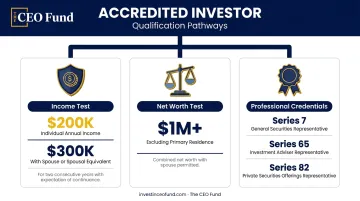
The Income Test
An investor must have earned income exceeding:
- $200,000 individually in each of the two most recent calendar years
- $300,000 combined with a spouse or spousal equivalent in each of those same years
- With a reasonable expectation of reaching the same income level in the current year
The Net Worth Test
Net worth must exceed $1 million, individually or combined with a spouse — and the value of your primary residence is explicitly excluded. Any debt secured by that residence up to its value is also excluded from the calculation.
The SEC's 2022 review estimated 24.3 million U.S. households — approximately 18.5% — met the financial thresholds.
Professional Credential Pathway
Since 2020, the SEC has recognized professional credentials as an alternative qualification route. Investors holding these licenses in good standing qualify:
- Series 7 (General Securities Representative)
- Series 65 (Investment Adviser Representative)
- Series 82 (Private Securities Offerings Representative)
Knowledgeable employees of a private fund also qualify for investment in that specific fund.
Not every participant in a Reg D offering needs to be accredited, though. Rule 506(b) creates a separate pathway worth understanding.
Non-Accredited "Sophisticated" Investors Under 506(b)
Under 506(b), up to 35 non-accredited investors may participate — but only if they have "sufficient financial and business knowledge to evaluate the merits and risks" of the investment. A purchaser representative can satisfy this standard on their behalf.
Watch for conflicts of interest: If that representative has a financial stake in the offering, their judgment may not be fully independent. Investors using this pathway should confirm who the representative is and how they're compensated before proceeding.
Key Risks and Restrictions of Reg D Investments
Illiquidity
Reg D securities are restricted securities. Investors cannot simply sell them through a brokerage account. If you want to resell, you must comply with exemptions like Rule 144, which generally requires a one-year minimum holding period for securities of non-reporting issuers — and meeting the holding period still doesn't guarantee a buyer.
For private equity and venture-style investments, Cambridge Associates notes typical holding periods of 7–10 years, sometimes longer before full exit. Plan accordingly.
Limited Disclosure
Reg D issuers — particularly those selling only to accredited investors — face far lighter disclosure requirements than registered public offerings. A PPM is not reviewed or approved by the SEC. Risk factors may be incomplete, projections may be optimistic, and there's no regulator standing between you and a poorly structured deal.
Independent due diligence isn't optional. It's the only protection available.
Fraud Risk and Bad Actor Disqualification
Unregistered offerings attract bad actors. The SEC's Rule 506(d) disqualifies issuers when covered persons — including directors, promoters, and paid solicitors — have prior criminal convictions, regulatory sanctions, injunctions, or disciplinary orders related to securities violations.
Red flags investors should watch for:
- Any claim that the SEC has "approved" or "endorsed" the offering
- No Form D filing discoverable on EDGAR for the issuer
- Offering documents that don't describe the securities as restricted or omit the required restrictive legend
If any of these appear, walk away before investigating further.
What to Evaluate Before Investing in a Reg D Offering
Due Diligence Checklist
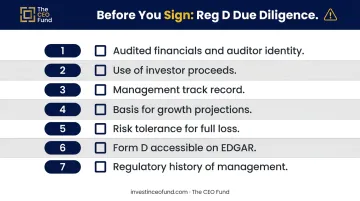
Before signing anything, get clear answers to these questions:
- Are audited financial statements provided, and who performed the audit?
- How does the issuer plan to use investor proceeds?
- What is management's track record — verifiable through public records or references?
- Are growth projections grounded in actual data, or promotional assertions?
- Can you afford a complete loss of this investment?
- Is the Form D filing accessible on EDGAR under the issuer's legal name?
- Has anyone in management or affiliated with the deal been subject to regulatory action?
The SEC's investor bulletin on private placements under Regulation D provides additional specific verification steps worth reviewing.
PPM and Subscription Agreement Review
The PPM is required to disclose all material facts about the investment. It's not technically mandated by Reg D's rules — but its absence is a red flag. A missing or vague PPM suggests the issuer hasn't gone through the discipline of formally documenting what they're offering and why.
The Subscription Agreement is where you formally commit capital and certify your accredited investor status. Read both documents carefully, and consider having a securities attorney review them before signing.
Any material misstatement or omission in a PPM can give rise to federal claims under Rule 10b-5, as well as state securities law and common law fraud claims. That liability protects investors — but it only helps after the damage is done.
An Example: Real Estate-Backed Reg D Funds
To see these principles in practice, consider how funds like The CEO Fund structure offerings under Regulation D. The fund provides mortgage note investments backed by real estate collateral across multiple U.S. states, where investors act as lenders rather than property owners. This shows how Reg D frameworks can support passive income structures without the management burden of direct ownership.
As with any Reg D investment, prospective investors should request the full PPM, verify Form D filings, and conduct independent due diligence on management, collateral, and use of proceeds before committing capital.
Frequently Asked Questions
What is the difference between Reg D 504 and 506?
Rule 504 caps raises at $10 million per 12-month period and permits both accredited and non-accredited investors, with no federal disclosure mandate. Rule 506 has no fundraising cap but is primarily restricted to accredited investors — though 506(b) allows up to 35 sophisticated non-accredited participants. Unlike 506(c), neither 504 nor 506(b) permits general solicitation at the federal level.
What restrictions does Regulation D place on issuers and investors?
Reg D restricts resale — securities sold under the exemption are "restricted securities" and cannot be freely resold without complying with another exemption, such as Rule 144. Depending on the rule used, general solicitation may also be prohibited. Issuers remain subject to federal antifraud laws and state notice and antifraud requirements regardless of which rule they rely on.
What is the difference between Rule 144A and Regulation D?
Reg D governs the initial private offering — the issuer selling securities directly to investors. Rule 144A is a resale exemption that lets qualified institutional buyers (QIBs, generally holding $100M+ in securities) trade unregistered securities among themselves in a secondary market. In short: Reg D is the fundraising framework; Rule 144A is the institutional resale mechanism.
Do I need to be accredited to participate in a Reg D offering?
Not always. Rule 504 imposes no accredited investor requirement. Rule 506(b) allows up to 35 non-accredited but sophisticated investors. However, Rule 506(c) requires every purchaser to be verified accredited — and most private funds default to structures that restrict participation to accredited investors only.
What is a PPM, and is it required?
A Private Placement Memorandum discloses investment terms, risks, and issuer details to prospective investors. Reg D does not technically require one, but its absence is a serious red flag — and any material misstatement or omission exposes the issuer to federal and state securities liability.
Is a Reg D offering approved by the SEC?
No. Filing Form D is a notice requirement — it tells the SEC an offering is happening. The SEC does not review, evaluate, approve, or endorse any Reg D offering. Any issuer claiming SEC approval of their offering is a serious fraud indicator.