

Introduction
Most investors default to stocks and bonds. It's a familiar pattern — open a brokerage account, pick a few ETFs, and call it a portfolio. But a significant and growing share of economic activity and value creation happens entirely outside of public exchanges.
According to McKinsey's Global Private Markets Review, global private-market assets under management reached $13.1 trillion as of mid-2023 — growing roughly 14% annually since 2013. That's not a niche corner of finance. It's a massive, parallel economy that most retail investors have never accessed.
Accredited individuals now have more access points than ever — from private equity funds and direct lending vehicles to real estate-backed income strategies like mortgage note investing.
This guide breaks down the major asset types, who qualifies to invest, and what getting started actually looks like.
Key Takeaways
- Private markets encompass investments in companies and assets not traded on public exchanges — including private equity, venture capital, private credit, and real estate
- Access is Participation requires accredited or institutional investor status, given higher risk, lower liquidity, and longer time horizons
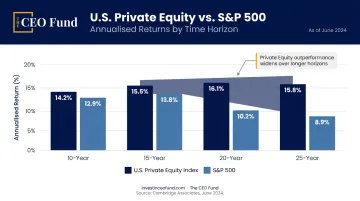
- Private equity has historically outperformed public benchmarks at the 15-, 20-, and 25-year mark
- Higher return potential and diversification come with real trade-offs — illiquidity, limited transparency, and higher minimums
- Multiple entry points exist — funds, direct credit vehicles, real estate-backed instruments — each suited to different goals
What Are Private Markets?
Private markets are where equity and debt in privately owned companies and assets are bought and sold entirely outside of public exchanges like the NYSE or Nasdaq. These aren't click-to-buy transactions. They're negotiated deals that require specialized knowledge, due diligence, and often relationships.
The Scale of What's Private
The opportunity set is larger than most investors realize. Hamilton Lane reports that 87% of U.S. companies with more than $100 million in revenue are privately held — only 13% are publicly traded. That means most established, revenue-generating U.S. businesses remain unavailable through a standard brokerage account.
Companies Are Staying Private Longer
The window to participate in a company's highest-growth phase has been shrinking for public investors. Data from Jay Ritter's IPO research shows the median age of a company going public was 9 years in the 1990s — by 2024, that figure had reached 14 years. Companies are spending more of their growth trajectory in private hands, which means more value creation is captured by private investors before any IPO occurs.
This isn't a temporary trend. Structural incentives keep companies private longer:
- Avoiding the cost and complexity of regulatory compliance
- Making long-term decisions without quarterly earnings pressure
- Accessing more private capital than at any prior point in history
Private Markets vs. Public Markets: Key Differences
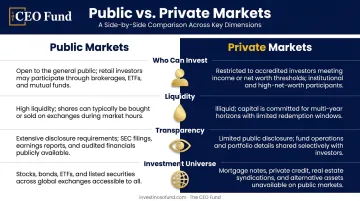
The two markets operate under fundamentally different rules. Here's how they compare across the dimensions that matter most:
| Dimension | Public Markets | Private Markets |
|---|---|---|
| Who can invest | Anyone with a brokerage account | Accredited and institutional investors |
| Liquidity | Shares trade daily | Capital locked up for years |
| Transparency | Mandated SEC disclosures | Limited reporting requirements |
| Investment universe | ~4,000 U.S. public companies | Hundreds of thousands of private businesses |
The Illiquidity Premium
Private markets' lower liquidity is often framed as a pure drawback. Investors who accept capital lockup are typically compensated with higher return potential over long time horizons — a concept known as the illiquidity premium.
NBER research examining secondary market transactions from 2006 to 2014 found that buyers of illiquid private fund stakes outperformed sellers by approximately 5 percentage points annually on a public-market-equivalent basis. The average discount on those transactions was 13.8% of net asset value, reflecting genuine compensation for accepting reduced liquidity.
That premium isn't automatic, though. Capturing it depends on selecting the right asset class, manager, and fund structure. Private market transactions occur through private placements — not open exchanges — so the rigor behind manager selection and deal underwriting determines whether investors actually realize the premium or leave it on the table.
Types of Private Market Investments
Private Equity
Private equity involves purchasing a significant or majority ownership stake in a mature private company, then improving operations, financial performance, or strategy before exiting through a sale or IPO. PE funds typically operate on long holding periods — Bain's 2025 report places the median buyout holding period at 6.1 years for deals exited in 2024, up from 5.4 years in 2019.
Returns depend heavily on the manager's ability to create operational value and time exits effectively. PE generally targets the highest return potential among private market strategies, but also requires the longest commitments.
Venture Capital
Venture capital funds early-stage, high-growth startups through minority-stake investments. It operates on a power-law model: a handful of exceptional outcomes drive the entire portfolio's returns.
Cambridge Associates examined top VC investments from 1995 to 2012 and found that the top 100 deals in each year accounted for 72% to more than 100% of total asset-class value creation. The implication is clear: VC offers the highest return ceiling among private strategies, but also the highest risk and the steepest manager-selection bar.
Private Credit
Private credit involves lending directly to private companies — through direct lending, mezzanine debt, or real estate-backed instruments — and earning returns through contractual interest payments rather than equity appreciation. Unlike equity strategies, it generates predictable, income-oriented cash flow with historically lower correlation to public equities.
The asset class has expanded sharply. The Federal Reserve measured $1.34 trillion of U.S. private credit AUM in mid-2024, roughly five times the 2009 level. The Cliffwater Direct Lending Index has posted a 9.0% gross annualized return over the trailing 10 years ending December 2024, compared to 4.9% for high-yield bonds over the same period.
Real Assets: Real Estate and Infrastructure
Real assets provide exposure to physical, tangible properties and infrastructure through private funds. Key characteristics:
- Income stability: Cash flows from rents, tolls, or mortgage payments
- Inflation linkage: NCREIF data shows private real estate beat inflation in 84% of sampled five-year periods from 1978 to 2011, by an average of 698 basis points
- Low correlation: The transaction-based NCREIF index showed a 0.07 correlation with the S&P 500 and -0.15 with U.S. aggregate bonds from 1984 to 2018
One specific strategy within real assets is mortgage note investing — where investors effectively become the lender on existing mortgages, receiving monthly payments backed by property collateral. Rather than owning and managing physical properties, note investors hold the debt instrument secured by real estate.
The CEO Fund, for example, acquires Grade A–C mortgage notes across 50+ U.S. states. Its portfolio spans performing and non-performing first-lien notes backed by single-family homes, multifamily properties, commercial real estate, and mobile home parks. Investors receive monthly income from borrower payments — no property management, tenant coordination, or maintenance involvement required. The fund targets annual returns of 8–12%, with distributions paid directly into savings or IRA accounts.
Secondary Transactions and Co-Investments
Beyond direct fund participation, accredited investors can access private markets through secondary purchases and co-investments. Each approach offers more visibility into the underlying investment than a blind pool fund structure:
- Co-investments let investors participate alongside a PE fund in a single deal — with full transparency into the target company and often reduced fees
- Secondary purchases involve acquiring existing private fund interests from other investors, typically at a discount to NAV
- Both strategies suit investors who want targeted exposure without committing to a multi-year blind pool
Benefits and Risks of Investing in Private Markets
Benefits
Higher return potential over long horizons
Cambridge Associates' U.S. Private Equity Index data through June 2024 shows meaningful outperformance over longer periods:
| Horizon | U.S. Private Equity | S&P 500 | Difference |
|---|---|---|---|
| 10 years | 15.05% | 15.09% | -0.04 pts |
| 15 years | 16.75% | 10.42% | +6.33 pts |
| 20 years | 14.49% | 8.96% | +5.53 pts |
| 25 years | 12.73% | 8.16% | +4.57 pts |
The 10-year result is a useful reality check — private equity doesn't outperform over every period. But the 15- to 25-year track record is compelling for long-horizon investors.
Portfolio diversification
Not all private assets behave the same way relative to public markets. KKR's forward-looking capital market assumptions illustrate the differences:
- Buyout private equity: 0.80 correlation with global public equity (substantial overlap)
- Direct lending: 0.50 correlation (moderate)
- Core private real estate: 0.40 correlation (lower)
Real estate-backed credit strategies offer the lowest correlation of the three — a useful counterweight for portfolios heavily concentrated in public equities.
Access to a larger investment universe
Private markets open the door to pre-IPO companies, real estate-backed income vehicles, and direct lending opportunities that don't exist through a standard brokerage account. For investors seeking both growth and income, this expanded universe matters.
These advantages come with trade-offs. Before committing capital, investors need to weigh the following risks carefully.
Risks to Understand Before Committing
- Illiquidity: Capital is typically committed for years. Most PE and credit funds have lifespans of 7–12 years. Investors should only allocate funds they won't need during that window
- Limited transparency: Private companies aren't subject to SEC disclosure mandates, making thorough upfront due diligence essential
- Fee structure: Private funds typically charge management fees plus performance-based carried interest, which can erode net returns if not evaluated carefully
- Higher minimums: Investment thresholds are often substantially higher than public market alternatives, which affects how capital is allocated across a broader portfolio
Who Can Invest and How to Get Started
Accredited Investor Requirements
The SEC restricts private market participation to accredited investors. Qualification thresholds include:
- Income: $200,000+ individually (or $300,000+ jointly with a spouse) in each of the two prior years, with reasonable expectation of the same in the current year
- Net worth: $1 million+, individually or jointly, excluding the primary residence
- Professional credentials (added in 2020): Series 7, 65, or 82 licenses held in good standing
These thresholds exist because private investments carry higher complexity, lower liquidity, and less regulatory protection than public securities. The assumption is that accredited investors have both the financial cushion and the sophistication to absorb potential losses.
Choosing the Right Access Point
The right vehicle depends on what you're optimizing for:
| Goal | Vehicle to Consider |
|---|---|
| Long-term capital growth | Private equity fund |
| Predictable income | Private credit or mortgage note fund |
| Real estate exposure without landlord duties | Mortgage note investing |
| Startup upside | Venture capital fund |
| Lower fees, deal-level transparency | Co-investment or secondary purchase |
Conducting Due Diligence
Before committing capital, evaluate:
- Track record: What has the manager actually returned, net of fees, across multiple vintages?
- Strategy clarity: Is the investment approach specific and repeatable, or vague?
- Fee structure: What are the management fee and carried interest terms, and at what hurdle rate does carry kick in?
- Alignment: Does the manager co-invest alongside LPs, or is their income primarily from management fees?
- Sourcing edge: How does the fund access deals that others don't?
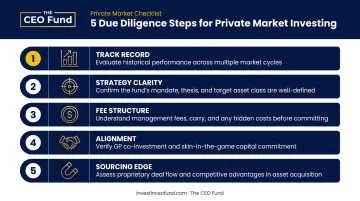
Information asymmetry runs deeper in private markets than in public ones. Vetting managers rigorously — on returns, strategy, and alignment — is the foundation of every sound private market allocation.
Tax-Advantaged Private Market Investing
Accredited investors can access certain private market investments through self-directed IRAs and solo 401(k) accounts, allowing gains to grow on a tax-deferred or tax-free basis. IRS rules permit broad investment discretion in these accounts, though prohibited-transaction rules and potential unrelated business taxable income (UBTI) implications apply depending on the structure.
The CEO Fund, for instance, allows investors to receive monthly mortgage note payments directly into IRA accounts — making it a potentially attractive option for those seeking passive income within a tax-advantaged wrapper. Consult a qualified tax advisor before structuring private investments inside a retirement account.
Frequently Asked Questions
What is private market investing?
Private market investing means allocating capital into companies and assets not traded on public exchanges — such as private equity, private credit, and real estate — typically through funds or direct deals managed by professional investment firms. It requires working outside of standard brokerage accounts and is generally restricted to accredited or institutional investors.
Is investing in private markets a good idea?
For accredited investors, private markets offer higher long-term return potential and meaningful portfolio diversification. The trade-offs — illiquidity, longer time horizons, higher minimums, and limited transparency — must align with your financial situation and goals before committing capital.
Who qualifies to invest in private markets?
The SEC requires either income above $200,000 individually ($300,000 jointly) for two consecutive years, or a net worth exceeding $1 million excluding your primary residence. Holders of Series 7, 65, or 82 licenses also qualify, as do institutional investors such as pension funds and endowments.
How long is money typically locked up in a private market investment?
Most private equity and credit funds run 7–12 years, with capital committed for the full term. Some vehicles — like mortgage note funds targeting 8–12% annual returns — distribute income quarterly throughout the holding period, making the illiquidity more manageable than a single-exit structure.
How do private market investments generate returns?
Returns come from three main mechanisms: capital appreciation (selling a company or asset for more than its purchase price), regular income distributions (interest payments on private credit or mortgage notes), and hybrid strategies combining both. The mechanism varies significantly by asset type and strategy.
What is the difference between private equity and private credit?
Private equity involves taking an ownership stake in a company and profiting from its growth or eventual sale. Private credit involves lending money to private companies or real estate borrowers and earning returns through contractual interest payments. Private credit generally offers more predictable income and lower risk than equity strategies, at the cost of lower upside.