

Key Takeaways
- Family offices allocate 10%–18% of portfolios to real estate, with U.S.-based offices trending higher
- Real estate serves as both an inflation hedge and a multigenerational wealth transfer vehicle
- Multifamily, industrial, and healthcare properties attract the most family office capital today
- Direct ownership, co-investments, and mortgage note funds suit different priorities around control, liability, and passive income
- Self-directed IRAs let accredited investors grow real estate returns — including mortgage note income — tax-deferred or tax-free
What Is a Family Office and How Does Real Estate Fit In?
A family office is a privately managed firm handling the financial, legal, and administrative needs of one or more wealthy families — covering investments, estate planning, tax strategy, and philanthropy. Single-family offices (SFOs) serve one family, typically those with more than $100 million in assets. Multi-family offices (MFOs) pool resources across several families, offering shared infrastructure at lower cost.
Real estate isn't a portfolio add-on for most family offices — it's a structural pillar. Survey data tells a clear story:
| Survey | Sample | Real Estate Allocation |
|---|---|---|
| J.P. Morgan 2024 | 190 family offices | 10% average |
| UBS 2024 | 320 SFOs | 10% (12% planned for 2024) |
| Citi 2024 | 338 family offices | 14% direct plus funds |
| UBS 2025 | 317 SFOs | 18% for U.S. family offices |
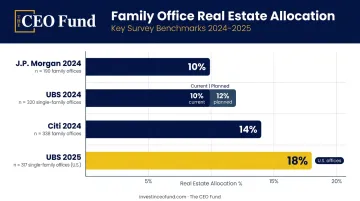
The patient capital advantage is real. Unlike private equity funds facing mandate-driven exit pressures after 10+ years, family offices can hold assets for decades — riding out market cycles and capturing long-term value that shorter-horizon investors are forced to leave behind. How a family office acts on that advantage, though, depends heavily on its structure.
Types of Family Offices and Their Real Estate Approach
Three distinct profiles emerge when family offices approach real estate:
- Large MFOs with dedicated real estate teams pursue direct acquisitions at scale, using in-house underwriting and legal resources to close complex deals
- SFOs without dedicated RE staff favor passive or syndicated structures — real estate economics without the operational overhead
- Real estate-native offices (families whose wealth originated in property) bring deep expertise, move fast on off-market deals, and typically require meaningful control
Each type differs in check size, speed, and how much ongoing involvement they'll tolerate.
Core Benefits of Real Estate for Family Office Portfolios
Inflation Protection and Wealth Preservation
The inflation hedge case for real estate is data-backed. According to J.P. Morgan's 2026 Global Family Office Report, family offices that identify inflation as their primary portfolio risk allocate 25% to real estate — double the 12% average across all surveyed offices. Offices most concerned about purchasing power erosion are also the ones most heavily weighted toward real estate.
Real estate values and rental income tend to rise with inflation — rents reset, and property values track replacement costs. That said, Preqin notes the hedge only holds when rent growth outpaces expense growth. Across long time horizons, real estate has historically preserved purchasing power better than most alternatives.
Cash Flow, Diversification, and Low Correlation
Rental income from multifamily, commercial, and industrial properties provides recurring income that doesn't depend on market sentiment. Wealth managers consistently cite cash flow — not just appreciation — as the primary draw. J.P. Morgan Asset Management's research shows direct real estate has exhibited low or negative correlation with the S&P 500 over time, making it a genuine diversifier rather than a redundant market bet.
Three characteristics make real estate appealing as a portfolio diversifier:
- Recurring income: Rents from multifamily, commercial, and industrial properties produce cash flow independent of market sentiment
- Low correlation: J.P. Morgan Asset Management's research shows direct real estate has exhibited low or negative correlation with the S&P 500 over time
- Appreciation: Property values compound separately from equities, adding a second return driver
Wealth managers consistently cite cash flow — not just appreciation — as the primary draw. The correlation data reinforces why.
Opportunistic Upside for Patient Capital
Family offices can move when institutional funds cannot. A compelling example: Realm, a collective of roughly 100 families, deployed $100 million into Northern California real estate in the six months preceding March 2026 — including a San Francisco office acquisition at approximately 21% of both its previous trade value and current replacement cost. That pricing is unavailable to investors with shorter capital cycles.
Estate Planning Utility
Real estate can be:
- Held in trusts and transferred to future generations
- Gifted at discounted valuations through valuation discount strategies
- Structured to minimize estate and capital gains taxes
For family office principals thinking in 30-year horizons, these structures turn real estate into a wealth transfer tool — not just an investment return.
Real Estate Asset Classes Family Offices Target
The FORE Institute's survey of 100 mostly U.S.-based family offices provides the clearest sector-level picture available:
| Property Type | Current Allocation | Future Preference |
|---|---|---|
| Multifamily | 30% | 40% |
| Industrial | 20% | 25% |
| Healthcare/Medical | — | 15% |
| Data Centers | — | 10% |
| Office | 15% | Declining |
| Retail | 10% | Not leading |
Multifamily and industrial dominate current allocations, with healthcare and data centers emerging as future targets. Traditional office remains strictly opportunistic — purchased only at steep discounts to replacement cost, not as a core holding.
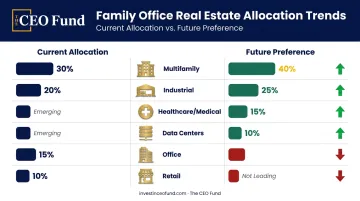
On overall deal activity, PwC's Global Family Office Deals Study 2025 reports real estate reached 39% of global family office investment transactions in H1 2025 — its highest transaction share since H2 2019. The trend is clear: family office capital is moving back into real estate at scale.
Multifamily in major metro areas draws the most consistent interest, prized for reliable occupancy and predictable income streams. Beyond core assets, family offices — and the accredited investors who co-invest alongside them — are looking at niche sectors where favorable entry points still exist: mobile home parks, tax liens, land entitlement plays, and construction syndications in high-growth states like Florida offer yield and diversification that stabilized core assets have made harder to find.
How Family Offices Structure Real Estate Investments
UBS research breaks down how family offices actually hold their real estate:
- 52% — fully owned physical property (direct control and ownership)
- 19% — co-investments (shared deal exposure)
- 19% — direct closed-end real estate funds (manager-run pooled structures)
Direct ownership dominates, but co-investments and funds remain material. Most family offices use all three channels deliberately, calibrating the mix based on deal size, internal capacity, and return targets.
Direct Ownership and Club Deals
Direct acquisition gives family offices maximum control, full depreciation benefits, and the ability to execute off-market deals through proprietary networks. The growing trend is deal-by-deal or club deal structures with aligned co-investors — avoiding fund fees while maintaining selectivity.
Funds, Syndications, and Joint Ventures
Funds and syndications solve a real problem: accessing larger assets or diversifying geographically without building full in-house infrastructure. A professionally managed sponsor runs operations; the family office provides capital and collects distributions.
This structure works particularly well for families without dedicated real estate staff. The trade-off is reduced individual control and dependence on the fund manager's judgment.
Mortgage Notes and Real Estate-Backed Debt
Beyond equity structures, some family offices move further down the capital stack entirely. Mortgage note investing places investors in the lender position, not the owner's. Monthly payments arrive secured by real estate collateral, without any property management obligation.
This structure suits family offices and accredited investors who want real estate economics with zero operational involvement. The Fannie Mae and Freddie Mac enterprise note sales program has transacted $31.8 billion in aggregate unpaid principal balance across 173,571 non-performing loans through December 2024, reflecting the depth and scale of the secondary market for mortgage notes.
Tax Advantages and Estate Planning Through Real Estate
Depreciation and Deductions
The IRS allows real estate investors to deduct depreciation on a straight-line basis, using the mid-month convention:
- Residential rental property: depreciated over 27.5 years
- Nonresidential real property: depreciated over 39 years
- Land: not depreciable
Family offices prioritize after-tax returns. Real estate's favorable tax treatment — depreciation, mortgage interest deductions, operating expense deductions — often means it outperforms other asset classes on a net basis, even when gross returns look comparable.
1031 Exchanges and Tax-Deferred Compounding
Section 1031 allows investors to sell appreciated property and reinvest proceeds without triggering immediate capital gains taxes — provided replacement property is identified within 45 days and received within 180 days.
The scale of this strategy is significant: IRS data for 2023 shows 54,746 individual Forms 8824 filed, covering $55.4 billion in like-kind property received and $23.7 billion in deferred gain. That's a substantial portion of U.S. real estate capital moving tax-sheltered. Across generations, 1031 exchanges allow capital to compound tax-deferred indefinitely — a structural advantage unavailable to most other asset classes.
One important limitation: mortgage notes do not qualify as real property under Section 1031, so this deferral strategy applies to direct property holdings only. Note investors have a different — and often more flexible — path to tax-advantaged compounding through retirement accounts.
Self-Directed IRAs and 401(k)s
Accredited investors can invest in real estate assets — including mortgage notes and private real estate funds — through self-directed IRA or solo 401(k) accounts, allowing returns to compound tax-deferred or tax-free. IRS guidance confirms IRA law does not prohibit real estate holdings, though custodians may restrict available assets and prohibited transaction rules apply strictly.
Passive Real Estate Alternatives for Family Offices and Accredited Investors
Direct property ownership delivers control and tax benefits, but it also brings tenant management, maintenance obligations, vacancies, and geographic concentration risk. For many family office principals and accredited investors, these burdens outweigh the benefits — particularly when passive alternatives offer comparable economics.
Mortgage Note Investing as a Passive Alternative
Investing in performing and non-performing mortgage notes allows accredited investors to act as the lender — receiving monthly income secured by real estate collateral — without owning or managing physical property.
The structural advantages over direct ownership:
- No tenants, toilets, or tiles — investors receive mortgage payments without any property management obligations
- Geographic diversification across multiple states through a single fund position
- Asset-backed security — real estate collateral protects investor capital
- IRA compatibility — investments can compound tax-advantaged inside self-directed retirement accounts
- First-lien priority — senior claim on collateral in default scenarios
The CEO Fund acquires and manages mortgage notes across 50+ states, giving accredited investors access to consistent monthly income backed by diversified real estate collateral. Fund Manager Carlo Turner, a Certified Note Investing Specialist with 15+ years in corporate finance, has overseen 500+ loan acquisitions — including bulk portfolio purchases at roughly 52 cents on the dollar.
Beyond note acquisitions, the fund also operates the $20M SUNRISE Construction Syndication in Florida: a ground-up development delivering 1,000 homes, a marina, and a golf course community — demonstrating the range of real estate structures accessible to fund participants.
How to Evaluate Passive Real Estate Vehicles
Key due diligence criteria for family office-aligned investors:
- Fund manager track record: Look for verifiable loan volume, relevant certifications, and a finance background that extends beyond real estate alone
- Asset diversification: Confirm geographic spread across multiple states and a mix of property types — multifamily, commercial, and single-family
- Collateral structure: First-lien position, conservative loan-to-value ratios, and meaningful equity cushion between acquisition price and current property value are all non-negotiable
- Distribution mechanics: Clarify payment frequency (monthly vs. quarterly), self-directed IRA compatibility, and the fund's historical consistency in distributions
- Transparency: Any fund worth considering should provide offering memoranda, regular portfolio reporting, and clear documentation of management credentials

Frequently Asked Questions
How much of their portfolio do family offices typically allocate to real estate?
Global surveys show a range of 10%–14% across J.P. Morgan, UBS, and Citi 2024 data. UBS's 2025 report places U.S. family offices specifically at 18%. The figure varies based on risk profile, whether funds are counted alongside direct property, and inflation expectations — offices most concerned about inflation allocate as high as 25%.
What types of real estate do family offices invest in most?
Multifamily housing leads at 30% of current allocations, followed by industrial at 20%. Family offices are increasingly rotating toward healthcare/medical office and data centers for future exposure, while traditional office remains opportunistic-only — purchased only at severe discounts to replacement cost.
How do family offices use real estate for estate planning?
Property can be held in trusts, transferred at discounted valuations, and structured to minimize estate and capital gains taxes through mechanisms like 1031 exchanges and valuation discounting.
What is the difference between direct real estate investing and funds for family offices?
Direct investing delivers maximum control, full depreciation benefits, and off-market access — but requires hands-on management or dedicated staff. Funds and syndications provide passive diversification with lower operational burden and no in-house infrastructure requirement, at the cost of reduced individual deal control and manager dependence.
Can family offices invest in real estate through a self-directed IRA?
Yes. Accredited investors can use self-directed IRAs and solo 401(k)s to invest in real estate assets including mortgage notes and private real estate funds. Returns compound tax-deferred (traditional accounts) or tax-free (Roth accounts). Prohibited transaction rules apply — personal use of IRA-owned assets or transactions with disqualified persons can disqualify the account.
What is mortgage note investing and is it suitable for a family office portfolio?
Mortgage note investing means purchasing the debt secured by real estate rather than the property itself. Investors receive monthly payments as the lender, with real estate collateral providing downside protection. For family offices prioritizing passive income without operational burdens, professionally managed note funds — such as The CEO Fund, which acquires performing and non-performing notes across 50+ states — offer diversified real estate exposure without direct property ownership.