Introduction
Income-focused investors have long looked beyond government bonds and savings accounts when they want yields that actually keep pace with — or exceed — inflation. High-yield bonds fill that gap, but they come with a clear trade-off: the extra income you earn reflects the extra risk you're accepting.
These securities, often called "junk bonds," are issued by companies whose creditworthiness falls below investment grade. Because lenders see a higher chance of default, issuers must offer elevated interest rates to compensate. As of July 9, 2026, the ICE BofA U.S. High Yield Index effective yield stood at 6.98%, compared to 5.27% for broad investment-grade corporates and 4.54% for the 10-year Treasury — a meaningful gap that explains why this market attracts so much attention.
That spread doesn't come free. Understanding what drives it — credit ratings, bond structures, default risk, and market dynamics — is what separates informed allocation from chasing yield blindly. This guide walks through each of those factors in plain terms.
Key Takeaways
- High-yield bonds are rated below BBB− (S&P/Fitch) or Baa3 (Moody's), offering elevated coupons in exchange for greater default risk
- Structural types include PIK, step-up, zero-coupon, convertible, and tax-exempt bonds, each with different income mechanics
- The four primary risks are default, price volatility, interest rate sensitivity, and liquidity constraints
- "High yield" is not a monolith — BB-rated bonds carry a 1.59% OAS vs. 9.75% OAS for CCC-rated issues
- Accredited investors can pair HY bond exposure with real estate-backed private credit for added collateral protection
What Are High-Yield Bonds and How Are They Rated?
High-yield bonds are debt securities issued by corporations whose credit quality falls below investment grade. Because these issuers carry a statistically higher default risk, they must offer higher interest rates to attract buyers. "Junk" was the label that stuck decades ago — today, the market spans virtually every sector and is tracked with institutional precision.
The Rating Boundary
Three agencies set the threshold:
| Agency | Investment Grade (lowest rung) | High Yield (highest rung) |
|---|---|---|
| S&P Global | BBB− | BB+ |
| Fitch Ratings | BBB− | BB+ |
| Moody's | Baa3 | Ba1 |
Below these thresholds, bonds enter speculative-grade territory, descending through B, CCC, CC, C, and eventually default categories (D for S&P and Fitch; C for Moody's). FINRA defines high yield as Ba1 or lower or BB+ or lower.
Who Issues High-Yield Bonds?
Issuers tend to fall into a few recognizable categories:
- Highly leveraged companies — those that took on debt through buyouts, acquisitions, or aggressive expansion
- Companies undergoing restructuring — where balance sheet stress has eroded credit quality
- Fallen angels — formerly investment-grade issuers downgraded due to financial deterioration
- Rising stars — below-investment-grade issuers improving toward investment-grade status
That last distinction matters. CFA Institute research found that 26.7% of fallen angels in a matched sample became rising stars within five years, and that fallen angels demonstrated a long-run return edge over original-issue high-yield bonds on both absolute and risk-adjusted bases.
Yield Spreads Reflect Credit Quality
Where an issuer sits in that hierarchy directly affects its borrowing cost. The yield spread — the premium an HY bond pays over comparable Treasury rates — widens as credit quality declines, and the gap between rating tiers is substantial. On July 8–9, 2026, option-adjusted spreads (OAS) varied dramatically by rating tier:
- BB-rated: 1.59% OAS
- Single-B rated: 2.89% OAS
- CCC and lower: 9.75% OAS
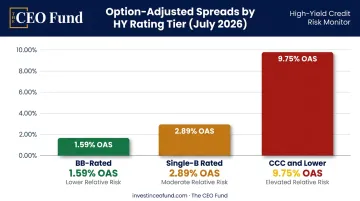
A BB issuer and a CCC issuer share a label but not a risk profile. For investors, that distinction shapes everything from expected return to appropriate position sizing.
Types of High-Yield Bond Structures
Not all high-yield bonds pay interest the same way. The structure chosen typically reflects the issuer's near-term cash position and the investor's preference for current income versus deferred return.
| Structure | How It Works |
|---|---|
| PIK (Payment-in-Kind) | Interest accrues to principal instead of being paid in cash — useful for issuers with tight near-term liquidity |
| Step-Up | Coupon starts lower and increases at scheduled intervals, rewarding investors who hold through each reset date |
| Zero-Coupon | Issued at a steep discount with no periodic interest; profit comes from price appreciation to face value at maturity |
| Convertible | Allows the bondholder to convert debt into equity shares under agreed terms — adds upside exposure to company performance |
| Tax-Exempt HY Municipal | Below-investment-grade municipal debt; interest is often excluded from federal gross income (subject to the specific issue's tax status) — structurally distinct from corporate HY bonds |
PIK bonds appear most often in leveraged buyout financing, where early operating cash flow leaves little room for cash interest payments. Zero-coupon bonds trade current income for price appreciation, while convertibles add equity upside — both suit investors with longer time horizons and lower near-term income needs. Tax-exempt HY municipal bonds operate in an entirely separate market governed by municipal credit dynamics and tax treatment, making direct comparisons to corporate issuances unreliable.
High-Yield Bonds vs. Investment-Grade Bonds
Credit risk is the fundamental dividing line between these two bond categories — and it shapes everything from coupon rates to how each asset class responds to economic shifts.
Investment-grade bonds (BBB−/Baa3 and above) carry lower default probability and lower coupon rates, with prices that move primarily in response to interest rate changes. As of July 9, 2026, the broad U.S. investment-grade corporate index yielded 5.27%, with BBB-rated bonds at 5.45%.
High-yield bonds pay more to compensate for that added risk: the broad HY index yielded 6.98% on the same date. Their prices, though, respond more to corporate earnings and the economic outlook than to rate movements alone. CFA Institute's analysis puts a number on it: effective duration explained 82.2% of price change variance for A-rated bonds in June 2016, but only 9.5% for B-rated issues.
Behavior Across Economic Cycles
- Rising rate environment: Investment-grade bonds suffer more from duration exposure; HY bonds are insulated by their credit-spread dynamics
- Economic expansion: HY bonds tend to perform well alongside equities as corporate cash flows improve
- Recession: HY bonds sell off sharply — default rates spike, spreads widen, and the asset class behaves more like equities than fixed income
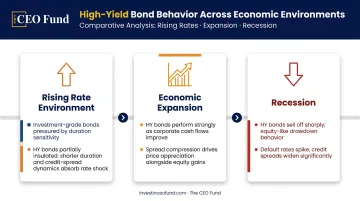
That equity-like behavior during downturns is a critical portfolio construction point: HY bonds offer yield, not stability, which is why they don't replace investment-grade fixed income in a defensive allocation.
Benefits of Investing in High-Yield Bonds
Enhanced Income
The yield premium is the primary draw. At current levels, HY bonds pay roughly 244 basis points more than both investment-grade corporates and the 10-year Treasury — the same spread applied against each benchmark. For income-focused investors — particularly those in or near retirement — that additional yield compounds meaningfully over time.
The ICE BofA U.S. High Yield Index delivered 6.97% annualized returns during 1997–2016, per CFA Institute data, driven heavily by coupon income.
Diversification Within Fixed Income
HY bonds historically exhibit lower correlation to Treasuries and investment-grade corporates than those two sectors show to each other. Adding HY exposure to a bond-heavy portfolio can reduce overall rate sensitivity — though that diversification benefit shrinks during recessions, when HY bonds correlate more closely with equities.
Capital Appreciation
If an issuer's financial position improves — through a ratings upgrade, better earnings, or a strategic acquisition — its bond prices can rise significantly. Rising stars generate return beyond just coupon income. Taken together, these three benefits — income, diversification, and price appreciation — explain why HY bonds attract both active managers and income-focused portfolio builders alike.
Investors who weigh these benefits alongside the associated risks (credit risk, liquidity constraints, and rate sensitivity) are better positioned to decide how much HY exposure makes sense for their specific allocation goals.
Key Risks Every Investor Should Know
High-yield bonds carry four distinct risks that tend to compound each other during downturns. Understanding each one is essential before allocating capital.
Default Risk
Default remains the most consequential risk in high-yield investing. When an issuer fails to make interest or principal payments, recovery depends on bond seniority, collateral availability, and market conditions. S&P data shows senior secured bonds recovering 57.6% (mean) and 58.9% (median) — but unsecured bondholders often recover considerably less.
Default rates spike during downturns. Fitch reported a trailing-12-month U.S. HY default rate of 5.5% in October 2020, reflecting pandemic-era corporate stress. In normal economic periods, annual default rates run considerably lower — but the potential for sudden spikes makes diversification across issuers essential.
Volatility and Market Risk
HY bond prices move like a hybrid between bonds and equities. In March 2016, 83% of single-B issues had returns spanning a 14-percentage-point range within the month — from -2% to +12%. That's not bond-like behavior.
Don't hold HY as a low-risk defensive position — when markets deteriorate, it tends to sell off alongside equities, not hold steady like traditional bonds.
Interest Rate Risk
Rising rates push bond prices down. HY bonds are less duration-sensitive than long-maturity investment-grade bonds — but they're not immune. The real danger is a rising-rate environment that coincides with economic slowdown: credit spreads widen at the same time prices fall from rate pressure, compounding the loss.
Liquidity Risk
The HY market is less liquid than investment-grade, particularly under stress. Federal Reserve research on the March 2020 corporate bond market dislocation found that bond mutual fund outflows exceeded $250 billion — roughly 5% of AUM — in a matter of weeks. The downstream effects were swift:
- Transaction costs surged as dealers widened bid-ask spreads
- Redemption pressure forced fund managers to sell at distressed prices
- ETFs and mutual funds — often perceived as liquid — carried meaningful redemption risk throughout the dislocation
How to Invest in High-Yield Bonds
Access Routes
1. Direct bond purchase — Available through broker-dealers for institutional or sophisticated investors. Requires deep credit analysis, access to offering documents, and the ability to build sufficient issuer diversification. Most individual investors lack the resources to do this effectively.
2. Pooled vehicles (funds and ETFs) — The practical route for most investors. Examples include HYG (iShares iBoxx $ High Yield Corporate Bond ETF, with $16.7 billion in net assets as of July 10, 2026) and JNK (SPDR Bloomberg High Yield Bond ETF, with $7.4 billion in AUM as of July 9, 2026). These provide instant diversification across dozens of issuers and sectors.
Funds reduce single-issuer default exposure significantly — but they don't eliminate market or liquidity risk during stress periods.
Due Diligence Framework
Before investing in an HY bond or fund, evaluate:
- Issuer leverage ratios and free cash flow — Can the company service its debt?
- Covenant protections — Does the bond include meaningful lender protections?
- Credit rating and recent changes — Any recent downgrades signal deteriorating credit
- Fund expense ratio and duration — Lower expenses and appropriate duration for your horizon
- Historical default experience — How has the fund manager navigated past credit cycles?
A Real Asset Alternative for Accredited Investors
Accredited investors who want high-yield income without unsecured corporate credit risk have another option: private real estate-backed credit strategies.
The CEO Fund, for example, acquires mortgage notes — performing and non-performing — secured by real property across 50+ states. Investors receive monthly income backed by tangible collateral (single-family homes, multifamily properties, commercial real estate), with the legal right to foreclose on the underlying asset in the event of borrower default.
That's structurally different from an unsecured corporate HY bond:
- Corporate HY bond default: Recovery depends on bankruptcy proceedings and creditor priority ranking
- Mortgage note default: Lender holds the right to foreclose on the underlying real property
- Income source: Monthly mortgage payments from borrowers, not corporate earnings
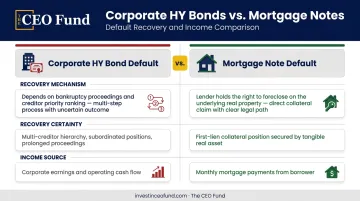
One documented position in the fund's portfolio — a Florida townhome with a market value of $115,000 — generated monthly payments of $764.39 against an unpaid balance of $92,100, producing a 10% ROI for the note holder. No tenants, no property management, no correlation to equity markets. For accredited investors weighing yield against collateral protection, mortgage note investing through a fund like The CEO Fund can serve as a complement to — or partial substitute for — a traditional HY bond allocation.
Frequently Asked Questions
What is the difference between high-yield bonds and investment-grade bonds?
Investment-grade bonds are rated BBB−/Baa3 or above and carry lower default risk, lower coupon rates, and prices driven primarily by interest rate movements. High-yield bonds fall below those thresholds, paying higher interest to compensate for meaningfully greater default probability and price volatility.
What credit rating classifies a bond as high yield?
A bond is classified as high yield when rated below BBB− by S&P or Fitch, or below Baa3 by Moody's — also called sub-investment-grade or speculative-grade. FINRA uses the same boundary, defining HY as Ba1/BB+ or lower.
What are the biggest risks of investing in high-yield bonds?
The four core risks are default risk, price volatility, interest rate risk, and liquidity risk. Of these, default risk and liquidity risk tend to hit hardest during market stress — issuers may fail to pay while positions become difficult to exit at fair value.
Are high-yield bonds a good investment for retirement accounts?
HY bonds can be held in self-directed IRAs or 401(k)s through ETFs and mutual funds, but their volatility and default risk make them better suited as a smaller allocation within a diversified retirement portfolio — not a core holding.
What happens to high-yield bonds during a recession?
Recessions typically cause HY bond prices to fall sharply and default rates to rise, as corporate revenues shrink and weaker issuers struggle to service debt. The asset class becomes more correlated with equities during downturns, reducing its defensive value.
How much will $10,000 make in a high-yield savings account?
A high-yield savings account is a bank deposit — not a bond — protected by FDIC insurance. Bankrate cited a national average of 0.61% APY for July 2026, meaning $10,000 earns roughly $61 annually — far below HY bond yields, but with no default or market risk.