

Introduction
Private investment markets — hedge funds, venture capital, private mortgage note funds — remain closed to most Americans. Not because of wealth alone, but because of a specific legal designation: accredited investor status.
Many high-net-worth individuals assume they qualify. Others with significant professional credentials don't realize they may already meet the bar. The SEC's 2020 rule amendments expanded who counts — and H.R. 3394, which passed the House in 2025 with a 397–12 vote, could expand the definition further before 2026 is out.
According to SEC staff data, 24.3 million U.S. households — roughly 18.5% — met at least one financial criterion as of 2022. That number could grow meaningfully if pending legislation clears the Senate.
This guide covers the full 2026 requirements: individual and entity qualification pathways, current regulatory status, verification procedures, and what investment opportunities become available once you qualify.
Key Takeaways
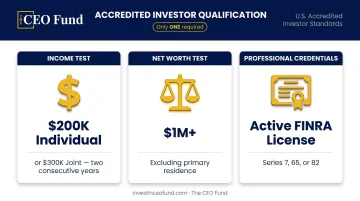
- Individuals qualify via income ($200K individual / $300K joint, two consecutive years), net worth ($1M+ excluding primary residence), or an active Series 7, 65, or 82 license
- Entities qualify through $5M+ in assets/investments or by being wholly owned by accredited investors
- Existing Rule 501 thresholds remain unchanged as of 2026 (H.R. 3394 passed the House in June 2025 but still awaits Senate approval)
- Verification is handled by the private offering's issuer, not the SEC, using documents dated within the prior three months
- Accredited status opens access to private placements, hedge funds, venture capital, and mortgage note funds
What Is an Accredited Investor?
An accredited investor is an individual or entity the SEC permits to invest in unregistered securities under Rule 501 of Regulation D, based on the presumption that they have the financial sophistication and resources to evaluate and absorb potential losses without the same regulatory protections extended to retail investors.
The Securities Act of 1933 created investor protections for the general public. The accredited investor classification identifies those for whom the SEC considers those protections less necessary — they're deemed capable of evaluating risk on their own terms, without needing the same regulatory guardrails.
One important distinction: accredited investor status is separate from qualified purchaser status. The two differ in a few key ways:
- Accredited investors qualify based on income ($200K+/yr individual, $300K+ with spouse) or net worth ($1M+ excluding primary residence) under Regulation D
- Qualified purchasers face a higher bar under the Investment Company Act, requiring $5M+ in investments, and access a broader universe of private funds
Understanding where you fall on this spectrum determines which private offerings — including mortgage note funds and real estate syndications — are available to you.
2026 Accredited Investor Requirements for Individuals
Individual investors can qualify through one of three pathways. Only one needs to be satisfied.
Pathway 1: Income Test
An individual must have earned more than $200,000 in each of the two most recent calendar years, with a reasonable expectation of reaching the same level in the current year. For married couples or spousal equivalents, the joint threshold is $300,000 for both prior years.
One common compliance error: you cannot mix individual income one year with joint income the next to meet the threshold. The test must be satisfied consistently under the same filing approach.
As of 2026, H.R. 3394's proposed CPI adjustment to these figures has not been enacted. The $200K/$300K thresholds remain in force unchanged.
Pathway 2: Net Worth Test
The threshold is $1 million in net worth, calculated as total assets minus total liabilities, with one specific exclusion: the value of your primary residence is not counted.
Primary residence mortgage treatment follows specific rules:
- Debt secured by the primary residence is excluded as a liability up to the home's fair market value
- Any debt exceeding the home's fair market value is counted as a liability
- Increases in secured debt on the primary residence during the 60 days before the securities purchase are generally counted as a liability, even if total debt stays below fair market value
Example: An investor earns $150,000 annually — below the income threshold — but holds $400,000 in brokerage accounts, $250,000 in retirement accounts, a rental property worth $500,000 with a $150,000 mortgage, and $100,000 in other liabilities. Net worth calculation: ($400K + $250K + $500K) minus ($150K + $100K) = $900,000 — just below the threshold. If the rental property has appreciated or the investor holds additional savings, they cross $1M and qualify.
Pathway 3: Professional Credentials
Since December 8, 2020, individuals holding active FINRA licenses in good standing can qualify regardless of income or net worth:
- Series 7 — General Securities Representative
- Series 65 — Investment Adviser Representative
- Series 82 — Private Securities Offerings Representative
Note that Series 65 alone is insufficient without the applicable active state registration in good standing.
Separate from the license pathways, knowledgeable employees of private funds under Rule 3c-5 — including affiliated management persons and those directly involved in investment activities — may qualify as accredited investors specifically for investments in that fund.
How Entities Qualify as Accredited Investors in 2026
Entities have more qualification routes than most people realize. The $5M and all-owner tests are the most cited, but status-based categories also apply.
Asset-Based and Ownership-Based Routes
| Route | Requirement |
|---|---|
| Corporations, partnerships, LLCs, 501(c)(3)s | More than $5M in total assets; not formed to acquire the specific offering |
| Trusts | More than $5M in total assets; purchase directed by a financially sophisticated person |
| Catch-all entities | More than $5M in investments; not formed for the specific purchase |
| Family offices | More than $5M AUM; investment directed by a capable evaluator |
| All-equity-owner route | Every equity owner is individually accredited |
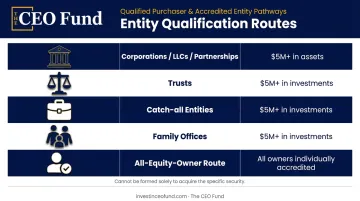
Critical restriction: an entity cannot be formed solely for the purpose of acquiring a specific security. This applies across all asset-based categories.
Status-Based Institutional Qualifiers
These institutions qualify by regulatory status alone, with no asset test required:
- Banks, savings associations, trust companies, insurance companies
- Registered investment companies and business development companies
- SEC-registered broker-dealers and registered investment advisers
- State-registered advisers and exempt reporting advisers
What Changed in 2020
The 2020 SEC amendments expanded entity access in three meaningful ways:
- LLCs explicitly added to Rule 501(a)(3) — any LLC, regardless of formation date, can now qualify through the asset-based route
- Catch-all entity category created for entities with more than $5M in investments not formed for a specific purchase
- Family offices and family clients added as distinct qualifying categories
These changes brought a broader range of private wealth structures — including multi-generational family entities — within reach of private offerings.
2025–2026 Regulatory Updates
H.R. 3394: Passed the House, Pending the Senate
The Fair Investment Opportunities for Professional Experts Act passed the House on June 23, 2025, by a 397–12 vote — a notably bipartisan margin. As of July 2026, Congress.gov shows the bill was referred to the Senate Committee on Banking, Housing, and Urban Affairs on June 24, 2025, with no Senate passage or presidential signature recorded. The bill is pending, not enacted.
If passed, H.R. 3394 would add a fourth individual qualification pathway: demonstrable education or job experience establishing professional knowledge related to a particular investment, verified by a registered national securities association.
Proposed Inflation Adjustments
The bill also proposes CPI-U adjustments to the $1M net worth and $200K/$300K income thresholds every five years, rounded to the nearest $10,000. Since the bill hasn't been enacted, no adjusted thresholds are currently in force. The existing figures are the first potential adjustment since they were originally set.
What This Means for Participation
The current accredited investor pool is already substantial — and H.R. 3394 could expand it further:
- The SEC estimates 18.5% of U.S. households met at least one financial criterion as of 2022
- The 2020 amendments identified roughly 691,000 FINRA-registered individuals who could potentially qualify through the credentials pathway
- No authoritative estimate of the additional population the education/experience expansion would reach has been published
For investors who don't hold qualifying licenses or credentials, the core financial thresholds remain unchanged in 2026.
How to Verify Your Accredited Investor Status
There is no SEC application. Accreditation is confirmed by the issuer of the private offering, who must take reasonable steps to verify accredited status before allowing an investor into a Rule 506(c) private placement.
Income Verification Documents
For income-based qualification, acceptable IRS forms covering the two most recent calendar years include:
- W-2 forms
- Form 1099
- Schedule K-1 (Form 1065)
- Form 1040 (or any combination of the above)
A written representation that the investor reasonably expects to meet the income threshold in the current year is also required.
Net Worth Verification Documents
Rule 506(c) specifies that net worth verification requires:
- Bank and brokerage account statements
- Securities holdings records
- Certificates of deposit, tax assessments, or appraisal reports
- A nationwide consumer reporting agency (credit) report to document all outstanding liabilities
- A written disclosure of all liabilities not appearing in the credit report
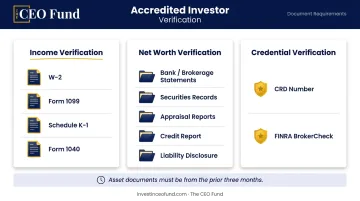
All asset documentation must be from the prior three months (the regulation uses this phrase, not a fixed 90-day count).
Professional Credential Verification
For Series 7, 65, or 82 holders, provide your CRD (Central Registration Depository) number — issuers can confirm active status directly through FINRA's BrokerCheck or the SEC's Investment Adviser Public Disclosure database. No financial documentation is required.
A separate route is available to any investor: a written accreditation letter from a qualified third party. Under Rule 506(c), this letter serves as a safe-harbor verification method as long as it was issued within the prior three months. Accepted third-party sources include:
- Licensed CPAs
- Attorneys
- Registered investment advisers
- Registered broker-dealers
What Can Accredited Investors Invest In?
Accredited status opens a distinct tier of the investment market that's simply unavailable through retail brokerage accounts.
Private Investment Categories
- Private placements — direct equity in early-stage or pre-IPO companies under Rule 506(c)
- **Venture capital and private equity funds** — institutional-grade fund structures
- Hedge funds — actively managed, strategy-diverse alternative funds
- Real estate crowdfunding — platforms restricted to accredited participants
- Real estate syndications — pooled investments in specific properties or development projects
Alternative Asset Classes
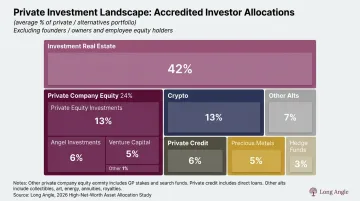
Private credit, mortgage note funds, and specialty funds represent a growing portion of accredited investor capital. The CEO Fund, for example, is a private mortgage note investment fund open exclusively to accredited investors. It acquires performing and non-performing mortgage notes across the U.S., with investors functioning as the lender rather than the landlord — receiving passive monthly income without property management responsibilities. Target returns run in the 8–12% annual range.
Why these investments are restricted: The lender-not-landlord model is one reason funds like these appeal to high-net-worth investors — but the access comes with real trade-offs. Private offerings carry higher risk, disclose less than public securities, and are often illiquid. Accredited status indicates the investor has the financial capacity to take on those conditions — it doesn't eliminate risk. Thorough due diligence remains essential regardless of status.
Frequently Asked Questions
What are the current requirements to be an accredited investor?
Individuals must meet one of three tests: income above $200,000 individually (or $300,000 with a spouse) for the past two years with the same expectation going forward; net worth above $1M excluding your primary residence; or an active Series 7, 65, or 82 FINRA license in good standing. Entities qualify separately — see the entity question below.
How do I check if I am an accredited investor?
There's no formal SEC application. You self-assess against the qualifying criteria, then provide supporting documentation — tax returns, financial statements, or license records — to the issuer of the private investment you wish to access. The issuer verifies your status under Regulation D.
Does my primary residence count toward the $1 million net worth requirement?
No. Your primary residence is explicitly excluded under SEC rules. Financial assets (brokerage accounts, savings, retirement accounts) and other real estate you own count toward the $1M threshold — but any liabilities tied to those assets, such as a mortgage on a second property, are subtracted from the total.
Can an entity qualify as an accredited investor?
Yes — provided the entity wasn't formed solely to make the specific investment. Corporations, LLCs, partnerships, trusts, and family offices qualify if they hold $5M+ in investments or assets, or if every equity owner is individually accredited.
What is the difference between an accredited investor and a qualified purchaser?
Accredited investor is the baseline standard required for most Regulation D private offerings. Qualified purchaser is a higher classification — generally requiring $5M+ in investments — that unlocks access to an even broader range of private funds not available to accredited investors alone.