
That's a significant risk for anyone who hasn't taken time to understand the rules before investing.
This guide covers how self-directed IRAs work for real estate, the core rules every investor must follow, prohibited transactions to avoid, eligible investment types, and key tax considerations — including UBIT, RMDs, and Form 990-T.
Key Takeaways
- Your IRA — not you personally — owns all real estate, pays all expenses, and receives all income
- Transactions with "disqualified persons" (spouse, lineal family, yourself) are prohibited under IRC 4975
- Leveraged real estate in an SDIRA may trigger Unrelated Business Income Tax (UBIT)
- Mortgage note funds and similar passive vehicles avoid many direct-ownership compliance pitfalls, including UBIT exposure
- A single prohibited transaction can disqualify your entire account — triggering full income tax and early withdrawal penalties
How a Self-Directed IRA Works for Real Estate
A self-directed IRA (SDIRA) is a retirement account that allows investment in alternative assets — real estate, mortgage notes, tax liens, private placements — while retaining the same tax advantages as a standard IRA. Traditional SDIRAs offer tax-deferred growth; Roth SDIRAs offer potentially tax-free growth when IRS qualification requirements are met. Traditional SDIRAs offer tax-deferred growth; Roth SDIRAs offer potentially tax-free growth when IRS qualification requirements are met. That tax structure applies to every asset the IRA holds — including real property and notes — which is what makes the legal separation between you and your IRA so consequential.
The IRA as a Separate Legal Entity
The IRA is a separate legal entity, not an extension of you personally. Property titles, contracts, and legal agreements must reflect the IRA as the owner, not the individual investor. Every transaction that blurs this line creates compliance risk.
Correct titling follows this format: "[Custodian Name] FBO [Your Name] IRA [Account Number]"
For example, The Entrust Group uses: "The Entrust Group, Inc. FBO [Owner Name] [Account Number]." Any deviation from proper titling creates compliance risk from day one.
The Custodian's Role
SDIRAs require a qualified IRA trustee or custodian — one willing and equipped to administer directly held real estate. Standard brokerages typically don't accommodate this. Custodians like Equity Trust and The Entrust Group specialize in alternative asset administration, handling transaction facilitation, asset titling, and compliance recordkeeping.
Custodians do not provide investment advice. Due diligence is entirely the investor's responsibility.
How Income and Expenses Must Flow
Every dollar that touches IRA-owned property must stay within the IRA structure. That means:
- Rental income, sale proceeds, and interest payments flow directly back into the SDIRA
- All property expenses are paid from SDIRA funds
- Repairs, taxes, insurance, and management fees must not come from personal accounts
- Routing any funds through the investor personally triggers compliance risk
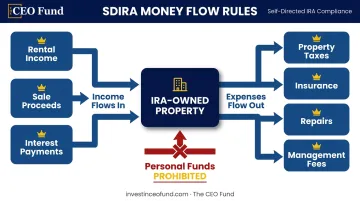
The logic is straightforward: the IRA owns the asset, so the IRA handles the money.
Traditional vs. Roth SDIRA:
| Account Type | Tax Treatment | Best For |
|---|---|---|
| Traditional SDIRA | Tax-deferred; taxed on distribution | Investors expecting lower tax rates in retirement |
| Roth SDIRA | Potentially tax-free if qualified | Long-hold properties with significant appreciation |
The 6 Core Self-Directed IRA Real Estate Rules
Rule 1 — The IRA Owns the Property
Title must be held in the IRA's name from the date of purchase. The investor cannot personally own, co-own, or claim any ownership interest outside the account structure.
Rule 2 — No Personal Use or Benefit
The IRA exists to generate retirement income — not present-day benefits. IRS guidance on prohibited transactions explicitly prohibits using IRA assets for the benefit of the account holder or any disqualified person. This includes:
- Vacationing at an IRA-owned property
- Operating your business from an IRA-owned building
- Allowing a family member to reside in the property — even at fair market rent
Rule 3 — All Expenses Come from the IRA
Every cost associated with the property must be paid by the SDIRA:
- Property taxes and HOA fees
- Insurance premiums
- Maintenance, utilities, and repairs
- Closing costs
If the IRA runs low on cash, the investor cannot personally cover shortfalls. Doing so constitutes a prohibited transaction.
Rule 4 — No Personal Labor on the Property
The account holder cannot perform any services on an IRA-owned property — repairs, renovations, or property management. IRC 4975(c)(1)(C) bars furnishing goods or services between a plan and a disqualified person. All work must be performed by independent, third-party contractors paid from IRA funds.
Rule 5 — Leverage Requires Non-Recourse Loans Only
Debt financing is permitted, but the loan must be structured as a non-recourse loan — meaning the lender's only recourse is the IRA-owned property itself, not the investor's personal assets. Per DOL Advisory Opinion 2011-04A, a personal guarantee on a loan constitutes a prohibited extension of credit between the investor and the plan.
Rule 6 — Co-Investments Require Proportional Splits
If the SDIRA co-invests with another party — another IRA, personal funds, or outside investors — income and expenses must flow to each party in exact proportion to their ownership percentage, fixed at acquisition. Adjusting those percentages after closing triggers prohibited transaction risk.
Prohibited Transactions and Disqualified Persons
Who Is a Disqualified Person?
IRC 4975(e)(2) defines disqualified persons to include:
- The IRA owner
- Their spouse
- Lineal ancestors (parents, grandparents)
- Lineal descendants (children, grandchildren) and their spouses
- Fiduciaries and entities in which the owner holds a significant ownership stake (50%+ for employers; 10%+ for shareholders/partners)
Siblings are not included in the statutory family definition — though a sibling could still become disqualified through another role (service provider, significant ownership stake, etc.).
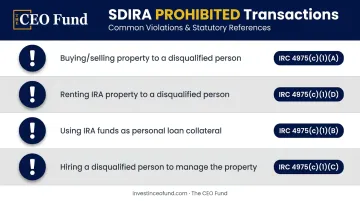
Most Common Prohibited Transactions
| Transaction Type | Statutory Basis |
|---|---|
| Buying/selling property to/from a disqualified person | IRC 4975(c)(1)(A) |
| Renting IRA property to a disqualified person | IRC 4975(c)(1)(D) |
| Using IRA funds as personal loan collateral | IRC 4975(c)(1)(B) |
| Hiring a disqualified person to manage the property | IRC 4975(c)(1)(C) |
The Consequences of a Prohibited Transaction
Any of the transactions above can trigger severe tax consequences — and the penalty isn't a fine. When the IRS identifies a prohibited transaction, the IRA loses its tax-advantaged status as of January 1 of the year the transaction occurred. The account's assets are treated as distributed at fair market value on that date.
For a Traditional IRA, that typically means:
- Ordinary income tax on the full distributed amount
- 10% early withdrawal penalty under IRC 72(t) if the investor is under 59½
Scenario: An investor holds a rental property inside their SDIRA, then allows their adult daughter to move in — even at market-rate rent. Because adult children are lineal descendants and therefore disqualified persons, this creates a prohibited transaction the moment the lease is signed. The entire account's tax-advantaged status is forfeit from January 1 of that year.
Types of Real Estate Investments Available in a Self-Directed IRA
Active/Direct Ownership Options
Direct property investments eligible for SDIRAs include:
- Single-family and multifamily rentals
- Commercial properties
- Raw land and farmland
- Fix-and-flip projects (subject to third-party contractor requirements)
These offer meaningful appreciation potential but carry the highest compliance complexity. These offer meaningful appreciation potential but carry the highest compliance complexity. Ongoing expenses, maintenance decisions, and the constant need for third-party management all create opportunities for a prohibited transaction to occur inadvertently.
Passive Real Estate Investment Options
Passive structures — mortgage notes, real estate syndications, tax liens, and real estate crowdfunding — allow the SDIRA to generate real estate-backed returns without direct property ownership.
With mortgage note investing, the IRA acts as the lender. Borrowers make monthly payments; those payments flow directly back into the account. No tenants, no maintenance calls, no property tax remittances from IRA funds. The compliance footprint is far smaller.
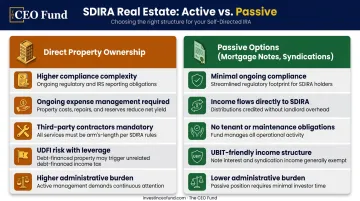
For accredited investors seeking this kind of passive, SDIRA-compatible exposure, The CEO Fund is a professionally managed mortgage note fund based in Miramar, FL that delivers consistent monthly returns backed by real estate collateral. The management team handles all acquisition, portfolio management, and operational decisions — investors face no ongoing compliance obligations after the initial investment.
Monthly cash flows deposit directly into the investor's SDIRA account, preserving tax-advantaged status. Accredited investors can learn more at investinceofund.com.
Tax Considerations: UBIT, RMDs, and Form 990-T
Unrelated Business Income Tax (UBIT)
Rent from real property is excluded from UBIT under IRC 512(b)(3). However, when an SDIRA uses a non-recourse loan to purchase property, IRC 514 brings the debt-financed portion of income into Unrelated Debt-Financed Income (UDFI) — which is taxable even inside a tax-advantaged account.
Key points:
- UDFI is calculated as the ratio of average acquisition debt to average adjusted basis
- The IRS allows depreciation deductions at the same debt-financed percentage, partially offsetting liability
- IRA trusts are taxed at trust rates — the top rate is 37% for 2026 per IRS Form 1041-ES
Pure interest income from mortgage notes falls outside UBIT — one structural reason passive note fund investing is tax-advantaged by design. If a fund uses leverage at the fund level, though, UDFI exposure can still flow through to SDIRA investors. Always confirm a fund's leverage practices with a qualified tax advisor before committing capital.
Required Minimum Distributions (RMDs)
Beyond income taxes, SDIRA holders must manage annual distribution obligations. RMD rules require distributions based on the total fair market value of the IRA — including illiquid assets like real estate. This creates two practical problems:
- Annual appraisal requirements — illiquid property must be valued each year for RMD calculation purposes
- Liquidity risk — if the primary IRA asset is a non-income-producing property, funding RMDs may require selling assets
RMD age reference:
- Born before 1960: RMDs begin at age 73
- Born in 1960 or later: RMDs begin at age 75 (per SECURE 2.0)
- Roth IRA owners: no lifetime RMD requirement
Form 990-T
When SDIRA-generated income exceeds $1,000 in unrelated business gross income, Form 990-T must be filed. Key filing requirements include:
- Income threshold: $1,000 in unrelated business gross income triggers the filing obligation
- Deadline: The 15th day of the fourth month following year-end for calendar-year IRA trusts
- EIN requirement: The IRA must have its own Employer Identification Number
- Payment source: Any tax owed is paid from IRA funds — not out of pocket by the investor
- Compliance responsibility: The account holder bears this obligation; custodians may assist with preparation but are not liable for filing
When evaluating fund investments, check whether the custodian offers Form 990-T filing support — it's a meaningful factor if UDFI exposure is likely.
Getting Started with Self-Directed IRA Real Estate Investing
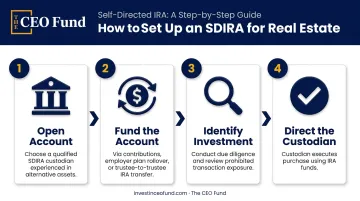
Setting up an SDIRA for real estate involves four steps:
- Open an account with a qualified SDIRA custodian experienced in alternative assets
- Fund the account via new contributions, a rollover from an employer plan, or a trustee-to-trustee transfer from an existing IRA
- Identify your investment and conduct due diligence — including reviewing prohibited transaction exposure specific to your situation
- Direct the custodian to execute the purchase using IRA funds
Before executing any transaction, work with a tax attorney or CPA experienced in SDIRA rules. Mistakes in this area are largely irreversible and can be expensive.
That professional guidance becomes especially important once you understand how much compliance responsibility varies by investment structure. Direct property investors must route every expense, maintenance decision, and third-party management obligation through the IRA — all documented, all traceable.
Passive investors in mortgage note funds or syndications carry far fewer ongoing obligations by design. That structural simplicity makes it easier to stay compliant over the long term without constant administrative oversight.
Frequently Asked Questions
Can I use my IRA to invest in real estate?
Yes — through a self-directed IRA, not a standard brokerage account. You'll need to use a qualified SDIRA custodian who can administer alternative assets. The IRA owns the property, and all income and expenses must flow through the account, never through you personally.
What is the 7% rule in real estate?
The "7% rule" is an informal investor heuristic — not an IRS standard — suggesting a rental property should generate roughly 7% gross annual income relative to its purchase price. For SDIRA investors, raw return metrics must also account for compliance requirements and liquidity constraints before committing capital.
What types of real estate can a self-directed IRA own?
Eligible assets include residential rentals, commercial property, raw land, farmland, mortgage notes, tax liens, and real estate syndications. Personal use by the account holder, any disqualified person, or through owner-use arrangements like timeshares creates prohibited transaction risk under IRC 4975.
What happens if you violate self-directed IRA real estate rules?
A prohibited transaction triggers account disqualification under IRC 408(e)(2) as of January 1 of that year. The entire account balance is treated as a taxable distribution, triggering income tax liability plus a 10% early withdrawal penalty under IRC 72(t) for investors under 59½.
Can I use leverage to buy real estate in my self-directed IRA?
Yes, but only through non-recourse loans — where the lender's recourse is limited to the IRA-owned property, not your personal assets. Leveraged income triggers UDFI, a subset of UBIT, which must be reported and paid from IRA funds via Form 990-T.
What is the difference between a Traditional and Roth SDIRA for real estate?
Traditional SDIRA growth is tax-deferred — you pay taxes on distribution. Roth SDIRA growth is potentially tax-free once the account meets IRS holding period and age requirements, which makes the Roth structure particularly advantageous for long-hold real estate that appreciates significantly over decades.