

Introduction
Most people assume that owning a rental property automatically means earning passive income. It doesn't. Fielding maintenance calls at midnight, screening tenants, and chasing down late rent checks is a job — not a passive income stream.
True passive real estate income means your capital works for you while professionals handle everything else. The distinction matters enormously, both financially and from a tax standpoint.
That distinction hasn't been lost on serious capital allocators. According to McKinsey's Global Private Markets Report, global closed-end real estate assets under management reached $1.7 trillion in June 2023 — up 13% year over year — reflecting sustained capital allocation into professionally managed real estate structures even as new fundraising slowed.
This guide breaks down what passive real estate income actually is, how money flows from asset to investor, and which structures are genuinely hands-off — versus which ones just sound that way.
Key Takeaways
- Passive real estate income is earned without managing tenants, properties, or operations — your role ends at capital deployment
- Equity-based structures (REITs, syndications) and debt-based structures (mortgage note funds) generate income through fundamentally different mechanisms
- Professional management is the dividing line between passive and active investing
- Tax-advantaged accounts like self-directed IRAs can meaningfully boost net returns by sheltering distributions from immediate taxation
- Before committing capital, vet the collateral quality, manager track record, and how distributions are structured and paid
What Is Passive Real Estate Income?
Passive real estate income is income generated from real estate assets without requiring the investor to manage operations, tenants, or maintenance. Professionals run the asset; investors receive distributions.
What It Is Not
Directly owning and managing a rental property — even with a property manager hired — is generally considered active investing. Under IRS Publication 925, rental activity is treated as passive for tax purposes, but the owner still bears full financial liability and must make ongoing decisions: lease disputes, repair approvals, debt refinancing. That's operational involvement, regardless of how it's labeled.
The distinction matters financially, too.
The IRS passive activity rules also note that rental losses above $25,000 phase out once modified AGI exceeds $100,000, disappearing entirely at $150,000 — further illustrating the complexity active landlords navigate that passive investors avoid entirely.
Why Passive Real Estate Income Exists
Real estate has historically offered compelling returns through rental income, appreciation, and inflation protection. The problem is the operational burden — what practitioners call the "3 T's": Tenants, Toilets, and Tiles.
Passive real estate structures solve this by separating capital from operations. Investors access real estate's return profile without becoming landlords.
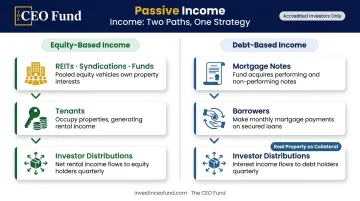
Two Ways Passive Income Is Generated
- Equity-based: Investors receive a share of rental income or property appreciation through funds, REITs, or syndications. Returns depend on occupancy, rental rates, and property values.
- Debt-based: Investors act as the lender. In mortgage note investing, borrowers make monthly mortgage payments — principal and interest — that flow directly back to investors, secured by real property as collateral. The CEO Fund operates on this model, acquiring diversified portfolios of performing and non-performing mortgage notes across 50+ states so investors receive real estate-backed income without owning a single property.
How Does Passive Real Estate Income Work?
Passive real estate income follows a defined sequence: capital is deployed, assets are professionally managed, income is generated by tenants or borrowers, and distributions flow to investors. The investor's meaningful role is concentrated at entry and exit — not in between.
Capital Deployment
A passive investor initiates their position by reviewing an offering, committing capital, and signing governing documents. This is when due diligence matters most — because once capital is deployed, the investor steps back.
Before committing, evaluate:
- Asset type and location — what backs the investment and where
- Manager track record — years of experience, historical performance, assets under management
- Distribution structure — preferred return, profit split, or fixed interest
- Collateral and lien position — FINRA advises investors to request proof when a note is described as secured, noting that collateral may not always be sufficient to cover full repayment
At The CEO Fund, the onboarding process involves verifying accredited investor status, reviewing fund documents, and consulting with the management team before capital is committed — so investors understand the asset before committing capital.
Income Generation
After capital is deployed, the asset does the work.
- Equity structures: Tenants pay rent, which funds operating expenses and generates distributions to investors
- Debt structures: Borrowers make monthly mortgage payments, from which interest income flows to investors
Professional asset managers handle acquisition, tenant placement or loan servicing, maintenance decisions, and portfolio optimization. Investors receive reporting, not phone calls.
Management and Oversight
Fund managers, note servicers, and syndication operators handle everything between capital deployment and distribution. That's what makes this passive. Core responsibilities include:
- Monitoring asset performance and managing vacancies or defaults
- Conducting workout negotiations on non-performing notes
- Overseeing collateral and making strategic decisions to protect capital
- Handling note servicing — functions that would otherwise fall to the investor directly
Distribution of Returns
Distributions are paid directly to the investor's account — savings account or self-directed IRA/401(k), depending on how the investment is structured. Distribution frequency and structure vary by vehicle and should be clearly defined in the offering documents before capital is committed.
A well-managed portfolio of performing mortgage notes or stabilized rental properties produces predictable distributions. Before committing capital, verify the fund's historical distribution record, manager experience, and how non-performing assets are handled — those details determine whether consistency holds.
Common Types of Passive Real Estate Income Vehicles
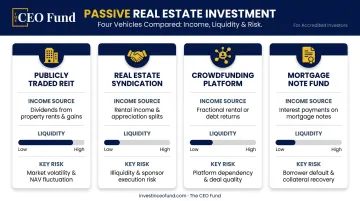
Each structure differs in how income is generated, how much liquidity it offers, and what type of investor it suits.
| Vehicle | Income Source | Liquidity | Key Risk |
|---|---|---|---|
| Publicly traded REIT | Rental income dividends | High (exchange-traded) | Market price volatility |
| Real estate syndication | Rental income / appreciation | Low (locked up) | Sponsor and project risk |
| Crowdfunding platform | Varies by project | Low to moderate | Platform and deal risk |
| Mortgage note fund | Borrower mortgage payments | Generally restricted | Credit and collateral risk |
Real Estate Investment Trusts (REITs)
REITs are publicly or privately traded companies that own income-producing real estate. Investors buy shares and receive dividends funded by rental income. By law, REITs must distribute at least 90% of taxable income to shareholders — which is why the FTSE Nareit All Equity REIT dividend yield has stayed consistent at 3.92%–3.97% from 2022 through 2024.
The tradeoff: publicly traded REITs reprice with the stock market. Listed REIT share prices fell 21.4% from the start of 2022 through December 2023 as interest rates rose — a reminder that liquid doesn't always mean stable. REIT dividends are also generally classified as portfolio income rather than passive-activity income under IRS rules, so the tax treatment differs from direct real estate investments.
Real Estate Syndications and Crowdfunding
Syndications pool capital from multiple investors to acquire a specific property or portfolio. One sponsor manages operations; investors participate as limited partners with no operational role. Under IRS rules, limited partners generally cannot establish material participation unless they satisfy specific tests — making syndication interests structurally passive for most investors.
Crowdfunding platforms lower the barrier to entry considerably. Two common examples:
- Fundrise — minimum $10; broadly accessible but limited liquidity
- CrowdStreet — minimum $25,000; targets accredited investors with institutional-quality deals
Performance on both depends heavily on the underlying deal and platform execution.
Mortgage Note Investing and Private Funds
Mortgage note investing is a debt-based passive income strategy. A fund acquires existing mortgage notes and receives monthly principal and interest payments from borrowers. The investment is secured by real property as collateral — giving investors bank-like returns without owning the underlying property.
Private real estate funds are not subject to the same 90% distribution requirement as REITs, giving fund managers more flexibility to deploy capital strategically. The CEO Fund, for example, acquires Grade A–C mortgage notes (both performing and non-performing) across 50+ states.
Investors act as "the bank" — collecting mortgage payments deposited directly into their savings or IRA accounts. There are no tenant management responsibilities, no repair obligations, and no property tax exposure.
Rental Properties with Professional Management
Some investors purchase physical properties and hire full-service property managers. This approach offers direct ownership but is generally considered semi-passive: the owner still bears full financial liability, must approve major decisions, and cannot fully transfer operational risk to a manager. For investors who want control over a specific asset, this tradeoff may be acceptable — but those prioritizing truly hands-off income typically find fund-based or note-based structures better suited to that goal.
Benefits and Risks of Passive Real Estate Investing
Core Benefits
- Consistent cash flow without operational involvement
- Real estate-backed security — tangible collateral versus paper assets
- Portfolio diversification beyond stocks and bonds
- Inflation protection as rents and property values tend to rise with inflation
- Tax advantages including depreciation deductions, 1031 exchanges, and self-directed IRA investing
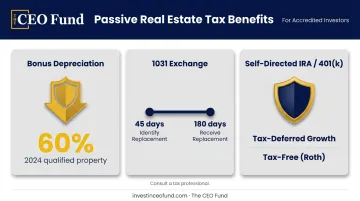
On the tax side: the IRS allows 60% bonus depreciation on qualified property placed in service in 2024. Section 1031 exchanges defer recognized capital gains on like-kind real property, with replacement property identified within 45 days and received within 180 days. These benefits can boost net returns — but their availability depends on how the investment is structured, so consulting a tax professional is essential.
Those tax advantages, however, come with trade-offs that every investor should understand before committing capital.
Key Risks to Evaluate
- Illiquidity: Private structures typically lock capital for a defined term — understand the redemption terms before committing
- Manager dependence: Returns in any passive vehicle depend on the manager's skill. A 10-year track record and institutional-grade due diligence process matter more than projected return percentages
- Market risk: Rising interest rates compress property values and affect borrower behavior in mortgage note portfolios; listed REITs lost value dramatically faster than private market valuations during 2022–2023
- Tax complexity in IRAs: UBTI or debt-financed income can trigger current tax inside an IRA — even in accounts that otherwise grow tax-deferred. Not all passive investments are equally IRA-efficient
Self-directed IRAs and solo 401(k)s allow investors to hold alternative assets including private real estate funds and mortgage notes. The CEO Fund is structured to accept IRA capital, with Inspira Financial as an affiliated custodian — but confirm the specific tax treatment with a qualified advisor before assuming any distribution is automatically sheltered.
Conclusion
Passive real estate income is a structured approach: capital is deployed into real estate assets, income flows through a defined distribution mechanism, and the investor's only ongoing role is reviewing performance and collecting returns. No tenants, no maintenance calls, no property management.
The right vehicle depends on liquidity needs, income goals, risk tolerance, and accredited investor status. REITs offer maximum liquidity. Syndications offer equity upside on specific assets. Mortgage note funds like The CEO Fund offer debt-backed monthly income with no property management responsibilities. Investors hold a lender position — secured by real estate collateral — rather than a landlord position.
Before committing capital to any passive vehicle, evaluate the manager's track record, the quality and lien position of underlying collateral, and how distributions are structured. Those three questions, answered honestly, will tell you more about a fund's real risk profile than any marketing materials will.
Frequently Asked Questions
What is the best type of real estate for passive income?
It depends on your goals. Mortgage note funds offer predictable monthly income backed by real estate collateral with no property management required. Equity syndications may offer higher appreciation potential. Accredited investors generally find private funds deliver stronger risk-adjusted returns than public market alternatives.
How can I make $1,000 a month in passive income from real estate?
At an 8% annual yield, approximately $150,000 invested generates $1,000 per month. Mortgage note funds and private real estate funds can produce distributions in that range without requiring property ownership — though returns vary by vehicle and are not guaranteed.
Is passive real estate income truly passive?
Only if the vehicle is managed entirely by professionals. REITs, private funds, and mortgage note funds qualify. Directly owned rental properties — even with a property manager — still require owner decision-making and carry full financial liability, making them semi-passive at best.
What are the tax benefits of passive real estate investing?
Key advantages include depreciation deductions, 1031 exchanges to defer capital gains, and self-directed IRA or 401(k) investing for tax-deferred or tax-free growth. How these apply depends on your investment structure — consult a tax professional.
How much capital do I need to start earning passive real estate income?
Entry points vary widely. Crowdfunding platforms start as low as $10–$25,000. Private funds and mortgage note investments typically require accredited investor status and higher minimums — but generally offer stronger asset backing and more predictable distributions.
Can I invest in real estate passively through my IRA or 401(k)?
Yes. Self-directed IRAs and solo 401(k)s can hold alternative assets including private real estate funds and mortgage notes. Returns compound tax-deferred (traditional accounts) or tax-free (Roth accounts). Unrelated Business Taxable Income (UBTI) rules may apply in certain structures, so review the fund's tax profile with a qualified advisor before investing.