A Roth IRA is funded with after-tax dollars, meaning qualified withdrawals in retirement are completely tax-free. But the tax advantage alone doesn't build wealth. Growth comes from a combination of consistent contributions, smart investment selection, and the compounding of gains over time — all happening within a tax-free wrapper that lets every dollar work harder.
This guide breaks down exactly how a Roth IRA grows, what drives its returns, and how investors can apply those mechanics more effectively.
Key Takeaways
- A Roth IRA grows through two forces: regular contributions and investment earnings on those contributions
- Starting earlier gives compound interest more time to multiply your contributions exponentially
- Investment selection inside the account determines your growth rate
- Qualified withdrawals in retirement are 100% tax-free, preserving the full value of compounding
- Accredited investors can boost returns via self-directed IRAs holding alternative assets like mortgage notes
What Is a Roth IRA?
A Roth IRA is an individual retirement account funded with after-tax dollars. Unlike a traditional IRA, where contributions may be tax-deductible but withdrawals are taxed, a Roth IRA works in reverse — you pay taxes before contributing, and qualified withdrawals of both contributions and earnings are completely tax-free.
Key distinguishing features:
- No RMDs required — unlike traditional IRAs or 401(k)s, you're never forced to take distributions during your lifetime
- Penalty-free contribution withdrawals — you can pull back what you put in at any time, without waiting for retirement age
- No upper age limit — keep contributing as long as you have earned income and fall within MAGI thresholds
2025 Contribution Limits and Eligibility
| Under Age 50 | Age 50+ | |
|---|---|---|
| Annual Contribution Limit | $7,000 | $8,000 |
| Catch-Up Contribution | — | +$1,000 |
For 2025, the IRS income phase-out range is $150,000–$165,000 for single filers and $236,000–$246,000 for married filing jointly. Above these thresholds, direct contributions phase out entirely.
Exceeding those limits doesn't eliminate your options. High-income earners can explore backdoor Roth strategies — contributing to a traditional IRA first, then converting it to a Roth.
How Does a Roth IRA Grow?
A Roth IRA isn't a savings account earning a fixed rate. It's a tax-advantaged container that holds investments — and those investments generate the growth.
Contributions
Consistent contributions form the foundation. Every dollar added expands the base that compounding works on.
One underrated habit: front-loading contributions early in the year rather than waiting until the April tax deadline. According to Vanguard's analysis, waiting from January to the following year's filing deadline can forfeit more than 15 months of potential compounding.
Their hypothetical makes the cost concrete: $7,500 contributed annually at a 4% return over 30 years. January contributors ended with $437,462; April contributors ended with $420,637. That's a $16,825 difference from timing alone.
Investment Gains
Three types of gains can accumulate inside a Roth IRA:
- Interest income — from bonds or cash instruments
- Dividend income — from stocks or funds
- Capital appreciation — from assets sold at a higher price than purchased
All three accumulate inside the account completely free from annual taxation. In a taxable brokerage account, dividends and realized capital gains create tax obligations in the year they occur — interrupting the compounding process. Inside a Roth IRA, that drag disappears entirely.
The investor controls which investments the account holds. A Roth IRA sitting in cash or CDs will grow far slower than one holding diversified equities or other growth-oriented assets.
The Power of Compound Interest in a Roth IRA
Compound interest means earning returns not just on your original contributions, but on the gains already sitting in the account — growth building on previous growth.
Vanguard's data illustrates how this accelerates over time: a hypothetical $10,000 invested at 6% earns $600 in year one and $636 in year two. By year 20, the annual gain exceeds $1,800 and the balance has more than tripled. The growth doesn't move in a straight line — it curves upward as the base grows larger.
A quick rule of thumb: divide 72 by your expected annual return to estimate how long it takes your money to double. At a 9% average return, Investor.gov's Rule of 72 suggests doubling in roughly 8 years.
Why the Roth Structure Amplifies Compounding
In a taxable account, a portion of gains is lost to taxes each year — reducing the base that compounds going forward. Morningstar's analysis found a 1.26% median tax-cost ratio for large-blend funds and 1.55% for intermediate core-bond funds. Those percentages might seem small annually, but they compound against you just as returns compound for you.
Inside a Roth IRA, the full balance compounds uninterrupted. No annual tax drag. Every dollar of gain stays in the account, generating its own future returns.
The practical difference this creates over decades:
- Taxable account: gains reduced each year by tax drag, shrinking the compounding base
- Traditional IRA: tax deferred during growth, but distributions taxed as ordinary income in retirement
- Roth IRA: contributions made after tax, then all growth and qualified withdrawals are completely tax-free
The Cost of Starting Late
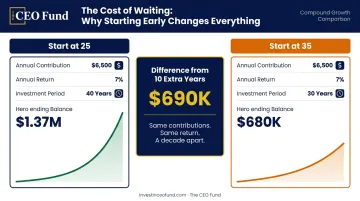
Time is the most powerful variable in compounding. The earlier money enters the account, the more compounding cycles it goes through. An investor contributing $6,500 per year starting at 25 — earning 7% annually — could accumulate roughly $1.37M by age 65. Starting at 35 with the same contributions and return, that balance drops to approximately $680K. Same discipline, same return rate. The $690K gap comes almost entirely from those 10 extra years of compounding.
For personalized projections using your own contribution amount and assumed return, the SEC's Compound Interest Calculator lets you model your own timeline before making contribution decisions.
What Investments Help Your Roth IRA Grow?
Investment selection is the primary variable controlling growth rate inside a Roth IRA. What you hold in the account determines how fast — and how reliably — it compounds over time.
Traditional Asset Classes
Vanguard's portfolio models covering 1926–2024 show a clear relationship between allocation and average annual return:
| Portfolio Allocation | Avg. Annual Return (1926–2024) |
|---|---|
| 100% Stocks | 10.3% |
| 60% Stocks / 40% Bonds | 8.7% |
| 20% Stocks / 80% Bonds | 5.9% |
| 100% Bonds | 4.6% |
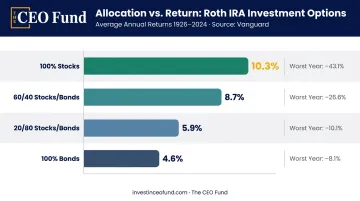
The tradeoff is real: the all-stock portfolio's worst calendar year was -43.1%, while the 60/40 portfolio's worst year was -22.5%. Higher average returns come with higher volatility — which is why time horizon and risk tolerance should guide allocation decisions.
Common asset classes held inside Roth IRAs include:
- Individual stocks and broad market index funds
- Exchange-traded funds (ETFs)
- Bonds and bond mutual funds
- Target-date and actively managed mutual funds
Self-Directed IRAs and Alternative Assets
Standard Roth IRAs through brokerage firms are limited to publicly traded securities. A self-directed IRA (SDIRA) is a distinct option that expands the investable universe — allowing investors to hold real estate, promissory notes, tax-lien certificates, and private funds inside the same tax-advantaged structure.
The SEC and FINRA both confirm that SDIRAs can hold mortgage notes and real estate-backed assets. The custodian holds and administers these assets but does not evaluate investment quality — due diligence falls entirely on the investor. For accredited investors, this opens the door to private fund interests — such as mortgage note funds like The CEO Fund — that generate passive income directly into a tax-advantaged retirement account.
How to Maximize Your Roth IRA Returns
Three levers consistently produce better outcomes over time:
- Contribute early and consistently — front-load each year where possible to maximize compounding exposure
- Reinvest dividends automatically — dividend reinvestment programs (DRIPs) keep gains working rather than sitting idle; S&P Dow Jones Indices data shows dividends supplied approximately 31% of S&P 500 total return from 1926 through 2025
- Choose low-cost investment vehicles — fees compound against you just as returns compound for you
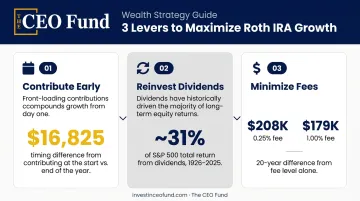
On fees specifically: the SEC's analysis found that a $100,000 investment at 4% gross return over 20 years produced $208,000 with a 0.25% annual fee versus $179,000 with a 1.00% fee. That's nearly $30,000 lost to expense ratios alone.
Alternative Income Through Self-Directed Roth IRAs
For accredited investors looking beyond traditional stocks and bonds, a self-directed Roth IRA can hold real estate-backed mortgage notes — where the IRA effectively acts as the lender and receives monthly principal and interest payments directly into the tax-sheltered account.
The CEO Fund works with investors using self-directed IRAs and 401(k)s to generate consistent passive income through mortgage note investments. Instead of owning property, the investor holds the loan secured by real estate — monthly payments deposit directly into the retirement account, where earnings compound tax-free. Key features of this structure:
- Target yields: 7–9%+ annually
- No landlord obligations: no tenant management, maintenance, or property correlation
- Eligibility: $200K+ individual income ($300K+ with spouse) or $1M+ net worth excluding primary residence
For qualified investors, this approach adds a collateral-backed, income-generating position alongside a traditional equity-heavy Roth IRA.
Tax Diversification in Retirement
The self-directed strategy above is one piece of a broader tax diversification approach. Combining a Roth IRA with other retirement vehicles gives you pull levers in retirement that most investors overlook.
Drawing from traditional IRAs (taxable), Roth IRAs (tax-free), and taxable brokerage accounts in different proportions lets you manage annual taxable income strategically — keeping Roth balances intact and compounding for as long as possible.
Frequently Asked Questions
What is the average yield on a Roth IRA?
There is no fixed "Roth IRA yield" — returns depend entirely on what the account holds. Historically, diversified equity portfolios have averaged between 7%–10% annually over the long term, based on Vanguard's 1926–2024 data. Conservative bond-heavy portfolios average closer to 2%–4% annually.
What is the 4% rule for Roth IRAs?
The 4% rule is a withdrawal guideline suggesting you can withdraw 4% of your portfolio annually without exhausting it over a 30-year retirement. Because Roth IRA withdrawals are tax-free, the full 4% goes to you — unlike traditional accounts where withdrawals are taxed as ordinary income.
How much will $10,000 make in a Roth IRA?
At a 7% average annual return, $10,000 roughly doubles every 10 years via the Rule of 72. Over 30 years, that $10,000 could grow to approximately $76,000 — with no additional contributions. Use the SEC's compound interest calculator for precise projections based on your assumptions.
Can a Roth IRA lose money?
Yes. A Roth IRA holds market investments, so its value can decline during downturns. Vanguard's historical data shows an all-stock portfolio lost as much as 43.1% in a single calendar year. Diversification and a long time horizon are the primary tools for managing that risk.
How long does it take for a Roth IRA to grow significantly?
Meaningful compounding typically becomes visible over 10+ years, with the most dramatic acceleration occurring in years 20–30. The growth curve is slow early and steep later — every year of delay costs more than it appears to, because the steepest gains come at the end of the timeline.
What is the best investment to grow a Roth IRA?
Broad market index funds and low-cost ETFs are widely favored for long-term growth — diversified, low-fee, and backed by decades of strong historical returns. Accredited investors can also hold mortgage notes and real-estate-backed assets inside a self-directed IRA, adding income-generating positions that aren't correlated to equity market swings.