
Introduction
Imagine receiving an invitation to invest in a high-yield, asset-backed opportunity — no stock ticker, no public prospectus, and access restricted to a select group of qualified investors. No public filing. No retail brokerage account required. Just a Private Placement Memorandum, a set of clearly defined terms, and a decision to make.
That's a private placement. For accredited investors, understanding how this structure works opens access to an entirely different category of opportunities — asset classes and deal structures that public markets simply don't offer.
According to the SEC's Division of Economic and Risk Analysis, private placements under Regulation D raised $2.148 trillion in 2024 across 32,554 initial filings. This isn't a niche corner of the market — it's where a substantial portion of institutional and high-net-worth capital moves.
What follows is a clear breakdown of how private placements work, who qualifies, what real-world deals look like, and where the risks sit — so you can decide whether this structure belongs in your portfolio.
Key Takeaways
- A private placement is a securities offering sold directly to qualified investors — no public exchange, no SEC registration required
- Only accredited investors (meeting income or net worth thresholds) are exclusively eligible
- Common vehicles include corporate debt, equity stakes, real estate funds, and mortgage note portfolios
- Private placements deliver yield premiums and portfolio diversification, but require investors to accept illiquidity and conduct their own due diligence
- The CEO Fund is a structured private placement targeting 8–12% annual returns through mortgage notes and real estate-backed assets
What Is a Private Placement? Definition and How It Works
A private placement is a securities offering made directly to a pre-selected group of investors — not listed on a public exchange, not registered with the SEC, and unavailable to the general public. Three characteristics define it:
- Securities are not publicly offered
- SEC registration is not required (relying instead on an exemption)
- Investors must be accredited or qualified institutions
The Process From Offer to Close
Private placements don't start with a press release. The issuing company (or fund) identifies and approaches qualified investors directly, often through a placement agent or broker-dealer relationship. Instead of a public prospectus, investors receive a Private Placement Memorandum (PPM), which outlines the terms, risks, use of proceeds, and the issuer's financial position.
The timeline moves significantly faster than a public offering. According to PGIM, a first private placement transaction generally closes in 6–8 weeks, compared to the 16–20 weeks or more the NYSE cites for a traditional IPO.
For issuers, that speed means capital without the delay of full SEC review. For investors, it means earlier access to positions before they become widely available.
The core distinction from an IPO comes down to access and disclosure. In a public offering, shares are registered with the SEC, listed on an exchange, and open to any investor. In a private placement, issuers face fewer disclosure requirements, the investor pool is limited to qualified parties, and the securities don't trade on public markets.
That restricted structure is made possible by a specific regulatory framework — which is where Regulation D comes in.
The Role of Regulation D
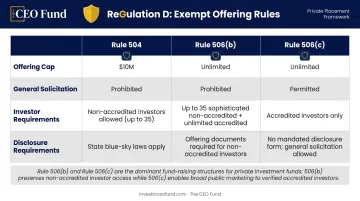
Most U.S. private placements operate under SEC Regulation D, which provides specific registration exemptions. Three rules matter most:
| Rule | Offering Cap | General Solicitation | Investor Requirements |
|---|---|---|---|
| Rule 504 | $10M per 12 months | Generally prohibited | No federal accredited investor requirement |
| Rule 506(b) | Unlimited | Prohibited | Unlimited accredited + up to 35 sophisticated non-accredited investors |
| Rule 506(c) | Unlimited | Permitted | All purchasers must be verified accredited investors |
Rules 506(b) and 506(c) are the dominant structures for investment funds. The key practical difference: under 506(c), issuers can advertise publicly but must independently verify each investor's accredited status. Under 506(b), no advertising is permitted, but issuers may rely on self-certification for a limited number of non-accredited sophisticated investors.
Types of Private Placements
Private placements aren't one structure — they span a wide range of asset classes and risk profiles.
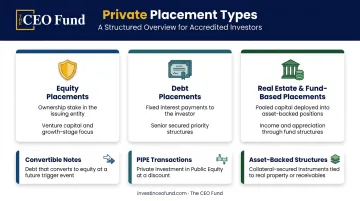
The three most common forms:
- Equity private placements — investors receive an ownership stake in a company; common in venture capital and startup funding rounds (Series A, B, etc.)
- Debt private placements — investors act as lenders, receiving fixed interest payments and principal repayment at maturity; often structured as senior secured notes with fixed maturities ranging from 3–10 years
- Real estate and fund-based placements — capital is pooled into a professionally managed vehicle backed by real assets such as mortgage notes, properties, or construction projects
The structural difference between debt and equity matters. Debt investors receive contractual interest payments and have priority in a default scenario. Equity investors receive ownership and upside potential, but bear more risk — they're last in line if the company fails.
Additional formats investors may encounter include:
- Convertible notes — debt instruments that may convert to equity under defined conditions
- PIPE transactions (Private Investment in Public Equity) — private placements by already-public issuers, typically to institutional investors
- Asset-backed structures — securities backed by specific collateral pools, such as mortgage note portfolios or commercial real estate loans
The range extends well beyond startup fundraising. Private placements appear across energy infrastructure, healthcare, apartment development, and secondary mortgage markets — each with its own risk profile, return structure, and investor requirements.
Who Can Participate: The Accredited Investor Requirement
Access to private placements is gated by the SEC's accredited investor definition. An individual qualifies if they meet at least one of the following:
- Income test: Over $200,000 annually for the past two years (or $300,000 combined with a spouse), with expectation of the same
- Net worth test: Over $1 million, excluding the value of their primary residence
- Professional credentials: Active Series 7, 65, or 82 license in good standing
- Insider status: Director, executive officer, or general partner of the issuer
Qualifying entities include banks, insurance companies, registered investment advisers, and organizations with assets exceeding $5 million (subject to applicable conditions). The SEC expanded these definitions in 2020 to include certain credentialed professionals and knowledgeable fund employees.
The accredited investor standard assumes these individuals have the financial capacity to absorb potential losses and the sophistication to evaluate risks — without the consumer protections that come with full SEC registration.
Verification requirements differ by offering type:
- Rule 506(c): Accredited status must be independently verified through tax returns, bank statements, or a third-party letter from a licensed attorney or CPA
- Rule 506(b): Self-certification is permitted, and up to 35 non-accredited sophisticated investors may participate
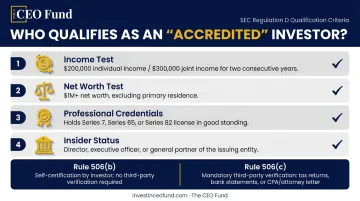
Accredited status unlocks investment opportunities — higher-yield debt instruments, asset-backed funds, and privately structured deals — that never appear in a standard brokerage account.
Real-World Examples of Private Placements
Private placements appear across industries and asset classes. Three concrete scenarios illustrate how the structure works in practice:
1. Corporate debt placement A mid-market manufacturing company needs $150 million in growth capital. Rather than issuing public bonds — which requires full SEC registration, roadshows, and months of preparation — the company raises the funds through a Reg D private placement with a group of insurance companies. The result: fixed-rate senior debt with defined maturity, negotiated covenants, and faster execution for all parties.
2. Startup equity round A technology company sells preferred equity shares to venture capital firms in a Series A round. The investors receive an ownership stake with negotiated preferences (liquidation priority, anti-dilution protections), while the company avoids the cost and scrutiny of a public offering. This is the most recognizable form of equity private placement.
3. Real estate mortgage note fund An accredited investor contributes capital to a pooled fund that acquires performing and non-performing first-lien mortgage notes secured by real property across multiple states. The fund generates monthly interest income from borrower payments, distributed to investors — with real estate collateral as the underlying security.
That third model extends private placements beyond institutional finance — making them accessible to individual accredited investors as passive income vehicles.
The CEO Fund operates on this structure. Based in Miramar, Florida, the fund acquires Grade A–C mortgage notes (performing and non-performing) across 50+ U.S. states, along with construction syndications and small business loans to general contractors. Investors participate as lenders, receiving returns backed by real estate collateral without property management responsibilities. The fund also syndicates larger development projects, including a $20 million construction syndication (the SUNRISE Project) delivering 1,000 homes, a marina, and a golf course in Florida.

Private placements are also active in energy infrastructure, apartment development, healthcare growth capital, and small business lending — the structure reaches well beyond the startup ecosystem.
Pros and Cons of Private Placements
Advantages for Investors
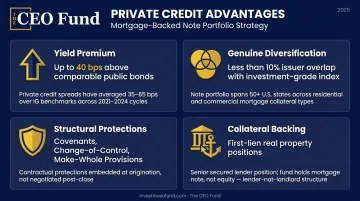
Yield premium. Investors earn a premium for accepting illiquidity. Research from the Federal Reserve Bank of Chicago shows private placement debt is priced up to 40 basis points above comparable publicly traded corporate bonds. Compounded over a multi-year holding period on a meaningful position, it adds up.
Genuine diversification. MetLife estimates less than 10% issuer overlap between its private placement portfolio and the U.S. investment-grade corporate bond index. Adding private placements to a portfolio provides actual diversification rather than rotation between sectors that already move together.
Structural protections unavailable in public markets. Private placement investors can negotiate directly with issuers. This enables:
- Financial covenants (leverage tests, lien restrictions)
- Change-of-control protections
- Make-whole prepayment provisions
- Direct lender-borrower engagement before a default escalates
These protections rarely exist in publicly traded bonds, where terms are standardized and non-negotiable.
Collateral backing. For asset-backed private placements — real estate funds, mortgage note portfolios — the underlying property provides a recovery layer unavailable in unsecured corporate debt. Investors hold a claim on a tangible asset. In The CEO Fund's structure, for example, notes are secured by first-lien positions on real property, with acquisition prices structured below both market value and unpaid principal balance, which builds in an equity cushion from day one.
Disadvantages and Risks to Understand
Illiquidity is the primary trade-off. Private placements don't trade on an exchange. Secondary market activity is limited, and investors must be prepared to hold for the full duration — often 3–10+ years for debt structures. If you anticipate needing access to this capital within a few years, a private placement is the wrong vehicle.
Due diligence burden shifts to you. The reduced disclosure requirements that make private placements attractive to issuers also mean investors receive less standardized information than they would in a public offering. There's no quarterly earnings call, no analyst coverage, no public filing trail. Before committing capital, you're responsible for evaluating the issuer's track record, reviewing audited financials where available, and verifying the fund manager's credentials and regulatory standing.
Equity-specific pressures. For equity private placements, sophisticated investors often extract preferred dividend structures, aggressive return hurdles, or significant ownership percentages. This can create tension for the issuing company. Investors in early-stage equity deals are taking on real execution risk alongside any structural benefits the deal provides.
Regulatory Framework: SEC, Reg D, and FINRA Oversight
Private placements are exempt from full SEC registration — but they're not unregulated.
Under FINRA Rules 5122 and 5123, broker-dealers that sell private placements must:
- File offering documents with FINRA's Corporate Financing Department (within 15 calendar days of first sale under Rule 5123)
- Conduct reasonable due diligence on the issuer
- Ensure investment recommendations meet suitability standards or Regulation Best Interest (Reg BI) obligations when recommending to retail customers
Alongside those broker-dealer requirements, issuers themselves must file Form D — the SEC notice — within 15 calendar days after first sale. It's publicly searchable through EDGAR.
What This Means for Investors
The regulatory framework provides oversight at the broker-dealer level. But because issuers carry a reduced disclosure burden compared to public offerings, individual due diligence remains critical. Before committing capital, investors should:
- Request and review the Private Placement Memorandum (PPM)
- Verify the fund manager's credentials and regulatory standing
- Review any available audited financials
- Confirm the offering's Regulation D exemption through SEC EDGAR
Regulatory oversight sets a floor — it doesn't replace the judgment you need to apply before writing a check.
Frequently Asked Questions
What's the minimum investment for a private placement?
There's no universal minimum — it varies significantly by structure. Fund-based placements may start at $10,000–$25,000, while institutional corporate debt deals typically require $100,000 or more. Review the specific offering's terms and speak directly with the fund manager before assuming a minimum exists.
Is a private placement a good investment?
For accredited investors seeking yield enhancement, genuine diversification, and asset-backed income, private placements can be a strong fit. Suitability depends on liquidity needs, risk tolerance, and time horizon. That said, illiquidity is a genuine constraint that must be weighed against the return premium before committing.
Who qualifies as an accredited investor for private placements?
The SEC's current thresholds: individual income above $200,000 (or $300,000 joint with a spouse) for the past two years, or net worth exceeding $1 million excluding the primary residence. Since 2020, certain credentialed professionals (Series 7, 65, or 82 license holders) and entity investors meeting asset thresholds also qualify.
What is the difference between a private placement and an IPO?
An IPO is a public securities offering registered with the SEC, open to all investors, and listed on a public exchange. A private placement is a restricted, non-registered offering available only to accredited or qualified investors — with less disclosure, faster execution, and no public trading of the resulting securities.
Can I invest in a private placement through a self-directed IRA?
Yes. Self-directed IRAs and solo 401(k)s can invest in private placements, including real estate funds and mortgage note portfolios, offering potential tax-advantaged growth. Investors should work with a custodian that supports alternative investments and confirm that the specific offering permits IRA participation before proceeding.