Regulation D gives issuers a path to raise capital without full SEC registration, but that exemption depends entirely on whether the right investors are properly assessed. The standard isn't uniform—it shifts depending on which rule governs the offering.
Key Takeaways
- Accredited investor status under Rule 501(a) is based on income ($200K individual / $300K joint), net worth (over $1M excluding primary residence), or professional credentials (Series 7, 65, or 82 licenses)
- Rule 506(b) requires "reasonable belief" of accredited status; Rule 506(c) imposes a higher bar, requiring issuers to take affirmative "reasonable steps to verify"
- Self-certification by checking a box alone does not satisfy either standard
- Valid documentation includes tax returns, brokerage statements, and third-party letters from CPAs, attorneys, or registered advisers
- Incorrect assessment can trigger SEC enforcement, investor rescission rights, and loss of the Regulation D exemption
What Is an Accredited Investor Under Regulation D?
An accredited investor is a person or entity meeting the specific standards in Rule 501(a) of Regulation D, which qualifies them to participate in unregistered securities offerings—private funds, private placements, real estate syndications—unavailable to the general public.
The SEC created this category to distinguish investors capable of evaluating complex, illiquid private investments without the full disclosure protections that registered public offerings require. Understanding those standards means knowing which pathways apply to you.
Qualification Pathways for Natural Persons
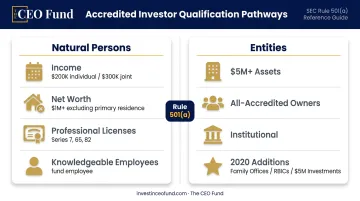
Rule 501(a) provides four main routes for individuals:
- Income: More than $200,000 individually, or $300,000 jointly with a spouse or spousal equivalent, in each of the two most recent years—with a reasonable expectation of the same in the current year
- Net worth: More than $1,000,000 individually or jointly, excluding the primary residence. Per the 2011 Dodd-Frank amendment, mortgage debt secured by the primary residence up to its fair market value is also excluded as a liability
- Professional licenses: Holders in good standing of Series 7, Series 65, or Series 82 licenses qualify based on financial sophistication rather than wealth (added via the SEC's 2020 amendments)
- Knowledgeable employees: Employees of a private fund who are knowledgeable about its investments qualify for that specific fund
Qualification Pathways for Entities
Entities qualify under several categories:
- Corporations, LLCs, partnerships, trusts, and charitable organizations with total assets exceeding $5,000,000, not formed for the specific purpose of acquiring the offered securities
- Entities where all equity owners are themselves accredited investors
- Institutional categories including banks, insurance companies, registered investment advisers, and broker-dealers
- 2020 additions expanded eligibility to three new entity types:
- Family offices with $5M+ in AUM and their family clients
- Rural business investment companies (RBICs)
- Any entity owning investments exceeding $5M under the Investment Company Act definition
Why Accredited Investor Status Is the Gateway to Private Investing
Private offerings under Regulation D differ fundamentally from public market investments. They are typically illiquid, carry no ongoing public disclosure requirements, and involve concentrated positions. The accredited investor threshold acts as a protective filter: participants must be able to absorb potential losses and evaluate complex risk structures without the safety net of SEC-mandated disclosures.
The scale of this market is substantial. According to the SEC's current statistics, Regulation D offerings generated approximately $2.392 trillion in reported capital across 34,553 initial Form D filings in 2025. This makes Regulation D one of the largest capital formation channels in the U.S. financial system.
For issuers—including private funds raising capital—accurately assessing accredited investor status serves two purposes at once:
- Investor protection: Confirms participants can evaluate risk and absorb potential losses
- Legal preservation: Maintains the exemption from SEC registration that the offering depends on
- Liability shield: A failed assessment can expose the entire offering to Section 5 liability under the Securities Act
Getting this right isn't procedural housekeeping. It's the foundation on which the offering stands.
Rule 506(b) vs. Rule 506(c): How Assessment Standards Differ
Both rules allow issuers to raise unlimited capital without SEC registration. The critical difference is the assessment standard each imposes—and choosing between them carries significant operational consequences.
| Feature | Rule 506(b) | Rule 506(c) |
|---|---|---|
| General solicitation | Prohibited | Permitted |
| Non-accredited investors | Up to 35 sophisticated non-accredited investors | Not permitted |
| Assessment standard | Reasonable belief | Reasonable steps to verify |
| Typical use case | Pre-existing networks and relationships | Publicly marketed offerings |
Rule 506(b): The "Reasonable Belief" Standard
Under Rule 506(b), the issuer must have a "reasonable belief" that each investor is accredited at the time of sale—but is not required to independently verify. This is a facts-and-circumstances analysis that depends on:
- The issuer's existing relationship with the investor
- The nature and amount of information already known about the investor's financial situation
The key tradeoff: Rule 506(b) permits up to 35 non-accredited but "sophisticated" investors (with additional disclosure requirements), and prohibits general solicitation. It's the standard choice for offerings distributed through pre-existing networks.
Rule 506(c): The "Reasonable Steps to Verify" Standard
Rule 506(c) permits general solicitation and advertising but imposes a stricter, more affirmative obligation. The issuer must take "reasonable steps to verify" that all purchasers are accredited.
Factors issuers must weigh under 506(c) include:
- The accredited investor category the purchaser claims
- Information already available about that investor's financial situation
- How the investor was solicited
- The minimum investment amount (a higher minimum reduces verification risk)
The SEC's non-exclusive safe harbor methods under 506(c) include:
- IRS documents (W-2, 1099, K-1, Form 1040) for the two most recent years, plus a written representation covering the current year
- Bank or brokerage statements dated within the prior three months, accompanied by a credit report and written representation that all liabilities were disclosed
- Written confirmation from a registered broker-dealer, SEC-registered investment adviser, licensed attorney, or CPA—stating they verified accredited status within the prior three months
Critical compliance point: Self-certification alone—checking a box on a subscription document—does not satisfy either the "reasonable belief" or "reasonable steps to verify" standard. The SEC's 2013 adopting release makes clear that a questionnaire or checked box, standing alone, is insufficient even if the investor ultimately qualifies.
How the Accredited Investor Assessment Works in Practice
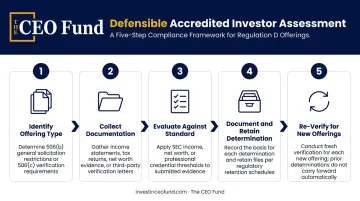
Most compliance failures don't stem from ignorance of the law. They come from skipping documentation steps or over-relying on self-reported information. The following five-step process outlines what a defensible assessment looks like from start to finish.
Step 1 – Identify the Offering Type and Applicable Rule
The first decision is whether the offering operates under Rule 506(b) or 506(c). This determines the entire assessment framework. Issuers using general solicitation must use 506(c) and cannot retroactively rely on 506(b)'s relaxed verification standard.
Step 2 – Collect Investor Information and Documentation
What you need depends on the rule:
- Under 506(b): Investor questionnaires, prior relationship history, or knowledge of the investor's professional and financial background
- Under 506(c): Two years of tax returns or W-2s for income qualification; or dated bank/brokerage/retirement statements plus a credit report for net worth qualification
Step 3 – Evaluate Against the Applicable Standard
The issuer evaluates whether the collected information supports an accredited status determination under the specific rule used. For 506(c) offerings, a written confirmation from one of the following professionals satisfies the safe harbor:
- Certified Public Accountant (CPA)
- Licensed attorney
- Registered broker-dealer
- Registered investment adviser
Step 4 – Document and Retain the Determination
Record the basis for each accredited investor determination in writing and retain all supporting documentation. For 506(c) offerings, a written investor self-representation confirming unchanged status satisfies re-verification for up to five years from the original verification date—provided the issuer has no contrary information.
Step 5 – Re-Verify for New Offerings
Accredited investor status must be assessed at the time of each investment, not just once. Re-verify for each new fund or offering to ensure the exemption remains intact.
How The CEO Fund Works with Accredited Investors
The CEO Fund is a Regulation D private fund operating under Everley Mae Fund LLC, headquartered in Miramar, Florida. It exclusively serves accredited investors, providing access to mortgage note investments, real estate syndications, and construction projects unavailable through public markets.
The fund's model positions accredited investors as the lender, not the landlord. Rather than owning property, investors participate in a diversified portfolio of performing and non-performing first-lien mortgage notes across 50+ states. The fund deposits monthly cash flow directly into investors' savings accounts or self-directed IRA/401(k) accounts.

The onboarding process is led by the fund's management team:
- Desi Arnez (Director/CEO & Senior Fund Manager): Leads mortgage note acquisitions, multifamily development, and the $20M Sunrise Construction Syndication across Florida
- Carlo Turner (Fund Manager & Certified Note Investing Specialist): 15+ years in corporate finance, overseeing asset acquisition and investment strategy
- Patrick Franz (VP & Executive Fund Manager): 25+ years in capital raising, guiding investors through qualification and onboarding
To begin, prospective investors verify accredited status against SEC thresholds:
- $200K+ individual income (or $300K+ jointly) for the past two years
- $1M+ net worth, excluding the primary residence
Qualified investors then receive the fund's Confidential Private Offering Memorandum. To initiate the process, contact the team at (888) 508-1143 or theceofund.fl@gmail.com.
Frequently Asked Questions
What is Regulation D in simple terms?
Regulation D is a set of SEC rules under the Securities Act of 1933 that allows companies and funds to raise capital without registering the offering with the SEC, provided they meet specific conditions—including restricting participation to accredited investors in most cases.
What are the main Reg D exemptions?
Three primary exemptions apply:
- Rule 504: Offerings up to $10 million in a 12-month period
- Rule 506(b): Unlimited capital, up to 35 sophisticated non-accredited investors, no general solicitation
- Rule 506(c): Unlimited capital, accredited investors only, general solicitation permitted with mandatory verification
Can I self-certify my accredited investor status?
Self-certification alone—checking a box on a subscription form—is not sufficient under Regulation D. Under 506(b), the issuer needs enough information to form a reasonable belief. Under 506(c), specific documentation or third-party verification is required.
What documents do I need to prove accredited investor status?
Acceptable documentation includes:
- Income: W-2s, 1099s, or tax returns from the two most recent years
- Net worth: Bank statements, brokerage statements, and a credit report dated within three months
- Third-party letter: Written confirmation from a CPA, attorney, broker-dealer, or registered investment adviser
What is the difference between Rule 506(b) and Rule 506(c)?
Rule 506(b) allows up to 35 sophisticated non-accredited investors and requires only "reasonable belief" of accredited status, but prohibits general solicitation. Rule 506(c) permits public advertising, but all investors must be accredited and issuers must take "reasonable steps to verify" their status.
What happens if an issuer accepts a non-accredited investor in a Regulation D offering?
Non-compliance can trigger Section 12(a)(1) rescission rights, allowing the investor to demand the transaction be unwound. Issuers also face SEC enforcement actions, civil penalties, and potential loss of the exemption for the entire offering round—putting all capital raised at risk.