
Introduction
According to the Federal Reserve's 2023 Survey of Consumer Finances, fewer than 20% of American households hold any income-generating assets outside of their primary job. For most people, income stops the moment work does — a fragile arrangement that leaves retirement entirely dependent on savings rates and market timing.
Passive wealth builders break that cycle. Unlike a savings account or a one-time bonus, they're income-generating assets that keep producing returns — whether you're actively working, taking time off, or fully retired. The distinction matters because one model builds equity over time; the other erodes it.
This guide covers the most effective passive wealth-building strategies available today, focusing on one approach that lets accredited investors act as the lender rather than the landlord: mortgage note investing.
If you're an accredited investor, a high-net-worth individual, or simply serious about making capital work without your constant involvement, this is written for you.
Key Takeaways
- Passive wealth builders generate recurring income without daily involvement and compound in value over time — unlike earned wages
- Diversifying across multiple passive income streams reduces risk and accelerates the path to financial independence
- Mortgage note investing lets accredited investors act as the lender, collecting monthly payments backed by real property collateral
- Self-directed IRAs and Solo 401(k)s can hold mortgage note investments for tax-deferred or tax-free growth
- A clear income target plus a professionally managed fund shortens the path to financial freedom
What Are Passive Wealth Builders?
A passive wealth builder is any asset or investment structure that generates recurring income with minimal ongoing effort. The key word is recurring — not a one-time gain, not a temporary windfall, but consistent cash flow that continues producing without requiring your active presence.
The distinction from active income is structural. Active income stops the moment you stop working. Passive income from deployed capital — mortgage notes, private funds, income-producing real estate assets — continues generating returns whether you're at your desk or not. That structural difference is what makes it a wealth-building mechanism rather than just a paycheck.
Passive Income vs. Traditional Savings: Why the Gap Matters
Savings accounts feel safe. They are not wealth builders.
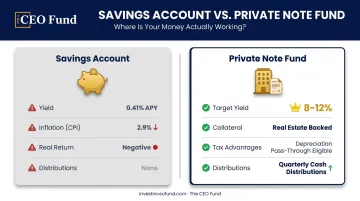
The FDIC reported a national savings rate of just 0.41% in March 2025, while the Bureau of Labor Statistics reported CPI-U rose 2.9% over 2024. That's a real-return gap of roughly -2.49 percentage points annually — meaning cash sitting in a savings account loses purchasing power every year, without exception.
That gap is the core argument for deploying capital rather than parking it. Income-producing assets — mortgage notes, private funds, real estate-backed instruments — can generate returns that outpace inflation rather than trail it.
For accredited investors, the options extend further. Private investment vehicles outside the retail market offer structures unavailable through a standard brokerage account:
- Higher target yields — funds like The CEO Fund target 8–12% annually (up to 15%), compared to sub-1% savings rates
- Asset-backed security — returns tied to real estate collateral, not market sentiment
- Tax-advantaged access — eligible for self-directed IRAs and 401(k) accounts
- Quarterly cash distributions — structured for consistent, predictable income
The Real Benefits of Building Passive Income Streams
Financial Freedom and the Crossover Point
Vicki Robin's Your Money or Your Life defines the crossover point as the moment when monthly income from invested capital equals monthly living expenses. At that point, work becomes optional — a choice rather than a necessity.
Getting there requires replacing earned income dollar-for-dollar with passive income. That's the real goal, not a "side income." Once passive income covers your expenses, you've bought back your time permanently.
Scalability and Compounding
Earned income is capped by hours in the day. Passive income scales independently of your time.
A $100,000 investment compounding at 8% annually grows to approximately $215,892 in 10 years and $466,096 in 20 years (per the SEC's compound interest calculator) — before accounting for reinvestment of distributions. Stack multiple passive streams and reinvest returns, and the trajectory steepens considerably.
Generational Wealth Creation
Passive income assets can be structured and transferred to heirs. Unlike a salary, they don't disappear when you do. Common vehicles include:
- Mortgage notes — transferable debt instruments secured by real estate collateral
- Equity positions — ownership stakes in income-producing properties or funds
- Dividend portfolios — publicly traded assets generating recurring distributions
Building a portfolio across these asset classes is how generational wealth is actually constructed. Mortgage notes, in particular, offer a structure that pays heirs the same way they paid you — through consistent, collateral-backed cash flow.
Top Passive Wealth-Building Strategies Worth Considering
The most effective passive wealth builders share two traits: they're asset-backed and expandable without requiring proportional effort. Here's a landscape overview before addressing the standout option for accredited investors.
Dividend Stocks and Index Funds
Dividend-paying stocks and broad index funds offer quarterly income and long-term capital appreciation with minimal management overhead. The liquidity advantage is real — you can sell shares within seconds.
The limitation: market volatility cuts both ways. Research from S&P Dow Jones Indices found that 29 S&P 500 High Dividend Index constituents — representing 36.1% of its January 2020 weight — cut full-year dividends during the 2019-2020 period. High yield alone doesn't guarantee reliable income; payout durability matters.
Real Estate Syndications and REITs
Syndications pool investor capital for large commercial or multifamily deals. REITs offer real estate exposure without direct ownership — the FTSE Nareit All Equity REITs Index returned 4.92% in 2024, with a 3.96% indicated dividend yield. Both deliver real estate exposure with solid return potential, though investors typically have no control over deal selection or exit timing.
Private Lending and Mortgage Notes
Private lending — deploying capital as a secured lender to property owners or developers — generates interest income passively. Collateral quality and borrower vetting can vary widely, which is why fund-managed vehicles outperform self-managed individual note purchases for most investors. Fund structures like mortgage note portfolios address this directly — offering professional vetting, diversified collateral, and consistent cash flow without the overhead of individual loan management.
Digital and Intellectual Property Assets
Royalties, online courses, and digital products offer low-capital entry points. These work well for early-stage wealth builders but lack the asset-backing and scale that accredited investors need to build meaningful passive income at the $1,000–$10,000/month level.
Why Mortgage Note Investing Stands Apart as a Passive Wealth Builder
When an investor acquires a mortgage note, they step into the lender's position — the borrower continues making monthly mortgage payments directly to the investor. The investor never owns or manages the property. They collect the income.
In this model, the investor functions as the bank. The property's equity, maintenance costs, property taxes, and tenant headaches stay with the borrower — not the note holder. No 2 a.m. maintenance calls. No vacancy losses. Just scheduled payments.
No Tenants, Toilets, or Tiles
The contrast with rental property investing is direct:
| Responsibility | Traditional Landlord | Mortgage Note Investor |
|---|---|---|
| Tenant management | Required | None |
| Repairs & maintenance | Investor's cost | None |
| Property taxes & insurance | Investor's expense | Borrower's expense |
| Vacancy risk | Real | None |
| Monthly income source | Rent | Mortgage payments |
| Truly passive? | Rarely | Yes |
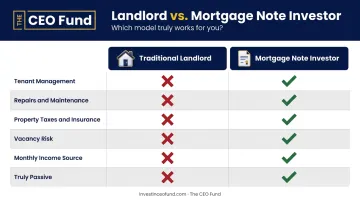
For accredited investors seeking genuine passivity — not "passive except for the dozen decisions a month" — mortgage notes are among the cleanest structures available.
Security Structure and Portfolio Diversification
Mortgage notes are backed by real estate collateral. In default scenarios, the note holder has a collateralized claim on the underlying property. That's a different risk profile than unsecured lending or equity positions, where recovery depends on asset sale proceeds after creditors are considered.
Well-managed funds diversify across note grades (performing and non-performing), property types, borrower profiles, and geographies — which reduces concentration risk compared to owning individual properties or notes. The CEO Fund applies exactly this approach across its nationwide portfolio.
The CEO Fund as a Professionally Managed Vehicle
Rather than sourcing, vetting, and servicing notes individually, accredited investors in The CEO Fund gain access to a professionally managed portfolio that spans:
- 500+ loans acquired across 50+ U.S. states
- Property types including single-family, multifamily, mobile home parks, and commercial assets
- A team with 40+ years of combined experience, led by Carlo Turner, a Certified Note Investing Specialist
The fund's model is concrete: a Florida townhome mortgage note at a 10% ROI, with a monthly payment of $764.39, purchased at $80,900 against a market value of $115,000, with a total payback of $197,212 over 21.5 years — without the investor ever managing a property.
How to Start Building Passive Wealth as an Accredited Investor
Step 1 — Define Your Income Replacement Target
Before choosing a vehicle, calculate the monthly passive income needed to reach your crossover point. A clear number — say, $8,000/month — determines which asset class and how much capital to deploy. At a 10% annual yield, generating $8,000/month requires approximately $960,000 in deployed capital. At 8%, closer to $1.2M.
That math turns an abstract goal into a concrete capital deployment plan.
Step 2 — Assess Your Investor Profile
Determine your:
- Accredited investor status (per SEC thresholds: $200K individual income, $300K joint, or $1M net worth excluding primary residence)
- Liquidity horizon — mortgage note funds typically target 3–5 year holds
- Tax account eligibility — mortgage note fund investments can be held inside self-directed IRAs for tax-deferred or tax-free compound growth
Step 3 — Diversify Across Asset Classes Strategically
A tiered approach reduces single-point-of-failure risk:
- Liquid layer: Dividend ETFs for accessibility and market exposure
- Yield layer: Real estate-backed mortgage notes for consistent cash flow and collateral security
- Appreciation layer: Syndications for upside participation in larger developments
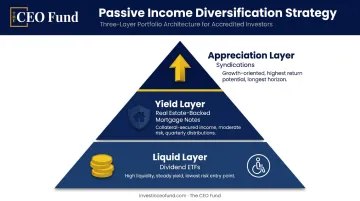
No single vehicle should carry the full weight of your passive income strategy.
Step 4 — Partner with Experienced Fund Managers
Executing that diversified strategy efficiently means partnering with professionally managed vehicles that handle due diligence, acquisition, and asset management on your behalf. Sourcing individual notes, vetting borrowers, managing servicers, and navigating default scenarios independently consumes the time passive income is supposed to free up.
Accredited investors can contact The CEO Fund at (888) 508-1143 or theceofund.fl@gmail.com to learn more about the fund's 8–12% target returns, quarterly distributions, and nationwide mortgage note portfolio.
Frequently Asked Questions
How can I make $1,000 to $10,000 per month in passive income?
The amount of capital deployed and the yield of your chosen asset class determines your monthly income. At The CEO Fund's target return range of 8–12% annually, generating $5,000/month requires roughly $500,000–$750,000 in deployed capital. Higher-yield, asset-backed vehicles accelerate this timeline compared to dividend stocks alone.
What is the 7-7-7 rule for money?
The 7-7-7 rule is an unofficial financial heuristic — not a regulatory standard — that generally encourages splitting income across savings, investment, and spending over defined time horizons. Building real passive wealth, however, requires deploying capital into income-producing assets, not just following a savings formula.
What is the difference between passive income and active income?
Active income stops when you stop working — it's tied directly to your time and labor. Passive income comes from assets generating returns with minimal ongoing effort, scales independently of hours worked, and is taxed differently: interest, dividends, and capital gains each carry distinct IRS treatment compared to ordinary wages.
What makes mortgage note investing a good passive wealth builder?
Mortgage note investing generates consistent monthly cash flow backed by real property collateral, without requiring the investor to manage tenants, handle repairs, or deal with vacancies. It's one of the most hands-off real estate income strategies available — and for accredited investors working through a managed fund, the due diligence and servicing are handled entirely by the fund team.
Can I invest in mortgage notes through my IRA or 401(k)?
Self-directed IRAs and Solo 401(k)s can hold mortgage notes and note fund investments, allowing returns to grow tax-deferred (traditional) or tax-free (Roth). Consult a self-directed IRA custodian and a qualified fund manager to structure the investment correctly and avoid prohibited transaction rules.
How much capital do I need to start building meaningful passive wealth?
Entry points vary — dividend ETFs can be started with minimal capital, while private mortgage note funds like The CEO Fund target accredited investors with higher minimums. The key is consistent reinvestment of returns over time. Compounding at 8–12% annually, even $250,000 deployed generates $1,667–$2,500/month in passive income.