

According to Tax Policy Center data, only 0.14% of decedents paid federal estate tax in 2022, but among the roughly 4,000 taxable estates in 2023, liability totaled $24 billion — averaging $6 million per taxable estate. That concentration of exposure is precisely why HNW estate planning requires a fundamentally different approach.
This guide covers five pillars every high-net-worth estate plan needs: foundational documents, tax minimization, trust structures, business succession and asset protection, and legacy planning.
Key Takeaways
- Federal estate tax hits 40% above the exemption — tax strategy is central, not secondary, for HNW estates
- The 2026 federal exemption is now set at $15M per individual following legislation enacted July 4, 2025
- 12 states plus D.C. impose estate taxes, often with much lower exemption thresholds than the federal level
- Beneficiary designations override your will entirely — outdated forms can silently derail your estate plan
- Self-directed IRAs holding real estate-backed investments can deliver passive income directly to heirs — tax-advantaged and outside the probate process
Why Estate Planning Is Different for High-Net-Worth Individuals
Most Americans never encounter federal estate tax. The exemption is high enough that the vast majority of estates pass without any federal transfer tax liability at all.
HNW individuals don't have that luxury. Unlike standard estate planning — which focuses primarily on asset distribution — HNW planning must address tax exposure, asset complexity, and multi-generational transfer simultaneously.
The Tax Math Changes Everything
At a 40% marginal rate above the exemption, the difference between a well-structured and a poorly structured estate can be measured in millions. A $30 million estate with no planning could face federal tax exposure in the tens of millions — not counting state-level taxes that kick in at far lower thresholds.
This makes tax strategy a primary design consideration, not a secondary concern layered on after distribution decisions are made.
Asset Complexity Requires Specialized Planning
A basic will works fine for a bank account. It doesn't work for:
- Operating businesses with complex ownership structures
- Concentrated stock positions in a single company
- Commercial real estate with embedded debt and depreciation
- Alternative investment portfolios including private funds and mortgage notes
- Family limited partnerships and multi-entity structures
Each of these assets has unique valuation, transfer, and tax characteristics that require specialized handling.
Multi-Generational Stakes
For HNW families, the goal extends well beyond asset distribution at death. The objective is a transfer structure that preserves wealth across two or three generations without triggering estate tax at each successive handoff. Achieving that requires tools most standard estate plans never deploy:
- Intentional trust structures designed to hold and transfer assets across generations
- Entity-level planning to control ownership and reduce taxable estate values
- Generation-skipping strategies that move wealth past the next generation entirely

Core Estate Planning Documents Every HNWI Needs
The foundation of any HNW estate plan starts with a coordinated set of legal documents. Missing even one creates gaps that can be expensive to fix after the fact.
Will, Pour-Over Will, and Revocable Living Trust
These three work as a system:
- Last will and testament — directs individually held probate assets, names the personal representative, and nominates guardians for minor children
- Pour-over will — captures assets that weren't retitled into a trust during life and funnels them into the trust at death, closing gaps in the plan
- Revocable living trust — the central hub; assets properly titled in the trust bypass probate entirely, meaning no court involvement, no public disclosure, and no delays
California courts report that formal probate typically takes 9–18 months and can involve substantial costs calculated as a percentage of the estate under state law. For a large estate, bypassing that process through a funded revocable trust saves time, money, and privacy.
The grantor retains full control of the revocable trust while alive and can amend or revoke it at any time. At incapacitation or death, a named successor trustee steps in without court involvement — which is precisely why incapacitation planning documents belong alongside the trust itself.
Incapacitation Planning Documents
Many HNW estate plans are thorough on paper but silent on incapacitation. A single unexpected medical event — even a temporary one — can freeze financial accounts and delay critical decisions without these documents in place:
- Durable financial power of attorney — authorizes an agent to manage financial and legal matters if the principal cannot
- Healthcare power of attorney — names an agent to make medical decisions when the principal lacks capacity
- HIPAA authorization — directs providers to release protected health information to named individuals
- Advance directive / living will — states end-of-life treatment preferences in writing, removing ambiguity for family and medical staff
Beneficiary Designations: The Silent Override
Life insurance policies, IRAs, and transfer-on-death brokerage accounts pass outside the will entirely — directly to whoever is named on the beneficiary form. An outdated form naming an ex-spouse, a deceased relative, or no beneficiary at all can disinherit intended heirs or trigger unnecessary tax consequences.
Beneficiary designations need active coordination with the overall estate plan — and should be revisited after marriage, divorce, the birth of a child, or any significant change in asset ownership.
Tax Minimization Strategies for Large Estates
Gift Tax and Estate Tax Exemption Planning
The 2025 federal lifetime gift and estate tax exemption is $13.99 million per individual, with the annual gift tax exclusion set at $19,000 per recipient. Through gift splitting, married couples can effectively cover $38,000 per recipient in 2025 with proper Form 709 reporting.
Legislation enacted July 4, 2025 set the 2026 basic exclusion at $15 million — significantly higher than what a prior scheduled sunset would have produced. Future legislative changes remain possible, which is exactly why current exemption levels reward action over delay.
Annual gifting to multiple heirs is the simplest, most consistent way to reduce a taxable estate over time. Consistent use of the annual exclusion across a large family can transfer hundreds of thousands of dollars annually without touching the lifetime exemption.
Advanced Tax Reduction Vehicles
Generation-Skipping Transfer (GST) Tax
Transfers to grandchildren or more remote descendants trigger a separate federal tax layered on top of estate and gift taxes. The GST exemption mirrors the lifetime exemption at $13.99 million in 2025. Allocating GST exemption to a dynasty trust lets wealth pass across multiple generations without being taxed at each generational transfer.
Family Limited Partnerships and Family LLCs
FLPs and family LLCs allow business or real estate interests to transfer at a discounted value. Two types of discounts apply:
- Minority interest discount — reflects inability to control management or distributions
- Lack-of-marketability discount — reflects transfer restrictions and the absence of a ready buyer
These discounts allow more wealth to transfer while consuming less of the lifetime exemption. The IRS scrutinizes FLPs carefully, and retained control can trigger estate inclusion under IRC 2036.
State-Level Estate Tax Exposure
Twelve states plus D.C. impose estate taxes, and five states impose inheritance taxes. Maryland imposes both. State exemption thresholds are often far lower than the federal level:
| State / Jurisdiction | Estate Tax Threshold |
|---|---|
| Oregon | $1 million |
| Massachusetts | ~$1 million |
| Washington D.C. | ~$4.87 million |
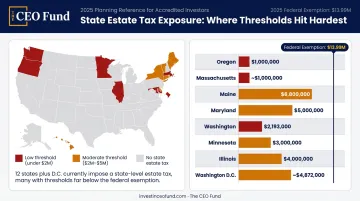
For residents of high-tax states, this means planning against two separate tax regimes — federal and state — each with its own exemption, rate schedule, and compliance requirements.
Trust Structures for Wealth Preservation and Transfer
No single trust does everything. Most sophisticated HNW estate plans layer multiple trust structures, each serving a specific purpose. The five structures below cover the core tools — from removing life insurance proceeds from your taxable estate to locking in today's exemption for a spouse.
Irrevocable Life Insurance Trust (ILIT)
Placing a life insurance policy inside an ILIT removes the death benefit from the taxable estate. The proceeds provide liquidity to pay estate taxes or equalize inheritances among heirs — particularly valuable when the estate is heavily concentrated in illiquid assets like real estate or a family business.
Note: Transferring an existing policy into an ILIT triggers a three-year lookback period under IRC 2035.
Dynasty Trust (Generation-Skipping Trust)
A long-term irrevocable trust designed to benefit children, grandchildren, and future descendants for decades — or in perpetuity in favorable jurisdictions. Assets held in a properly structured dynasty trust remain outside beneficiaries' taxable estates at each generation and can include creditor and divorce protection provisions.
Jurisdiction matters here. South Dakota has eliminated the rule against perpetuities entirely; Nevada permits trusts lasting up to 365 years.
Grantor Retained Annuity Trust (GRAT)
The grantor transfers appreciating assets into the trust and receives a fixed annuity back for a set term. Any growth above the IRS Section 7520 rate — 120% of the applicable federal midterm rate — passes to heirs gift-tax free.
A "zeroed-out GRAT" sets the annuity's present value roughly equal to the contribution, minimizing the taxable gift. GRATs work best for rapidly appreciating assets such as pre-IPO stock or real estate holdings.
Credit Shelter (Bypass) Trust
Uses the first-to-die spouse's exemption to shelter assets in a trust that benefits the surviving spouse while keeping those assets outside the survivor's taxable estate. Effectively doubles the couple's combined exemption usage without requiring portability elections.
Spousal Lifetime Access Trust (SLAT)
One spouse irrevocably transfers assets to a trust for the other spouse's benefit, locking in the current exemption while removing the gifted assets from both spouses' taxable estates. The key trade-off: the transfer is irrevocable, and if the beneficiary spouse predeceases the grantor spouse, indirect access to those assets is lost.
Trust structures at a glance:
| Trust | Primary Purpose | Key Consideration |
|---|---|---|
| ILIT | Remove life insurance from taxable estate | 3-year lookback on policy transfers |
| Dynasty Trust | Multi-generational wealth transfer | Jurisdiction choice affects duration |
| GRAT | Pass appreciation to heirs gift-tax free | Works best with rapidly appreciating assets |
| Credit Shelter | Double exemption usage for married couples | No portability election required |
| SLAT | Lock in exemption; retain indirect access | Irrevocable — access lost if beneficiary spouse dies first |
Business Succession Planning and Asset Protection
Business owners face estate planning challenges that purely liquid estates don't encounter. The core problem: a privately held company may represent the majority of an estate's value but cannot be easily sold to pay estate taxes.
Succession and Liquidity Planning
A complete business succession plan covers three distinct questions — and each requires a separate answer:
- Who takes ownership — clearly identified in a formal written succession plan, not just assumed
- Who takes operational control — often a different answer than ownership, requiring advance grooming of successors
- How the transition is funded — buy-sell agreements funded by life insurance ensure a smooth, liquid ownership transition at death or disability without forcing a fire sale

Following Connelly v. United States (2024), business owners using entity-redemption buy-sell agreements need to revisit their structures — the Supreme Court ruled that company-owned life insurance increases corporate value, with implications for estate tax valuation.
For qualifying estates, IRC Section 6166 allows deferral of estate taxes tied to closely held business interests when those interests exceed 35% of the adjusted gross estate.
The election provides four interest-only years followed by up to ten annual principal installments — 14 years total. This is not tax forgiveness, but it can prevent a forced business sale.
Asset Protection Structures
Deferring taxes addresses the cash flow problem. Protecting assets is a separate discipline — and business owners typically need both.
- LLCs and FLPs separate personal wealth from business and real estate liabilities, though charging-order protection varies by state
- Umbrella liability insurance offers a cost-effective first layer of defense before more complex structures are needed
- Domestic Asset Protection Trusts (DAPTs), available in states including South Dakota, Nevada, and Delaware, can shield assets from future creditors — but only when established proactively, before any claims arise
Life insurance held in an ILIT complements IRC 6166 planning — the insurance provides liquidity for immediate obligations while the installment election handles the remaining tax bill over time.
Charitable Giving and Legacy Planning
Charitable Giving Strategies That Reduce Estate Tax
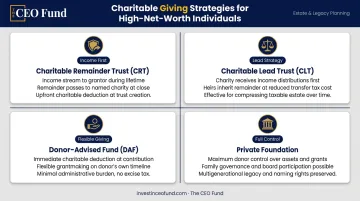
Four primary vehicles let high-net-worth individuals reduce estate tax while advancing philanthropic goals:
- Charitable Remainder Trusts (CRTs) — The grantor transfers assets to the trust, receives income for life or a term up to 20 years, then the remainder passes to charity. Assets leave the taxable estate immediately, and the grantor receives an upfront deduction. Under IRC 664, the charitable remainder must be at least 10% of the initial value.
- Charitable Lead Trusts (CLTs) — The reverse structure: charity receives the lead income interest first, and heirs receive the remainder at a reduced gift or estate tax cost. Split-interest deductions are governed by IRC 2522(c)(2)(B).
- Donor-Advised Funds (DAFs) — Provide an immediate tax deduction with the flexibility to recommend grants over time. Lower administrative burden, no separate legal entity required.
- Private Foundations — Offer greater governance and grantmaking control, allow family members to participate in charitable work, and create an institutional legacy that can span generations.
Building a Legacy That Lasts Across Generations
Choosing the right charitable vehicle is one decision. Keeping wealth intact across generations requires a parallel investment in family governance and financial education:
- Regular family meetings about estate plans, values, and financial expectations
- Incentive trust provisions that tie distributions to milestones — completing education, maintaining employment, or matching earned income
- Formal financial literacy programs that prepare the next generation as active stewards rather than passive recipients
On the investment side, passive income streams are a reliable component of multi-generational estate planning. Real estate-backed investments held within self-directed IRAs — including mortgage note programs that allow accredited investors to act as the lender rather than the landlord — generate consistent cash flow without direct property management responsibilities.
The CEO Fund, for example, acquires mortgage notes that deposit returns directly into retirement accounts each quarter. When beneficiary designations are properly coordinated with the broader estate plan, those income streams can continue producing for heirs across successive generations.
Frequently Asked Questions
What is considered high net worth for estate planning?
By industry convention, high-net-worth typically means at least $1 million in liquid assets, very high net worth starts at $5 million, and ultra-high net worth begins at $30 million or more. These are industry labels, not legal classifications — actual estate tax exposure depends on total gross estate value relative to applicable federal and state exemption thresholds.
How is estate planning different for high-net-worth individuals?
HNW estate plans go well beyond basic asset distribution. They must address 40% federal estate tax exposure above the exemption, require sophisticated trust structures and entity planning, and handle complex assets like operating businesses and concentrated positions that a simple will cannot manage effectively.
How can high-net-worth individuals minimize estate taxes?
Core tactics include:
- Maximizing the annual $19,000 gift exclusion per recipient
- Using lifetime exemption capacity before future legislative changes
- Funding irrevocable trusts to remove assets and future appreciation from the taxable estate
- Incorporating charitable strategies — CRTs, CLTs, or DAFs — that reduce the taxable base
What is the best trust structure for a high-net-worth estate?
Most HNW plans combine a revocable living trust for probate avoidance, an ILIT for life insurance proceeds, and one or more irrevocable trusts — dynasty trust, GRAT, or credit shelter trust — tailored to the family's specific tax situation and multi-generational objectives.
How often should a high-net-worth individual update their estate plan?
ACTEC recommends event-driven reviews rather than a fixed schedule — after marriage, divorce, relocation, beneficiary changes, births, deaths, and material tax law changes. Given the 2026 exemption changes and ongoing legislative uncertainty, review your plan with qualified counsel now — regardless of when you last updated it.
Can alternative investments like real estate funds be included in an estate plan?
Yes. Real estate-backed investments held in self-directed IRAs or through fund structures can be incorporated into an estate plan and may generate passive income for heirs. IRA beneficiary designations override the will — coordinate them with your estate plan to avoid unintended tax consequences.