
Passive real estate investing lets you earn income from property-backed assets without running a rental portfolio or managing a single repair. The options have expanded well beyond buying a rental house and hiring a property manager. Today, accredited investors can access everything from publicly traded REITs to privately managed mortgage note funds that pay monthly income with zero property ownership.
This guide covers the main passive real estate strategies, their benefits and risks, the tax advantages available to investors, and how to choose the right approach for your financial goals.
Key Takeaways
- Passive real estate investing generates income from property-backed assets without day-to-day management
- Strategies range from REITs and crowdfunding to mortgage note investing and syndications
- Each option offers different liquidity, return potential, and hands-off involvement
- Depreciation deductions, 1031 exchanges, and self-directed IRAs can significantly improve net returns
- Accredited investors can access private fund structures — like mortgage note funds — offering truly passive, asset-backed income
What Is Passive Real Estate Investing?
Passive real estate investing is a strategy for earning income from property-related assets without day-to-day management. Instead of sourcing deals or screening tenants, you contribute capital to vehicles like managed funds or real estate debt.
This approach contrasts sharply with active investing—such as house flipping or self-managing rentals—where you invest significant time and effort alongside your capital. The distinction is more than just workload; it also has important tax implications.
IRS Classification: Why It Matters
According to IRS Publication 925, rental income is generally treated as passive activity income. This classification affects how losses can be deducted against other income, which is a key factor in your net returns.
Because exceptions exist for qualifying real estate professionals, it’s wise to consult a tax professional before structuring your investment approach.
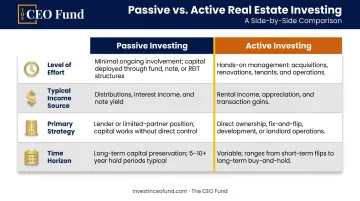
Passive vs. Active: A Quick Comparison
| Dimension | Passive Investing | Active Investing |
|---|---|---|
| Level of Effort | Minimal; capital is the primary contribution. | Substantial; requires ongoing time and work. |
| Typical Income Source | Fund distributions, interest, or mortgage payments. | Direct rental income or fix-and-flip profits. |
| Primary Strategy | Investing in funds, notes, or syndications. | Direct property ownership and management. |
| Time Horizon | Long-term (years) | Short-to-medium term |
Types of Passive Real Estate Investments
Passive real estate investing covers far more ground than most people realize — from publicly traded securities you can buy with a few dollars to private fund structures requiring accredited investor status. Here's how the main categories break down.
REITs and Real Estate Funds
Real Estate Investment Trusts (REITs) let investors buy shares in portfolios of income-producing properties — similar to buying stock. By law, REITs must distribute at least 90% of taxable income as dividends, making them a reliable income vehicle.
Real estate ETFs and mutual funds extend this concept further, bundling REIT exposure into a single tradable product.
Key characteristics:
- Exchange-listed REITs trade on public markets — high liquidity
- Entry point determined by share price and broker; no SEC-mandated minimum
- The FTSE Nareit All REITs index delivered 5.59% annualized over 10 years and 6.28% over 20 years through July 2026
- Investors have no control over individual property decisions
- Public non-listed REITs exist but offer limited redemption options and no national exchange market
Real Estate Crowdfunding and Syndications
Crowdfunding platforms let investors pool capital to co-fund specific projects. Minimums vary by platform: Fundrise starts at $10 for taxable accounts, RealtyMogul's REIT products begin at $5,000, and CrowdStreet minimums start at $25,000.
Syndications are a related structure used for larger deals — a sponsor manages the deal while limited partners (passive investors) provide capital. Most syndications are restricted to accredited investors and offer higher return potential than REITs, but with substantially lower liquidity. Capital is typically locked up for the duration of the project.
Mortgage Note Investing
Mortgage note investing flips the script on traditional real estate. Instead of owning property, you purchase the debt instrument — the mortgage note — and become the lender. Borrowers send you monthly principal and interest payments, backed by real estate collateral. No Tenants, Toilets, or Tiles to manage.
Notes fall into two categories:
- Performing notes — current payments generate steady, predictable cash flow
- Non-performing notes — purchased at a discount when borrowers default, with upside tied to resolution (modification, payoff, or asset recovery)
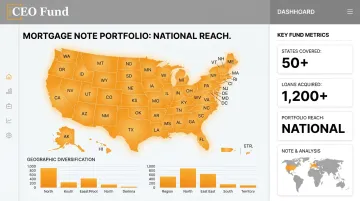
Accredited investors can access this strategy through professionally managed funds. The CEO Fund (Miramar, FL) has acquired 500+ loans across 50+ states, letting investors participate in a diversified note portfolio without sourcing or servicing individual loans.
Fund Manager Carlo Turner — a Certified Note Investing Specialist with 15+ years in corporate finance — oversees acquisition and underwriting across the portfolio.
Turnkey Rental Properties
Turnkey rentals involve purchasing a fully renovated, tenant-occupied property managed entirely by a third-party property manager. NAR reports that property managers typically charge 7%–10% of monthly rental income.
This is more passive than self-managing, but direct ownership still means repair reserves, vacancy exposure, and some ongoing oversight. The Census Bureau reported a national rental vacancy rate of 7.3% in Q1 2026, a useful benchmark when evaluating expected cash flow.
Key Benefits of Passive Real Estate Investing
Steady Income Without Trading Time for Money
Passive real estate strategies — mortgage note payments, private fund distributions, and syndication returns — generate consistent monthly or quarterly cash flow without requiring active involvement. According to the Federal Reserve's 2022 Survey of Consumer Finances, 12.9% of U.S. families owned residential property beyond their primary residence, reflecting widespread interest in real estate as an income source beyond traditional equities.
Portfolio Diversification
Real estate doesn't move in lockstep with traditional assets. A Nareit-hosted study found publicly traded real estate had a 0.56 correlation with U.S. equities and 0.16 with investment-grade bonds from 1993 to 2015. Private real estate funds and mortgage note portfolios tend to show even lower correlation, since their returns are driven by contractual note payments rather than market sentiment. Adding real estate exposure can meaningfully reduce overall portfolio volatility — particularly during equity market downturns.
Inflation Protection
Real estate values and rental rates have historically risen alongside or ahead of inflation. Nareit's research shows real estate income returns have tended to outperform equities during high-inflation periods, buffering portfolios when purchasing power erodes. For mortgage note investors specifically, fixed interest rates lock in yields at origination — meaning the real return improves as inflation climbs over the holding period.
Long-Term Wealth Accumulation
Real estate has appreciated significantly over time. The Case-Shiller national index stood 78.2% above its 2006 peak and 145.5% above its 2012 trough as of September 2025 — a strong long-run case, even accounting for the 27.4% drawdown between 2006 and 2012. For fund participants, compounding distributions can be reinvested to accelerate wealth building.
Professional Management
Private real estate funds are managed by experienced professionals, freeing investors from the operational burden entirely. Depending on your capital level and accreditation status, passive options include:
- Private mortgage note funds — quarterly distributions, asset-backed by real estate collateral, accredited investors only
- Real estate syndications — pooled capital for development projects with structured return timelines
- Self-directed IRA allocations — tax-advantaged exposure to real estate debt without active management
Risks and How to Manage Them
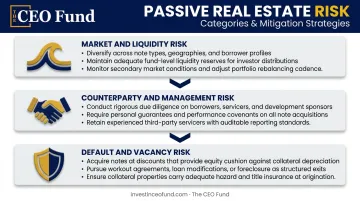
No investment eliminates risk entirely. Passive real estate has its own risk profile — different from active investing, but still real.
Market and liquidity risk:
- Real estate values fluctuate with economic conditions and interest rates
- Syndications, private funds, and note portfolios are often illiquid — you may commit capital for months or years
- Maintain a diversified portfolio with liquid assets alongside real estate; understand lock-up periods before committing
Counterparty and management risk:
- Passive investors delegate control to sponsors, managers, or platforms
- Management quality directly affects returns
- Vet track records thoroughly, review fee structures, confirm credentials, and look for evidence that manager and investor incentives are aligned
Default and vacancy risk:
- Property-based strategies face vacancy risk during economic downturns
- Note investors face borrower default risk — though the delinquency rate on single-family residential mortgages held by commercial banks was just 1.89% in Q1 2026, signaling healthy credit conditions across the cycle
- Geographic diversification across multiple markets and experienced operators with established underwriting processes reduce concentration risk
Within the default risk category, first-lien position offers note fund investors one concrete structural advantage: a senior legal claim on the underlying property that takes priority over other creditors in a default scenario — something unsecured fixed-income investments can't replicate.
How to Start Investing in Passive Real Estate
Step 1 — Define your goals and investor profile. Clarify what you want: monthly cash flow, long-term appreciation, or both. Determine your risk tolerance, investment horizon, and whether you qualify as an accredited investor (earning $200K+/yr individually, $300K+/yr jointly, or holding $1M+ net worth excluding primary residence). Accreditation unlocks access to private funds and syndications.
Step 2 — Assess your capital and liquidity needs. REITs and ETFs are liquid and low-cost; private funds and syndications require larger minimums and multi-year commitments. Match your vehicle to both available capital and your timeline.
Step 3 — Educate yourself on each investment type. Understand how returns are generated (dividends, note payments, appreciation), what fees apply (management fees, carried interest, acquisition fees), and what exit options exist.
Step 4 — Conduct thorough due diligence. Review the sponsor or fund manager's:
- Years in business and total deal volume
- Geographic diversification across markets
- Default rates, occupancy history, or loan performance data
- Investor reporting transparency and communication cadence
For private funds, request the Private Placement Memorandum (PPM) or equivalent offering document and review it with a financial or legal advisor before committing capital.

Step 5 — Choose a vehicle and start. For accredited investors seeking passive, asset-backed income without property management involvement, a professionally managed mortgage note fund is worth evaluating. The CEO Fund, for example, carries a 10+ year track record, has acquired 500+ loans across 50+ states, and is led by a team with 40+ years of combined real estate experience. Its Confidential Private Offering Memorandum details the full structure — review it with a financial or legal advisor before committing capital. Starting with a diversified, professionally managed vehicle is generally a sound first step before adding complexity.
Tax Advantages of Passive Real Estate Investing
Depreciation Deductions
For direct property investments, the IRS allows investors to deduct the cost of the property over its useful life — 27.5 years for residential and 39 years for commercial real property. This creates a paper loss that can reduce taxable income even while the property appreciates, offering a recurring offset against passive income year after year.
1031 Exchanges and Capital Gains Deferral
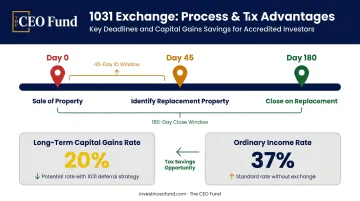
When selling an investment property, investors can defer capital gains taxes by rolling proceeds into a like-kind property through a Section 1031 exchange. Key deadlines and rate advantages:
- Identify a replacement property within 45 days of the sale
- Close on the replacement within 180 days
- Long-term capital gains (assets held over one year) are taxed at a top rate of 20% in 2024, compared to 37% for ordinary income — a 17-point spread before the 3.8% Net Investment Income Tax applies
Self-Directed IRAs and 401(k)s
Accredited investors can use self-directed IRAs or solo 401(k)s to invest in mortgage notes, private fund interests, and syndications — per SEC guidance, these are among the alternative assets permissible in self-directed accounts. Returns can then grow tax-deferred (traditional) or tax-free (Roth), compounding the value of passive real estate income over time.
The CEO Fund supports IRA and 401(k) participation, with its mortgage fund investments well-suited for tax-advantaged retirement accounts. Specific custodian arrangements are best confirmed directly with the fund.
Note that certain transactions — borrowing from the IRA or pledging it as loan security — constitute prohibited transactions under IRS rules. Always consult a qualified tax professional for guidance specific to your situation.
Frequently Asked Questions
Frequently Asked Questions
Is property good passive income?
Real estate can be an excellent passive income source, but the effort required varies widely by strategy. REITs, private funds, and mortgage note investments deliver income with minimal ongoing involvement. Self-managing rental property does not — it trades one job for another.
What is the 2% rule for property?
The 2% rule is a rough screening guideline: a rental property may be a strong cash-flow candidate if monthly rent equals at least 2% of the purchase price. It applies mainly to direct rental property evaluation and is less relevant to REITs or mortgage note funds, where income is evaluated differently.
How can investors reduce tax on rental income?
Common strategies include depreciation deductions, operating expense write-offs, 1031 exchanges to defer capital gains, and self-directed IRA investing for tax-deferred or tax-free growth. Tax outcomes vary by situation, so consult a qualified tax professional before acting.
What is the most passive way to invest in real estate?
REITs and professionally managed private funds (such as mortgage note funds) are among the most hands-off options. Investors contribute capital and receive income without managing property, tenants, or maintenance.
Can I invest in real estate passively through my IRA?
Through a self-directed IRA, investors can hold mortgage notes, private fund interests, and syndications, with returns growing in a tax-advantaged account. IRS rules and custodian requirements are specific to this structure, so consult a self-directed IRA specialist before making any moves.
What is mortgage note investing and how does it work?
Mortgage note investing means purchasing the loan secured by a property, not the property itself. The investor collects monthly principal and interest payments from the borrower, with the real estate serving as collateral. There are no ownership, management, or maintenance responsibilities — funds like The CEO Fund structure this as a lender-not-landlord model, where investors act as the bank.