Introduction
Picture a contracting firm with a full pipeline, six-figure invoices going out the door, and a healthy profit margin on paper. Three months later, it can't make payroll. That scenario plays out more often than most business owners want to admit, because revenue on an income statement doesn't pay a supplier invoice due on Friday.
This is the gap working capital management exists to close. ACCA's guidance on working capital management makes a point that trips up a lot of business owners: even established, viable, profitable businesses can fail simply because cash isn't available when they need it.
Growth, seasonal swings, and slow-paying customers can drain a business dry while its books still look fine.
This article covers what working capital management actually involves, the ratios that reveal financial health, what strong management looks like day to day, and the strategies that keep cash flowing. We'll also touch on why sophisticated investors treat working capital metrics as a window into a company's operational discipline.
Key Takeaways
- Working capital equals current assets minus current liabilities, keeping short-term obligations covered.
- Cash, receivables, inventory, and payables need constant balancing to avoid tying up capital.
- Current ratio, quick ratio, and cash conversion cycle reveal financial health at a glance.
- Disciplined management lowers financing costs and signals strength to lenders and investors.
What Is Working Capital Management and Why Does It Matter?
Working capital management (WCM) is the ongoing process of overseeing a company's short-term assets and liabilities so it always has enough liquidity to run daily operations, without leaving excess cash idle and earning nothing. It demands daily attention, touching nearly every operating decision a business makes.
Why Profitable Companies Still Run Out of Cash
Many businesses that look strong on their income statement still shut down because they can't meet near-term obligations, whether that's payroll, supplier invoices, loan payments, or tax bills, when those come due. Profitability and liquidity measure two different things entirely, and confusing them is one of the more common ways businesses get into trouble.
The Balancing Act: Liquidity vs. Profitability
Good WCM means chasing two goals that often pull in opposite directions:
- Liquidity - having enough cash and near-cash assets to cover obligations as they fall due
- Profitability - avoiding excess capital parked in low-yield or non-productive assets
Hold too much cash and you leave returns on the table. Hold too little and one slow month can trigger a liquidity crisis. Effective management means finding the right point between those extremes for your specific business.
The Working Capital Formula
The math itself is simple:
Working Capital = Current Assets − Current Liabilities
| Category | Includes |
|---|---|
| Current Assets | Cash, accounts receivable, inventory, marketable securities, prepaid expenses |
| Current Liabilities | Accounts payable, short-term debt, accrued expenses, unearned revenue |
For example, a distributor with $500,000 in current assets and $350,000 in liabilities has $150,000 in working capital to fund growth. A subscription software company may run negative working capital comfortably, collecting customer payments before paying suppliers.
A positive result generally signals financial health. A negative result can flag liquidity risk, though as we'll cover shortly, that isn't automatically a red flag for every business model.
The Core Components of Working Capital Management
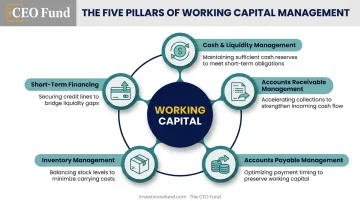
Working capital lives in five distinct places inside a business, and each one needs its own management approach.
Cash and Liquidity Management
Cash is the most critical current asset a business holds. Companies need enough on hand to cover immediate obligations, but idle cash sitting in a checking account earning next to nothing is also an opportunity cost. Most businesses handle this with a tiered approach:
- Keep a minimum operating cash buffer for day-to-day needs
- Park near-term reserves in liquid instruments like money market funds
- Deploy longer-term surplus into short-duration investments that still preserve access
Accounts Receivable Management
Once cash reserves are dialed in, the next lever is how quickly money actually comes in the door. Receivables are money customers owe for goods or services already delivered. Weak credit policies, slow invoicing, and inconsistent collections all delay cash inflows and stretch out the cash conversion cycle. Tightening this process through faster invoicing, clearer credit terms, and structured follow-up strengthens working capital without borrowing a single dollar.
Accounts Payable Management
Just as receivables control money coming in, payables control money going out. Payables are what a business owes its suppliers. Managing them well means negotiating favorable terms to hold onto cash longer, without triggering late fees or damaging supplier relationships.
There's a balance here. Pay too early and you deplete cash you didn't need to spend yet. Pay too late and you risk supply disruptions—or worse, a supplier who stops shipping altogether.
Inventory Management
For businesses carrying physical goods, inventory often represents a large share of current assets. Too much ties up capital and raises storage and obsolescence risk. Too little causes stockouts and lost sales. Demand forecasting and Just-in-Time (JIT) principles help keep inventory lean and tied to actual demand instead of guesswork.
Short-Term Financing as a Lever
Credit lines, commercial paper, and short-term loans can bridge temporary cash gaps, particularly during seasonal demand spikes or periods of rapid growth. These tools work best as a strategic buffer, not a permanent substitute for weak internal cash discipline.
How to Measure Working Capital Health: Key Ratios and Metrics
Current Ratio and Quick Ratio: The First Screen
| Ratio | Formula | What It Signals |
|---|---|---|
| Current Ratio | Current Assets ÷ Current Liabilities | Above 1.5-2.0 is often considered healthy; below 1.0 can signal stress |
| Quick Ratio (Acid-Test) | (Current Assets − Inventory) ÷ Current Liabilities | Above 1.0 generally signals solid near-term liquidity |
The quick ratio strips out inventory because it isn't always easy to convert to cash quickly. That makes it a more conservative gut check on true liquidity than the current ratio alone.
Industry context matters more than either number in isolation. CSIMarket data on grocery store financials shows the sector routinely running a current ratio near 0.93, well below the "textbook" healthy range. Favorable supplier payment terms let grocers operate lean without any liquidity trouble. A software company posting that same number would raise a very different set of questions.
Cash Conversion Cycle (CCC)
The CCC measures how long cash stays tied up before it comes back to the business:
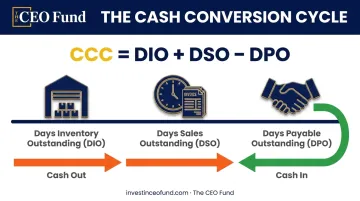
CCC = Days Inventory Outstanding (DIO) + Days Sales Outstanding (DSO) − Days Payable Outstanding (DPO)
- DIO: how long inventory sits before it sells
- DSO: how long it takes to collect from customers
- DPO: how long the company takes to pay its own suppliers
A shorter CCC means cash comes back faster, freeing it up for other uses. Some large retailers post a negative CCC entirely, collecting from customers before they even pay their own suppliers, a structural advantage most smaller businesses simply don't have.
Tracking DSO and DPO as Standalone Signals
Watching DSO and DPO trends over time tells you more than any single snapshot:
- Rising DSO means collections are slowing down
- Falling DSO means the AR process is tightening
- Rising DPO means payables are stretching further, which is fine until it strains supplier goodwill
The goal is lowering DSO while extending DPO strategically, without burning trust with vendors along the way.
Working Capital Turnover Ratio
Working Capital Turnover = Net Sales ÷ Average Working Capital
A higher ratio means the business generates more revenue per dollar of working capital deployed. A lower ratio can mean assets are underused or working capital has become bloated. This metric works best measured against close industry peers rather than treated as an absolute benchmark.
What Good Working Capital Management Looks Like
Good WCM isn't defined by a single magic number. It's consistent discipline across every component: timely collections, smart payables strategy, lean inventory, and proactive cash forecasting. The goal is keeping money constantly moving through the business instead of letting it sit dormant in the wrong place.
Signs It's Working
- The business pays obligations comfortably without leaning on emergency credit
- The current ratio sits in a healthy range for its specific industry
- The cash conversion cycle trends shorter over time
- Growth opportunities, whether expansion, new equipment, or acquisitions, get funded without scrambling for last-minute financing
Warning Signs It Isn't
- DSO (Days Sales Outstanding) creeping upward, meaning collections are slowing
- Inventory growing faster than revenue
- Repeated reliance on short-term debt just to cover operating expenses
- Frequent late payments to suppliers
- Current or quick ratios declining across multiple reporting periods
These patterns often point to one of two underlying problems: overtrading, where a business grows faster than its working capital can support, or over-capitalization, where resources sit unused and inefficient. Both erode the margin for error a business needs to survive a rough quarter.
Proven Strategies to Maintain Positive Cash Flow
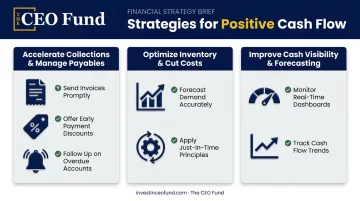
Accelerate Collections, Manage Payables Strategically
On the collections side:
- Offer early payment incentives to customers
- Automate invoicing to cut delays
- Build structured follow-up procedures for overdue accounts
On the payables side:
- Negotiate longer payment terms with suppliers
- Take early payment discounts when cash allows it
Even a few days shaved off Days Sales Outstanding (DSO), multiplied across a full customer base, compounds into real cash freed up for other uses.
Optimize Inventory and Cut Unnecessary Costs
Right-sizing inventory starts with better demand forecasting and JIT principles, plus regular audits to clear obsolete stock before it becomes dead weight on the balance sheet. Beyond inventory, look at operating costs directly. Automating manual processes or renegotiating vendor contracts frees up working capital without touching revenue at all.
Improve Cash Visibility and Forecasting
A pattern shows up constantly across businesses of every size: they don't run out of cash because they don't have any, they run out because they don't know where it is. PwC's 2025 global working capital study backs this up. Covering more than 17,000 listed companies, it estimated roughly €1.84 trillion (about $2 trillion) sitting idle in excess working capital. That scale of waste traces largely to poor visibility and process discipline, not a genuine lack of capital.
Effective visibility requires:
- Building short- and medium-term cash flow forecasts
- Consolidating visibility across every account
- Setting clear thresholds that trigger action before a gap appears, not after
How Investors Read Working Capital as a Financial Signal
Accredited investors, CFOs, and institutional finance professionals don't just glance at a P&L when evaluating a business for acquisition, partnership, or lending. They dig into working capital metrics specifically.
A company with strong positive working capital and a tight cash conversion cycle signals operational discipline and lower risk. Chronic negative working capital, absent a business model built to support it, raises real questions about sustainability and management quality.
Liquidity Discipline Isn't Just a Business Concern
The same logic applies to personal and portfolio liquidity for high-net-worth investors and corporate finance professionals. Consistent, reliable cash flow, whether from business operations or a passive investment allocation, is what allows capital deployment over the long term without a forced, bad-timing asset sale.
This is where mortgage note investing occupies an interesting niche. For accredited investors who already understand working capital metrics and want a cash flow stream that isn't tied to operating business risk, The CEO Fund's mortgage note investment model offers a structurally different approach: investors hold positions backed by real estate-secured mortgage notes, acting as the lender rather than the landlord.
That structure produces income without the responsibilities of direct ownership:
- Monthly or quarterly cash distributions from borrower payments
- No tenant management or leasing responsibilities
- No property maintenance or repair obligations
- No direct property tax exposure
For a CFO or fund manager already fluent in reading DSO, DPO, and CCC trends, that kind of contractual, asset-backed income stream functions as a natural complement. It offers cash flow with low correlation to equity markets and none of the operational drag.

The Bigger Picture
Working capital does more than guide internal management decisions: it sends a clear signal to outside stakeholders. A business that consistently generates positive working capital can self-fund its own growth, honor its commitments on time, and absorb economic shocks without panicking. That's the kind of company worth funding, partnering with, or acquiring.
Frequently Asked Questions
What is good working capital management?
Good working capital management means balancing current assets and liabilities so a business can meet obligations on time and maintain adequate liquidity. It shows up in healthy current ratios, declining DSO (days sales outstanding), and a short cash conversion cycle.
What are the main components of working capital management?
The five core components are cash and liquidity management, accounts receivable management, accounts payable management, inventory management, and short-term financing. Each needs active oversight to keep working capital positive and efficient.
What are three examples of working capital?
Three common examples: cash in a business checking account available for payroll, outstanding customer invoices (accounts receivable), and finished goods inventory ready for sale. All three are current assets.
What is the difference between positive and negative working capital?
Positive working capital means current assets exceed current liabilities, so short-term obligations are covered. Negative working capital means liabilities exceed assets, a liquidity risk unless the business model, like large retail chains, is built to operate that way.
What is the cash conversion cycle and why does it matter?
The CCC equals DIO (inventory days) plus DSO (receivable days) minus DPO (payable days), measuring how fast a business turns investments back into cash. A shorter cycle frees up liquidity faster, while a longer one keeps more capital locked up.
How does working capital management affect a company's ability to grow?
Strong WCM lets a business self-fund growth, whether that's new markets, equipment, or headcount, without heavy reliance on external financing. Poor WCM stalls growth as cash gets consumed by operational gaps instead of strategic investment.