

The appeal is straightforward: you invest, a professional sponsor manages everything, and you collect distributions. But syndications are private, illiquid, and structurally complex. Getting in without understanding the mechanics is how investors make expensive mistakes.
This guide covers what syndication is, how it works, the GP/LP structure, accredited investor qualifications, key risks, and what to look for in a sponsor — giving you a practical framework before you commit capital.
Key Takeaways
- Real estate syndication pools capital from multiple investors, with a sponsor managing operations and passive investors sharing returns
- Investors participate as Limited Partners (LPs), with limited liability and no active management responsibilities
- Most syndications require SEC-defined accredited investor status to participate
- Structures range from equity and debt to deal-based and fund-based models, each with distinct risk and return profiles
- Evaluating the sponsor's track record, fees, and transparency matters more than any single deal metric
What Is Real Estate Syndication and How Does It Work?
Real estate syndication is a legal structure where multiple investors pool capital to acquire, develop, or manage a real estate asset. A sponsor leads the deal — sourcing, structuring, and managing the investment on behalf of everyone involved.
This is not a REIT or a crowdfunding platform. It is a private, typically illiquid investment offered under SEC Regulation D exemptions — specifically Rule 506(b) or Rule 506(c):
- Rule 506(b): No general solicitation; allows unlimited accredited investors plus up to 35 sophisticated non-accredited investors
- Rule 506(c): General solicitation is permitted, but every investor must be accredited and verification must be documented
Both exemptions permit unlimited capital raising, require a Form D filing within 15 days of the first sale, and produce restricted securities.
The deal lifecycle typically follows this sequence:
- Deal sourcing — sponsor identifies and underwrites the opportunity
- Syndication structuring — legal entity formed, terms documented in a PPM
- Capital raising — investors commit capital via Subscription Agreement
- Acquisition — property or asset purchased
- Asset management — sponsor manages operations, distributions paid periodically
- Exit — sale, refinancing, or recapitalization returns capital to investors
Syndications are a multi-year commitment. Preqin's research on private real estate places typical hold periods at 3–10 years — plan for full illiquidity before committing capital.
Equity vs. Debt Syndications
Equity syndications give investors an ownership stake in the property. Returns come from cash flow distributions during the hold period and appreciation at sale. Higher return potential, but returns depend entirely on property performance.
Debt syndications position investors as lenders rather than owners. The fund holds the mortgage note and collects borrower payments, which flow back to investors as fixed income. This structure prioritizes capital preservation and predictable income over appreciation upside.
The CEO Fund operates within this debt model, acquiring performing and non-performing mortgage notes backed by real estate collateral across 50+ states. Investors receive cash distributions from borrower mortgage payments without managing any property directly. One position from the fund's portfolio illustrates the structure: a Florida mortgage note purchased for $80,900 generates $764.39 per month over a 21.5-year term, producing a 10% ROI with a total payback of $197,212, secured by a property valued at $115,000.
Deal-Based vs. Fund-Based Models
| Model | Structure | Key Tradeoff |
|---|---|---|
| Deal-based | Capital committed to one specific property | Investors evaluate the asset directly; no diversification |
| Fund-based | Capital pooled across a portfolio managed by the sponsor | Broader diversification; requires greater trust in sponsor allocation |
The choice between these models shapes how much control you have over individual asset selection — and how much concentration risk you carry. Fund-based structures like The CEO Fund's mortgage note portfolio spread exposure across hundreds of positions in multiple markets; deal-based structures trade that diversification for direct visibility into each asset.
Benefits of Real Estate Syndication for Accredited Investors
Access to Institutional-Scale Assets
The NCREIF Property Index covered 12,996 U.S. institutional properties valued at over $900 billion as of Q1 2026 , a scale of institutional real estate that individual investors simply cannot access alone. Syndications open the door to large multifamily complexes, commercial buildings, construction projects, and mortgage portfolios that would require millions to acquire independently.
The CEO Fund's $20M SUNRISE Project illustrates this directly: a ground-up Florida community delivering 1,000 homes, a marina, and a golf course — the kind of development that requires sophisticated capital coordination far beyond any single investor's reach.
Passive Income Without the Landlord Burden
LP investors collect distributions without dealing with tenants, maintenance, or property management. For high-net-worth professionals, this is often the primary draw: their time is finite, and active property management consumes it.
The CEO Fund's debt model takes this further by eliminating what they call the "three T's": Tenants, Toilets, and Tiles. Borrowers make monthly mortgage payments; the fund handles all active management; distributions flow directly into investor savings or IRA accounts.
Tax Advantages
Key tax benefits available through syndication structures include:
- Depreciation pass-throughs — Schedule K-1 reporting reduces taxable income without a cash outlay
- Cost segregation — can accelerate depreciation on qualifying components (the IRS notes that classification depends on specific facts and applicable authorities)
- IRA and Solo 401(k) compatibility — returns grow tax-deferred or tax-free inside self-directed retirement accounts
The CEO Fund is structured as a pass-through entity, enabling depreciation benefits and avoiding double taxation at both the fund and investor levels. Passive-activity rules and basis limitations may affect how quickly losses can be used, so consult a tax advisor for your specific situation.
Preferred Returns and Waterfall Structures
Tax structure is only part of the equation. Most well-structured syndications also protect investors through a preferred return, typically 7–10% annually per Origin Investments' analysis of private real estate fee structures, paid out before the sponsor earns any profit share. This means investor capital is prioritized in the distribution hierarchy before the GP participates in upside.
GP vs. LP: Understanding Your Role as a Passive Investor
General Partner (GP) / Sponsor
The GP carries the full operational and fiduciary weight of a deal. That includes:
- Sourcing and underwriting the deal
- Structuring the syndication and securing financing
- Managing day-to-day operations and vendor relationships
- Providing investor reporting throughout the hold period
- Executing the exit strategy (sale, refinance, or disposition)
How GPs are compensated:
- Acquisition fee: 1%–2.5% of the purchase price, paid at closing
- Asset management fee: 1%–2% of gross revenue or invested equity, paid ongoing
- Sponsor promote (carried interest): typically 20% of profits after LPs receive their preferred return
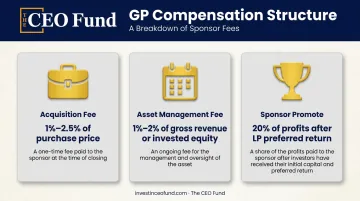
Fee bases matter as much as percentages. A 2% fee on gross revenue hits differently than 2% on net operating income. Review the full fee schedule carefully, because these costs directly reduce net returns to LPs.
Limited Partner (LP) / Passive Investor
The LP contributes capital in exchange for a defined ownership stake or debt position, receives periodic distributions, and reviews sponsor-provided reports. LPs do not participate in day-to-day decisions, and their financial exposure is capped at their invested amount.
Key LP rights you should expect:
- Full access to the PPM, Operating Agreement, and Subscription Agreement before signing
- Periodic financial reports covering portfolio performance and distributions
- Schedule K-1 tax documents delivered annually
- Limited voting rights on major decisions — property sale, refinancing, or capital calls
Read every document before signing. A sponsor who discourages that review — or rushes you past it — is telling you something important about how they operate.
Accredited Investor Requirements: Do You Qualify?
The SEC defines three primary pathways to accredited investor status:
- Income threshold: More than $200,000 individually, or $300,000 jointly with a spouse or partner, in each of the prior two years — with reasonable expectation of the same in the current year
- Net worth threshold: More than $1 million individually or jointly, excluding the value of your primary residence
- Professional certification: Holders of Series 7, Series 65, or Series 82 licenses in good standing qualify regardless of income or net worth
The SEC expanded this definition effective December 8, 2020, adding the professional certification pathway.
Two additional rules apply in specific situations:
- Entities (corporations, LLCs, trusts): Qualify with more than $5 million in assets, provided the entity wasn't formed solely to invest in the offered securities. Entities also qualify when all equity owners are individually accredited.
- Verification: Accreditation isn't government-certified — sponsors must confirm your status before accepting your investment, typically through tax returns, brokerage or bank statements, or a letter from a CPA, attorney, or registered investment advisor. Self-certification alone does not satisfy the 506(c) standard.
Key Risks to Understand Before You Invest
Illiquidity tops the risk list for a reason. Unlike stocks or REITs, syndication investments cannot be sold on an exchange. The SEC explicitly warns that investors in private placements may need to hold restricted securities indefinitely, and total loss is possible. A sponsor's projected hold period is not the same as a contractual liquidity right.
Sponsor and execution risk runs a close second. Poor underwriting assumptions, mismanagement, or economic miscalculations by the GP can reduce or eliminate returns entirely.
Market conditions compound this exposure. The ULI's 2024 Emerging Trends report found commercial property values down 16% from their 2022 peak, with multifamily down 14.5% by summer 2023 and transaction volume down 70% from 2021 levels. No syndication is sheltered when broader markets turn.
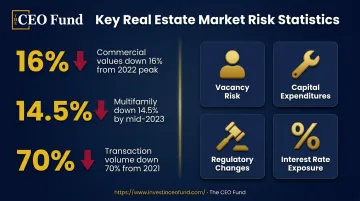
Property-specific risks include:
- Vacancy rate increases beyond underwriting assumptions
- Unexpected capital expenditures eating into cash flow
- Regulatory changes such as rent control legislation
- Interest rate increases that compress refinancing options or cap rates
Ask every sponsor how they stress-test their underwriting — specifically, what vacancy rate and interest rate assumptions they model in a downside scenario. A vague response tells you everything you need to know.
How to Evaluate a Real Estate Syndication Sponsor
Track Record and Transparency
Look for sponsors with a verifiable history of closed deals and consistent investor communication across multiple market cycles. Operational depth matters — a sponsor who has navigated both rising and declining markets demonstrates resilience that a newer entrant cannot.
The CEO Fund's 10+ year track record and 500+ loans acquired across 50+ states illustrates the kind of documented history accredited investors should seek. The team's combined 40+ years of real estate experience, led by President Desi Arnez and Fund Manager Carlo Turner (a Certified Note Investing Specialist with 15+ years in corporate finance), gives the fund the operational range to source, manage, and exit positions across property types and economic conditions that less experienced teams haven't encountered.
Fee Alignment and Co-Investment
Review the full fee schedule — acquisition, management, and disposition fees — before committing capital. Then ask whether the sponsor has invested their own capital alongside LPs. Sponsors who have committed their own money to the same fund have a direct financial stake in performance — not just in fees collected. That alignment matters when markets tighten.
Legal Documentation and Compliance
Confirm the offering is structured under Reg D (Rule 506(b) or 506(c)) and that the following documents are provided before you sign anything:
- Private Placement Memorandum (PPM) — full disclosure of terms, risks, and use of proceeds
- Operating Agreement — governance, voting rights, and control provisions
- Subscription Agreement — your formal commitment as an investor
The CEO Fund makes offers exclusively through a Confidential Private Offering Memorandum, restricting access to accredited investors as required under the Securities Act of 1933. Before committing capital, request references from prior investors and verify that all three documents are in hand — if a sponsor resists either, that is a clear signal to walk away.
Frequently Asked Questions
What is the minimum investment for real estate syndication?
Minimums vary by deal size, sponsor, and investor type. Many private syndications start in the $25,000–$100,000 range, though this is not a universal standard — some larger funds require more. Contact sponsors directly or review their offering documents for current minimums.
How much money do I need to be an accredited investor?
The two primary thresholds are $200,000 in annual income (or $300,000 jointly with a spouse) for the past two years, or a net worth exceeding $1 million excluding your primary residence. Holders of Series 7, Series 65, or Series 82 licenses also qualify regardless of income or net worth.
Are real estate syndications a good investment?
For the right investor, syndications offer real passive income and portfolio diversification — but suitability depends on your risk tolerance, liquidity needs, and time horizon. Sponsor quality and deal structure are the primary determinants of performance. No structure guarantees returns.
What is the difference between a GP and LP in a real estate syndication?
GPs (sponsors) manage all operational aspects and earn fees plus a profit share after investors receive their preferred return. LPs (passive investors) contribute capital, receive distributions, and hold limited liability with no active management role.
Can I invest in real estate syndications through my IRA?
Yes — a self-directed IRA or Solo 401(k) can hold syndication investments, allowing returns to grow tax-deferred or tax-free. This requires a qualified self-directed IRA custodian and careful compliance with IRS prohibited transaction rules.
How long is capital typically tied up in a real estate syndication?
Preqin places typical private real estate hold periods at 3–10 years, with exits occurring through property sale, refinancing, or recapitalization. Plan for full illiquidity throughout the hold period regardless of projected timelines.