
This guide is written specifically for accredited investors, high-net-worth individuals, and wealth-conscious families who want more than generic saving tips. What follows is a practical, sequentially structured framework — five actionable steps that build toward a lasting financial legacy.
Key Takeaways
- Generational wealth includes financial assets (investments) and crucial non-financial values (financial literacy).
- 70% of wealthy families fail to preserve wealth past the second generation — deliberate strategy is not optional
- The five core steps: build a financial foundation → invest for long-term growth → generate passive income → establish estate planning structures → instill financial literacy
- Mortgage notes offer passive, real estate-backed income without the responsibilities of being a landlord.
- Estate plans must be reviewed regularly to reflect changes in laws and family circumstances.
What Is Generational Wealth?
Generational wealth is the accumulation and intentional transfer of financial assets — real estate, investment portfolios, business interests, and cash — from one generation to the next, compounding over time to create lasting family security.
Two distinct components make it work:
- Financial generational wealth: Investable assets, property, retirement accounts, and business equity
- Non-financial generational wealth: Financial literacy, entrepreneurial mindset, professional networks, and shared family values
Both are necessary. Families who transfer assets without transferring knowledge frequently watch those assets disappear within a generation — a pattern documented in research showing roughly 70% of family wealth is lost by the second generation, and 90% by the third.
The distinction between leaving an inheritance and building generational wealth matters more than most families realize. An inheritance is reactive — it happens at death. Generational wealth-building is proactive and structural, beginning decades before any transfer occurs.
Why Most Families Fail to Preserve Wealth Across Generations
The pattern has a name across cultures: "shirtsleeves to shirtsleeves in three generations." The first generation builds wealth. The second maintains it. The third spends it.
Research on why these transitions fail points to four primary causes:
| Threat | Share of Failed Transitions |
|---|---|
| Trust and communication breakdown | 60% |
| Inadequately prepared heirs | 25% |
| No shared family mission | 12% |
| Adviser, legal, or tax failures | 3% |
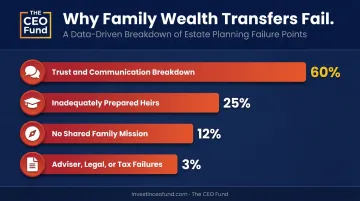
Notice what's at the bottom: taxes and legal failures account for just 3% of failed transitions. The real threats are human — communication breakdowns, unprepared heirs, and the absence of shared values.
The four threats that compound over time:
- Financial illiteracy in heirs — wealth passed without context gets spent, not grown
- Outdated estate plans — a plan written in 2010 may not reflect today's family size, tax environment, or asset mix
- Tax erosion — estate tax exposure affects fewer than 0.25% of estates, but those above the federal exemption threshold face a 40% rate on amounts exceeding it
- Without a family mission, heirs often disagree about purpose, priorities, and strategy — eroding both assets and relationships
Each of these failures is preventable. The five steps that follow address them directly.
The Five Steps to Building Generational Wealth
Step 1: Build a Solid Financial Foundation
Generational wealth cannot be built on a fragile base. Before pursuing external investments, the foundation must be secure.
Three non-negotiables:
- Eliminate high-interest debt — carrying high-rate consumer debt while investing elsewhere creates negative net returns
- Build a fully funded emergency reserve — CFP Board guidance recommends 3–6 months of essential expenses; more may be appropriate with variable income or elevated employment risk
- Maximize tax-advantaged retirement contributions — for 2025, the 401(k) employee deferral limit is $23,500 ($7,500 additional catch-up for ages 50+, and a special $11,250 catch-up for ages 60–63); the combined IRA limit is $7,000 ($1,000 additional for ages 50+)
For accredited investors, this step also means mapping the full net worth picture — including illiquid assets — so capital allocation decisions are made with complete information rather than partial visibility. You cannot make sound investment decisions without knowing what you actually have.
Step 2: Invest in Long-Term Growth Assets
Compounding is the engine of wealth accumulation — and time is the fuel that drives it.
A hypothetical $10,000 investment at 7% annual return grows to $76,122 over 30 years — at 8%, it reaches $100,626. These are constructed illustrations using SEC calculator methodology, not forecasts. But the math illustrates why starting early amplifies outcomes so dramatically.
For context on the starting rate: Fidelity notes the S&P 500 has averaged about 10% annually since its 1957 launch — though past performance is not a reliable forecast.
Core investment vehicles for long-term growth:
- Diversified index funds and equity portfolios
- Tax-advantaged retirement accounts (401k, Roth IRA, traditional IRA)
- Bonds and fixed income for balance and stability
- Alternative assets and private placements for risk-adjusted diversification
High-net-worth investors should look beyond standard equity portfolios. Geographic and asset class diversification — across property types, geographies, and investment structures — reduces volatility while building the wealth base over time.
Step 3: Generate Passive Income Through Real Estate and Alternative Investments
Passive income-generating assets produce recurring cash flow that can be reinvested, preserved, or transferred across generations — without requiring active management from investors or their heirs.
Traditional real estate income vehicles:
- Rental properties (active management required)
- REITs — market-correlated, publicly traded
- Private real estate funds — pooled exposure, typically lower management burden
The case for mortgage fund investing:
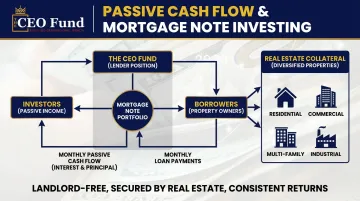
For accredited investors who want real estate-backed returns without landlord responsibilities, mortgage fund investing offers a compelling alternative. When an investor purchases a mortgage fund, they step into the lender position — collecting monthly borrower payments backed by real estate collateral, with no involvement in property management, tenant relations, or maintenance.
The CEO Fund has built its entire model around this approach. With 500+ loans acquired across 50+ states, the fund offers diversified exposure to performing Grade A–C mortgage funds across single-family, multifamily, commercial, and mobile home park assets — no Tenants, Toilets, or Tiles. Monthly borrower payments flow directly into investors' savings or IRA accounts.
Holding mortgage funds through a self-directed IRA or 401(k) allows income to compound tax-deferred (traditional) or tax-free (Roth). The CEO Fund's pass-through structure also allows depreciation benefits to flow directly to investors, avoiding double taxation.
This combination — passive income plus tax-sheltered compounding — is especially effective for multi-decade wealth accumulation.
Step 4: Establish Estate Planning and Wealth Transfer Structures
Estate planning is not a one-time event. It is an ongoing discipline.
Essential legal instruments:
- Will — directs how probate assets are distributed; without one, state intestacy law decides
- Revocable trust — allows assets to pass outside probate while retaining control during the grantor's lifetime; assets remain in the taxable estate
- Irrevocable trust — removes assets from the taxable estate; generally cannot be changed after establishment
- Powers of attorney — allow designated individuals to act on your behalf for financial and healthcare decisions
- Beneficiary designations — on all accounts and insurance policies; these override what a will says
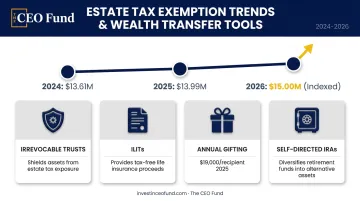
Federal estate tax thresholds (per individual):
| Year | Basic Exclusion |
|---|---|
| 2024 | $13.61 million |
| 2025 | $13.99 million |
| 2026 (enacted) | $15.00 million (indexed) |
Above these thresholds, taxable estates face a 40% federal rate. Irrevocable Life Insurance Trusts (ILITs) allow life insurance proceeds to pass outside the taxable estate, provided ownership and control requirements are met. Annual gifting — $19,000 per recipient in 2025 — allows ongoing wealth transfer without touching the lifetime exemption.
Estate plans must be reviewed regularly. Births, marriages, divorces, deaths, and significant asset changes all require updates. An outdated plan can be as harmful as having no plan at all.
Step 5: Instill Financial Literacy and a Wealth Culture in the Next Generation
Legal structures protect wealth. What transfers it across generations is culture — and this is the most overlooked step in the process. The research confirms it. Deloitte's 2024 family office study of 354 single-family offices found that 30% considered the next generation unprepared for succession and 28% considered them unqualified. With 41% expecting generational succession within 10 years, this readiness gap is urgent.
Practical actions for preparing heirs:
- Begin age-appropriate financial education early — not just concepts, but involvement
- Include younger family members in investment decisions and portfolio reviews
- Have open conversations about the family's wealth, values, and expectations
- Establish a family council or governance structure with defined roles and communication norms
- Create a family mission statement that articulates shared values around wealth
Families who approach wealth transfer as both a cultural and legal process — not just a legal one — have significantly better outcomes. Governance structures reduce the likelihood of conflict over inheritance and provide a framework for decision-making across generations.
Key Factors That Shape Your Generational Wealth Strategy
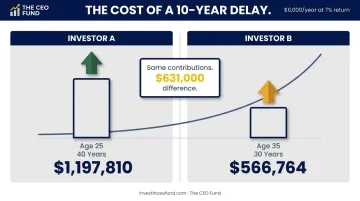
Time horizon and compounding matter more than most investors realize. Consider two hypothetical investors both contributing $6,000 annually at a constant 7% return:
- Investor A (starts at 25, 40 years of contributions): $1,197,810
- Investor B (starts at 35, 30 years of contributions): $566,764
A single decade of delay creates a $631,000 gap — from identical contribution amounts.
Asset mix and liquidity shape how well a portfolio survives market cycles. A generational wealth portfolio should balance:
- Growth-oriented assets (equities, private placements)
- Income-generating assets (mortgage funds, rental income, real estate investment trusts)
- Liquid reserves sufficient to weather downturns without forcing the liquidation of long-term positions
Regulatory environments shift — sometimes dramatically. The 2026 estate tax exemption rising to $15 million is one recent example. It replaced the previously anticipated TCJA sunset reduction, catching many families whose advisors had modeled lower exemption thresholds. Families with significant assets should work with advisors who actively monitor legislative changes, not just review plans at year-end.
Common Myths About Building Generational Wealth
Myth 1: Generational wealth is only for the ultra-wealthy.
Successful generational wealth builders are distinguished by consistent strategy, disciplined planning, and a commitment to financial education across generations — not by the size of their starting capital. The compound arithmetic demonstrated earlier shows that even modest, consistent investment started early creates meaningful multi-generational outcomes. There is no IRS, SEC, or CFP Board threshold that defines "generational wealth." Strategy and intent matter more than starting capital.
Myth 2: Real estate wealth requires owning property directly.
Direct property ownership is one path. It is not the only path, and for many accredited investors, it is not the most efficient one. Passive vehicles allow investors to access real estate-backed returns without ownership responsibilities:
- Mortgage note funds — investors hold a legal lender position and collect monthly borrower payments secured by real estate collateral
- Real estate syndications — pooled capital structures that share ownership economics without direct management duties
- Private placements — structured deals offering real estate-backed returns with defined terms
The CEO Fund's model illustrates this directly: investors who purchase mortgage funds through the fund hold a lender position, collect monthly borrower payments, and retain real estate as underlying collateral — without ever managing a property. As the fund describes it, investors are the bank, not the landlord.
Frequently Asked Questions
What is considered generational wealth?
Generational wealth refers to financial assets — real estate, investments, businesses, cash — intentionally passed from one generation to the next, along with non-financial assets like financial literacy, values, and networks that enable heirs to manage and grow what they receive.
How much money do you need for generational wealth?
There is no universal dollar threshold. Generational wealth is defined more by strategy and intent than by a specific amount — modest investments begun early and compounded over decades can create meaningful multi-generational wealth, as the contribution comparison above illustrates.
What is the 3 generation rule for wealth?
The "shirtsleeves to shirtsleeves" pattern describes how the first generation builds wealth, the second maintains it, and the third dissipates it. Deliberate financial education, estate planning, and family governance structures break this cycle.
What assets are best for building generational wealth?
The strongest generational wealth portfolios typically combine diversified investment portfolios, real estate (both direct and passive vehicles like mortgage funds), family businesses with succession plans, and life insurance. Diversification across these categories builds multiple income streams while reducing concentration risk.
How do you protect generational wealth from taxes?
Key tools include irrevocable trusts, annual gifting within IRS exclusion limits ($19,000 per recipient in 2025), irrevocable life insurance trusts, and self-directed IRAs. Proactive planning with a qualified estate attorney and financial advisor is essential — the specifics change as laws evolve.
Can you build generational wealth without owning property directly?
Yes. Passive vehicles like mortgage fund funds and real estate syndications let accredited investors earn real estate-backed returns and consistent cash flow without direct ownership or property management. For those seeking scalable, hands-off exposure, these structures are often more practical than owning property outright.