If you're ever sued, face a business judgment, or file for bankruptcy, the account type holding your retirement savings could determine whether creditors can touch a single dollar of it. One wrong rollover decision can quietly strip away protection you didn't even know you had.
With $28.1 trillion currently sitting in 401(k) and IRA accounts combined as of Q1 2026 (ICI), understanding these legal distinctions isn't a niche concern. It's a real question for anyone building wealth through retirement accounts, especially business owners, contractors, and high-liability professionals.
This guide breaks down exactly how 401(k)s and IRAs differ in bankruptcy, in lawsuits, and after a rollover, so you can make an informed decision before a crisis forces your hand.
Key Takeaways
- 401(k)s covered by ERISA get unlimited bankruptcy and lawsuit protection under federal law
- Traditional and Roth IRAs are capped at $1,711,975 in bankruptcy (2025 figure)
- SEP, SIMPLE, and qualifying rollover IRA amounts fall outside that cap entirely
- Lawsuit protection for IRAs depends entirely on your state of residence
- Rolling a 401(k) into an IRA can trade federal lawsuit protection for state-by-state uncertainty
401(k) vs IRA: Quick Comparison
Here's the side-by-side breakdown that matters most when creditors come knocking:
| Protection Type | 401(k) (ERISA-covered) | Traditional/Roth IRA |
|---|---|---|
| Bankruptcy protection | Unlimited — no federal dollar cap | Capped at $1,711,975 (cases filed on/after April 1, 2025) |
| Lawsuit protection (outside bankruptcy) | Federal ERISA shield applies nationwide | Governed entirely by state exemption law |
| SEP/SIMPLE IRA | Not applicable | Excluded from the bankruptcy cap |
| Rollover funds from a 401(k) | Stays uncapped if left in the plan | Amounts attributable to the rollover, plus earnings, are disregarded when calculating the cap |
Why ERISA Makes the Difference
Corporate 401(k)s must include an anti-alienation clause under federal law. This provision blocks most creditors from reaching plan assets, regardless of what state you live in. IRAs were never built with this same federal shield.
Solo 401(k) and Self-Directed IRA Nuances
Two account types complicate the picture:
- Solo 401(k): Owner-only plans fall outside ERISA Title I since owners aren't legally employees, but they typically keep the same uncapped bankruptcy protection as corporate plans.
- Self-directed IRA: Carries the same federal bankruptcy cap as any IRA, even when holding alternative assets like mortgage notes. A prohibited transaction under IRC 408(e)(2) can void the account's tax status entirely.
What Is a 401(k) and How Is It Protected?
A 401(k) is an employer-sponsored retirement plan. When it's covered by ERISA, meaning it's a standard corporate plan with actual employees, it carries some of the strongest creditor protection available under U.S. law.
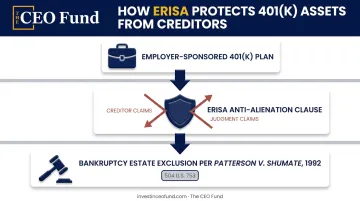
The core mechanism is ERISA's anti-alienation rule: plan benefits generally cannot be assigned, alienated, or attached by judgment creditors. In bankruptcy, this protection extends further.
The landmark case Patterson v. Shumate (504 U.S. 753, 1992) established that a plan's ERISA-required transfer restriction is enforceable under bankruptcy law. This means the interest can be excluded from the bankruptcy estate altogether. That case didn't involve a 401(k) specifically, but it set the controlling rule that ERISA-qualified plans still rely on today.
For business owners and high-liability professionals, this distinction carries real weight:
- Doctors and surgeons facing malpractice exposure
- Contractors with construction liability risk
- Entrepreneurs personally guaranteeing business debt
Use Cases of 401(k) Creditor Protection
Someone anticipating a lawsuit or bankruptcy filing often benefits most from keeping funds inside an employer-sponsored 401(k) rather than moving them elsewhere. A self-employed contractor, for example, might open a Solo 401(k) specifically because it delivers uncapped bankruptcy protection alongside retirement savings, even without full ERISA coverage.
The tradeoff: Solo 401(k) owners lose the federal lawsuit shield that corporate plan participants enjoy, so their outside-bankruptcy protection depends on state statute.
What Is an IRA and How Is It Protected?
Traditional and Roth IRAs work differently. They're not employer-sponsored, so they fall outside ERISA entirely. That means their protection structure is split into two separate questions: what happens in bankruptcy, and what happens everywhere else.
In bankruptcy, federal law caps Traditional and Roth IRA protection at $1,711,975 for cases filed on or after April 1, 2025, adjusted from the previous $1,512,350 threshold (Federal Register). A judge can raise that cap if the interests of justice require it, but it's not automatic.
Two exceptions matter here:
- SEP and SIMPLE IRAs are expressly excluded from that dollar cap
- Rollover IRA funds originating from a 401(k), including their earnings, are also disregarded when calculating the cap
Outside bankruptcy, there's no federal safety net. Protection depends entirely on the state you live in, which typically falls into one of three categories:
- Full exemption, regardless of amount
- A fixed dollar cap set by state statute
- Protection limited to what's "reasonably necessary" for support
Use Cases of IRA Creditor Protection
Self-directed IRAs receive the exact same bankruptcy and state-law protections as traditional IRAs, provided the account keeps its IRS-qualified status intact. That protection is part of why self-employed individuals, retirees consolidating old 401(k)s, and investors seeking more control gravitate toward these accounts. A standard 401(k) limits you to a curated menu of mutual funds, but a self-directed IRA opens the door to real estate-backed assets, including mortgage notes, private placements, and tax liens.
Firms like The CEO Fund manage mortgage note investments structured specifically for self-directed IRA and 401(k) capital, routing monthly borrower payments directly into an investor's retirement account. Because those payments stay inside the IRA wrapper, they carry the same creditor protections as any other IRA asset — accredited investors gain real estate exposure without sacrificing the account's legal safeguards.

401(k) vs IRA: Which Offers Better Protection?
There's no universal answer here. The right account depends on a handful of personal factors:
- Lawsuit exposure: Higher-liability professionals generally benefit more from ERISA's uniform federal shield
- State of residence: Some states fully protect IRAs; others cap protection sharply
- Rollover plans: Moving funds out of a 401(k) can trade federal lawsuit protection for state-dependent rules
- Investment flexibility needs: Alternative assets typically require a self-directed IRA or Solo 401(k)
If maximum creditor protection is the priority, keep funds in an employer 401(k) or open a Solo 401(k). If investment flexibility matters more, and you've confirmed your state's IRA exemption level, a self-directed IRA may be worth the tradeoff.
Real-World Scenario
Consider a self-employed real estate investor with $400,000 sitting in an old employer 401(k). Tired of market-dependent mutual fund returns, they roll the funds into a self-directed IRA to access mortgage note investments instead.
This investor's trigger usually has little to do with legal protection. What drives the rollover is the appeal of passive monthly income backed by real estate collateral instead of returns tied to stock market swings.
Platforms like The CEO Fund let accredited investors deploy self-directed IRA or Solo 401(k) capital into mortgage notes. This structure combines the tax-deferred (or tax-free, for Roth accounts) growth of a retirement account with the stability of real estate-backed lending.
Before making that move, this investor should confirm two things:
- Their state's IRA exemption level, since the rollover shifts protection from federal ERISA rules to state law
- That the $1,711,975 federal bankruptcy cap still comfortably covers their balance
Protection level should never be the only factor in this decision. Align your account choice with both your legal risk exposure and your long-term income goals.
Conclusion
Neither account "wins" outright. A 401(k), especially one covered by ERISA, delivers stronger and more uniform federal protection against creditors and lawsuits. An IRA trades some of that certainty for far greater investment flexibility, with a protection level that shifts depending on your state and a federal cap that applies in bankruptcy.
The right choice comes down to your personal risk exposure, where you live, and what you want your retirement dollars actually invested in—whether that's traditional securities or alternative assets like mortgage notes. Before rolling over a single dollar, talk to a financial advisor or attorney who understands both the legal safeguards and the investment tradeoffs involved.
Frequently Asked Questions
Are 401(k) and IRA protected from lawsuits?
401(k)s covered by ERISA have near-absolute protection from ordinary lawsuits under federal law. IRA protection against lawsuits depends entirely on your state's exemption statute and varies widely from state to state.
Can I lose my 401(k) if the market crashes?
A market crash reduces your account's value through investment losses, but it has nothing to do with creditor protection. Legal shielding from lawsuits and bankruptcy stays intact regardless of market performance.
Does rolling over a 401(k) into an IRA reduce creditor protection?
Rollover funds generally keep their unlimited bankruptcy protection since amounts attributable to the rollover are excluded from the IRA cap. However, they lose the blanket ERISA lawsuit shield and become subject to state law instead.
Is a Solo 401(k) protected from creditors the same way as a corporate 401(k)?
Not exactly. Solo 401(k)s aren't technically ERISA-covered since owners aren't considered employees of their own business. Many states extend similar strong protections under their own statutes, but it's not automatic.
What is the IRA bankruptcy protection limit in 2025?
The federal cap is $1,711,975 for cases commenced on or after April 1, 2025. SEP, SIMPLE, and qualifying rollover IRA amounts are excluded from this cap altogether.
Are retirement accounts protected from all types of claims, like divorce or IRS debt?
No. Creditor protections don't apply to qualified domestic relations orders in divorce, federal tax levies, or federal criminal fines and restitution, no matter which account type holds your savings.