Put emergency cash in an IRA, and you might face penalties trying to access it. Leave retirement money sitting in a savings account for decades, and you're leaving serious growth on the table.
Consider the gap: top HYSAs currently pay around 4% APY, while the S&P 500 has averaged 11% annually over the past 20 years, according to Fidelity's historical market data. That's not a knock against savings accounts. It's a reminder that the "best" account depends entirely on your timeline.
Key Takeaways
- HYSAs work best for emergency funds and goals within 1-5 years, with no market risk.
- IRAs (Traditional or Roth) provide tax-advantaged retirement growth, including self-directed options for real estate-backed assets.
- Neither account is universally better; the right choice depends on your time horizon and liquidity needs.
- Most financial planners recommend using both accounts together, not choosing one over the other.
High-Yield Savings Account vs. IRA: Quick Comparison
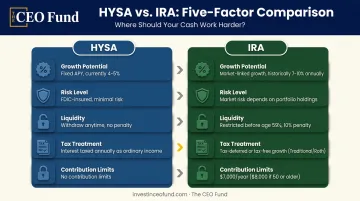
Here's how these two tools stack up across the factors that matter most:
| Factor | HYSA | IRA |
|---|---|---|
| Growth potential | Fixed APY, typically 3.85%-4.15% currently | Variable, tied to investments chosen |
| Risk level | Very low; FDIC/NCUA insured | Ranges from low to market-exposed |
| Liquidity | Withdraw anytime, no penalty | Roth contributions accessible anytime; earnings restricted until 59½ |
| Tax treatment | Interest taxed annually as income | Tax-deferred (Traditional) or tax-free (Roth) |
| Contribution limits | None | $7,500/year combined limit for 2026 |
Growth Potential and Risk
An HYSA's rate is fixed and predictable. What you see is what you get, and your principal never moves. An IRA has no built-in rate at all—your return depends entirely on what's inside it, whether that's index funds, bonds, CDs, or alternative assets like mortgage notes.
This means IRA risk isn't fixed either. A Traditional IRA holding CDs behaves almost like a savings account. A Roth IRA loaded with growth stocks can swing wildly year to year.
Contribution Limits and Access
One key difference stands out: HYSAs have zero contribution caps. Deposit $500 or $500,000, and the bank doesn't care.
IRAs work differently. They cap you at $7,500 per year for 2026, with an $8,600 total for savers 50 and older, per the IRS's updated retirement contribution rules.
That limit exists because IRAs come with a tax break. The government caps how much of your income can dodge taxes each year.
What Is a High-Yield Savings Account?
A high-yield savings account is a deposit account, usually offered by online banks, that pays significantly more interest than a standard savings account. Online banks skip the overhead of physical branches, and they pass those savings on to depositors through higher rates.
The core benefit is simple: your money grows while staying completely liquid. No lockup periods or withdrawal penalties, and no exposure to market swings.
Why the Insurance Matters
Every dollar in an FDIC-insured bank or NCUA-insured credit union is protected up to $250,000 per depositor, per institution, per ownership category. If the bank fails, your money doesn't disappear.
That said, HYSAs come with tradeoffs:
- Interest earned counts as taxable ordinary income every year.
- Growth is modest compared to long-term investing.
- Rates are variable and can drop when the Federal Reserve cuts rates.
Best Use Cases for an HYSA
HYSAs shine in specific scenarios:
- Emergency funds covering 3-6 months of expenses
- Home down payments you'll need within a year or two
- Near-term goals like a wedding, tuition payment, or planned trip
- Parking large sums temporarily, such as home sale proceeds or a bonus, while you decide on a longer-term strategy
The yield gap tells the real story here. A July 2026 Bankrate survey found top online HYSAs paying up to 4.15% APY, compared to a national average savings rate of just 0.61%—roughly six times higher. If your cash is sitting in a traditional bank account, you're leaving money on the table for no reason.
What Is an IRA?
An Individual Retirement Account (IRA) is a tax-advantaged account built for long-term retirement savings, not daily spending. Two main types exist:
- Traditional IRA: Contributions may be tax-deductible now; you pay taxes when you withdraw in retirement.
- Roth IRA: Contributions come from after-tax income; qualified withdrawals in retirement are completely tax-free.
Roth accounts have another key perk: no required minimum distributions during the owner's lifetime. Your money can keep compounding as long as you want.
Standard vs. Self-Directed IRAs
Most IRAs hold stocks, bonds, and mutual funds through a brokerage. But a self-directed IRA (SDIRA) opens the door to alternative assets, including:
- Real estate
- Mortgage notes and promissory notes
- Private placements
This route appeals to investors who want real estate exposure without becoming a landlord. Self-directed IRA investors seeking passive, real estate-backed income often turn to mortgage note funds like The CEO Fund. Monthly note payments can flow directly into a tax-advantaged retirement account instead of a taxable brokerage.
Best Use Cases for an IRA
IRAs fit situations where your money has decades to work, not months:
- Retirement savings meant to grow for 20, 30, or 40 years
- Wealth transfer planning, since Roth IRAs pass to heirs without the original owner ever paying tax on qualified growth
- Diversification beyond stocks, using an SDIRA to hold mortgage notes for monthly cash flow while skipping the "3 T's" (Tenants, Toilets, Tiles) of direct ownership
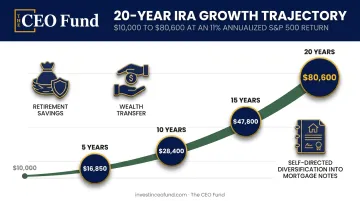
Over a 20-year horizon, the math favors long-term investing. Applying the S&P 500's historical 11% annualized return, a $10,000 investment grows to roughly $80,600, a scenario that simply isn't possible in a rate-capped HYSA. This is illustrative, not a guarantee, since actual IRA returns depend entirely on what you hold inside the account.
High-Yield Savings Account vs. IRA: Which Is Better?
Neither account wins outright. The right answer depends on four factors:
- Time horizon: Need the money within 5 years? Choose an HYSA. Investing for retirement 15+ years out? Choose an IRA.
- Liquidity needs: HYSAs offer instant access. IRA earnings are restricted until 59½, with limited exceptions.
- Income eligibility: Roth IRA contributions phase out for single filers earning $153,000-$168,000 MAGI (per 2024 IRS guidelines), and married couples at $242,000-$252,000.
- Risk tolerance: HYSAs guarantee your principal. IRAs carry investment risk, though that risk is a tradeoff for higher potential growth.
When to Choose an HYSA
Pick a high-yield savings account if you're building an emergency cushion, saving for a near-term purchase, or need guaranteed access to your cash without penalty.
When to Choose an IRA
Pick an IRA, including a self-directed option, if you're investing for retirement decades away and want tax-advantaged compounding working in your favor. Self-directed IRAs extend that advantage beyond stocks and bonds, letting investors — including clients of The CEO Fund — direct retirement capital into real estate-backed mortgage notes instead.
High earners above the Roth income thresholds aren't locked out entirely. A backdoor Roth conversion (contributing to a Traditional IRA, then converting to Roth) remains a common workaround, though it triggers tax reporting via Form 8606 and depends on your existing IRA balances.
Real-World Example: Diversifying Retirement Savings Beyond a Savings Account
Consider an accredited investor who built a solid emergency fund years ago, then kept adding to that same HYSA out of habit. By the time they checked the balance, it held $180,000—far more than any emergency fund needs.
The problem: that excess cash was earning around 4% APY, fully taxable, while inflation eroded its real value. Growth stalled. Nothing was compounding toward retirement.
The fix was straightforward. The investor opened a self-directed IRA and allocated a portion of that idle cash into mortgage note investments through The CEO Fund. Instead of one flat interest rate, the note investments targeted 8%-12% annual returns, with monthly payments flowing directly into the IRA custodial account.
The difference matters:
- Inside a Traditional or Roth IRA, that income compounds without annual tax drag.
- The investor never has to manage tenants, handle repairs, or pay property taxes; the borrower handles it instead.
- Returns are backed by real estate collateral, not market speculation.

The real takeaway: idle cash sitting past your emergency fund is a missed growth opportunity. Strategic investors use both accounts, layering HYSA safety with IRA tax-advantaged growth.
If you're an accredited investor sitting on excess savings and exploring self-directed IRA options for real estate-backed passive income, The CEO Fund's mortgage note offerings are worth a closer look. Reach out to the team to see how monthly note payments could fit into your retirement strategy.
Conclusion
There's no single winner in the HYSA vs. IRA debate, and there shouldn't be. An HYSA protects and grows your short-term cash safely. An IRA, especially a self-directed one, builds long-term, tax-advantaged wealth through vehicles like mortgage notes and other alternative assets, the specialty of firms like The CEO Fund.
The practical outcome is straightforward: emergency preparedness now, and compounding, passive retirement income later. Most investors don't have to pick a side—they build both into the same financial plan.
Frequently Asked Questions
Is it better to put money in an IRA or savings account?
It depends on your goal. Savings accounts suit short-term needs and emergencies, while IRAs are built for long-term, tax-advantaged retirement growth. Many people benefit from using both.
Which is better, a high-yield savings account or a 401(k)?
A 401(k) is an employer-sponsored retirement account, often with matching contributions, meant for long-term growth. An HYSA is for liquid, short-term savings. They serve different purposes and aren't substitutes for each other.
How much will $10,000 in a Roth IRA be worth in 20 years?
Using the S&P 500's historical 11% annualized return as an illustration, $10,000 could grow to roughly $80,600 in 20 years. Actual results vary based on investment choices, and qualified withdrawals would be tax-free.
Can I lose money in a Roth IRA?
Yes. Roth IRA funds are typically invested in market-based assets like stocks or mutual funds, so values can fluctuate and losses are possible, unlike the fixed returns of an HYSA.
Should I max out my Roth IRA before saving in a high-yield account?
Build your emergency fund in an HYSA first. Once your short-term liquidity needs are covered, prioritize Roth IRA contributions for long-term retirement growth.
Can a self-directed IRA hold real estate or mortgage note investments?
Self-directed IRAs can hold alternative assets such as real estate and mortgage notes, letting accredited investors diversify beyond stocks and bonds while keeping tax advantages. Firms like The CEO Fund specialize in mortgage notes that fit directly into these accounts.