Get this wrong, and the consequences add up fast. Missed deadlines can trigger income taxes, a 10% early withdrawal penalty, and mandatory withholding you didn't expect. You could also lose access to investment options that better fit your goals.
Part of the confusion comes from loose language. People use "rollover" and "conversion" interchangeably online, but they carry very different tax consequences. This article breaks down what a rollover actually is, why investors choose to do it, the exact steps involved, the tax rules that apply, and the mistakes that trip up even experienced savers.
Key Takeaways
- An old 401(k) offers four paths: stay put, transfer to a new plan, roll to an IRA, or cash out.
- Direct rollovers move funds custodian-to-custodian, avoiding taxes, penalties, and mandatory 20% withholding.
- Pre-tax funds roll into a traditional IRA tax-free; Roth IRA rollovers trigger a taxable conversion.
- Indirect rollovers must complete within 60 days, or the IRS taxes the funds as income.
- Self-directed IRAs unlock access to alternative assets, including real estate-backed mortgage notes.
What Is a 401(k) to IRA Rollover?
A 401(k) to IRA rollover transfers retirement funds from an employer-sponsored plan into an IRA, keeping the money invested without triggering an immediate tax bill in most cases. The point is simple: preserve tax-deferred (or tax-free, for Roth accounts) growth while gaining more control over how those dollars are invested.
Here's where terminology matters. A rollover keeps the same tax treatment, such as moving pre-tax 401(k) money into a traditional IRA. A conversion changes the tax treatment, like moving pre-tax funds into a Roth IRA. That distinction determines whether you owe taxes this year.
Traditional IRA vs. Roth IRA Destinations
A Traditional/Rollover IRA preserves tax-deferred growth, matching the pre-tax status of most 401(k) contributions. A Roth IRA holds after-tax dollars, offering tax-free growth and withdrawals in retirement.
The type of 401(k) money you're moving determines where it can go without creating a tax bill:
| 401(k) Money Type | IRA Destination | Tax Treatment |
|---|---|---|
| Pre-tax contributions & earnings | Traditional IRA | Generally no current tax |
| Pre-tax contributions & earnings | Roth IRA | Taxable in the year converted |
| Designated Roth 401(k) balance | Roth IRA | Generally tax-free |
| Non-Roth after-tax contributions | Roth IRA | Contribution amount rolls tax-free |
If a single distribution contains both pre-tax and after-tax money, the IRS generally allows you to split it: pre-tax dollars go to a traditional IRA, after-tax dollars go to a Roth IRA. Handling both in the same transaction avoids an unnecessary tax hit.
Why Investors Convert a 401(k) to an IRA
The biggest driver is investment choice. Vanguard's How America Saves 2025 report found the average 401(k) plan offers 27.6 investment options (or 17.5 when target-date series count as one option). That's a fixed menu set by your employer's plan administrator.
An IRA flips that script. You can typically choose from:
- Individual stocks and bonds
- ETFs and mutual funds across virtually any sector
- Self-directed options for alternative assets
Investment choice isn't the only motivator, though. Consolidation is the second big driver. Three old 401(k)s from three former employers means three sets of login credentials, three beneficiary forms, and three separate rebalancing schedules. Rolling them into one IRA simplifies tracking and makes it far easier to manage your overall allocation.
Beyond Stocks and Bonds
Self-directed IRAs push this flexibility further. Instead of stocks and mutual funds, some investors direct retirement funds into real estate-backed alternatives, such as mortgage notes secured by physical property.
This is where The CEO Fund fits in. The fund allows accredited investors to direct IRA or 401(k) capital into cash-flowing mortgage note investments, positioning investors as the lender rather than the landlord.
There's no tenant management, no property maintenance, and no "3 T's" (tenants, toilets, tiles) to deal with. Instead, investors receive monthly or quarterly interest payments backed by real estate collateral.
This isn't a fit for every investor. Self-directed IRAs come with additional custodian requirements and IRS rules on prohibited transactions. But for someone specifically looking to diversify beyond a traditional fund menu, it's a legitimate reason to roll over.

How to Rollover a 401(k) to an IRA
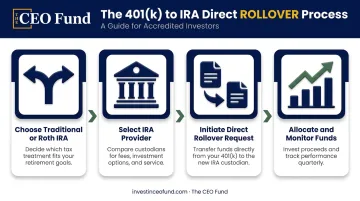
At a high level, the process runs through four stages: pick your IRA type, choose a provider, request a direct transfer, then allocate the funds once they arrive.
One decision matters more than any other: direct versus indirect rollover. A direct (trustee-to-trustee) rollover sends funds straight from your old plan to the new IRA custodian. You never touch the money, so there's no mandatory withholding and no 60-day clock ticking.
An indirect rollover pays you the check directly instead, and that's where most costly mistakes happen.
Step 1: Decide Between a Traditional or Roth IRA
Your choice hinges on tax timing. If you expect to be in a lower tax bracket in retirement than you are now, a traditional IRA's tax-deferred growth usually makes more sense. If you expect higher future rates, or simply want tax-free withdrawals later, a Roth IRA's after-tax structure can pay off, even though converting pre-tax funds means paying tax now.
Step 2: Choose an IRA Provider
Not all custodians are equal. Compare:
- Account fees - annual maintenance, trading commissions, and account closure fees
- Investment menu - standard brokerage options versus self-directed custodians that support alternative assets like mortgage notes
- Platform reputation - how responsive is customer support, and how established is the provider
Firms specializing in mortgage note investing, such as The CEO Fund, work directly with self-directed IRA custodians, giving rolled-over funds access to real estate-backed assets instead of just stocks and mutual funds.
Step 3: Initiate the Direct Rollover
Contact your former plan administrator and request a direct rollover. You'll typically need to provide:
- The receiving custodian's name and account number
- The tax character of the assets (pre-tax, Roth, after-tax)
- A distribution request form specific to that plan
Ask the plan to make the check payable to the new custodian "FBO" (for the benefit of) your name, not to you personally. That distinction alone determines whether withholding rules apply.
Step 4: Allocate and Monitor Your Funds
Once the funds land in your IRA, they usually sit in a cash or money market position until you actively invest them. Select your allocations based on your timeline and risk tolerance, then review the mix periodically as goals or market conditions shift. Funds sitting uninvested don't grow, so don't skip this step.
401(k) to IRA Rollover Rules and Tax Implications
Tax treatment depends heavily on how you execute the rollover, not just where the money ends up.
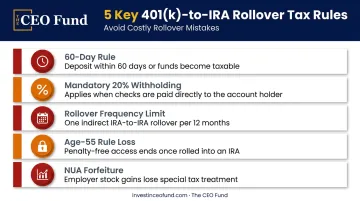
The 60-day rule. For indirect rollovers, the IRS requires the full distribution to be deposited into the new IRA within 60 days. Miss that window, and the entire amount becomes a taxable distribution. If you're under 59½, a 10% early withdrawal penalty typically applies on top of ordinary income tax.
Mandatory 20% withholding. When an employer plan pays a distribution directly to you (rather than to the new custodian), it must withhold 20% for federal taxes, even if you plan to roll the full amount over. To avoid tax on the withheld portion, you'll need to make up that 20% out of pocket when depositing into the IRA. You recover it later as a credit when you file your return.
Rollover frequency limits:
- No limit on the number of direct rollovers per year
- Only one indirect IRA-to-IRA rollover allowed per 12-month period across all your IRAs
- This limit doesn't apply to direct trustee-to-trustee transfers or plan-to-IRA rollovers
Roth conversions are taxable. Rolling pre-tax 401(k) funds into a traditional IRA is generally tax-free. Rolling the same pre-tax funds into a Roth IRA counts as a taxable conversion, with the full amount added to your ordinary income for that year.
The Age-55 Rule You Could Lose
Employees who separate from a job in or after the year they turn 55 can take penalty-free withdrawals directly from that employer's 401(k), even before 59½. This is a specific exception under IRS early distribution rules that doesn't carry over to IRAs. Roll that balance into an IRA, and you're locked out of penalty-free access until 59½. No exceptions.
Net Unrealized Appreciation (NUA)
If your 401(k) holds employer stock that's gained substantial value, a specialized strategy called NUA lets you pay ordinary income tax only on the original cost basis when distributed. The appreciation itself gets long-term capital gains treatment later when sold.
Rolling that stock into an IRA generally forfeits this treatment permanently, converting future gains back into ordinary income. This is a case where the "obvious" move (rolling everything into an IRA) can cost you real money.
Common Mistakes and Alternatives to a Rollover
Mistake #1: Assuming all rollovers are tax-free. Pre-tax-to-Roth conversions are the most common exception, and people are often surprised by the tax bill that shows up the following April.
Mistake #2: Taking the check personally. Once an indirect rollover check is in your hands, the clock starts. Miss the 60-day window, or forget to replace the 20% that was withheld, and part (or all) of the distribution becomes taxable.
Alternatives worth considering before you roll over:
- Leave funds in the old 401(k) if fees are low and investment options are solid. This also preserves ERISA creditor protections, which don't automatically extend to IRAs outside of bankruptcy.
- Roll into your new employer's plan if it offers lower costs, better funds, or loan access that IRAs don't provide.
- Roll into an IRA when you want broader investment choice, including self-directed options that open the door to alternative assets like mortgage notes, or when you plan to consolidate multiple old accounts.
There's no universal right answer. Compare fees, fund menus, and protections between your old plan and the receiving IRA before deciding.
Frequently Asked Questions
Is it worth converting a 401k to an IRA?
Often yes, for broader investment choice and easier account consolidation. But compare fees, investment menus, and creditor protections between your old plan and the IRA before deciding.
Can I transfer my 401k to an IRA without penalty?
A direct rollover avoids penalties and taxes entirely. An indirect rollover only avoids penalties if you deposit the full amount, including the withheld 20%, within 60 days.
Do I have to pay taxes when I convert a 401k to an IRA?
Rolling pre-tax funds into a traditional IRA is usually tax-free. Rolling pre-tax funds into a Roth IRA triggers ordinary income tax on the full converted amount that year.
How long does a 401(k) to IRA rollover take to complete?
Most direct rollovers take about 2-4 weeks, depending on your former plan administrator's processing speed. Some complete faster if done electronically between custodians.
Can I roll over my 401(k) into a self-directed IRA for real estate or alternative investments?
Yes. Self-directed IRAs allow rollover funds to be invested in alternatives like mortgage notes and real estate. Accredited investors can access mortgage note investments like those managed by The CEO Fund.
What happens if I miss the 60-day rollover deadline?
The distribution becomes taxable as ordinary income and may trigger a 10% early withdrawal penalty if you're under 59½. Limited IRS waivers exist for specific circumstances, such as bank errors or serious illness.