This guide is for both spouse and non-spouse beneficiaries trying to make sense of that decision. Getting it right affects how much tax you pay, how long your money keeps growing, and how much control you have over it. Getting it wrong can mean an unexpected tax bill or a missed deadline with real IRS consequences.
Terms like "inherited IRA," "10-year rule," and "direct rollover" get thrown around a lot, but rarely explained in plain terms. Below, we'll cover what conversion actually means, how it works step by step, the rules that shape your options, and when converting might not be the smartest move at all.
Key Takeaways
- Convert an inherited 401(k) via a direct trustee-to-trustee transfer into a properly titled Inherited IRA.
- Spouses have more flexibility than non-spouse beneficiaries, including rolling funds into their own IRA.
- Most non-spouse beneficiaries must empty the account within 10 years, except for certain "eligible designated beneficiaries."
- Taking a check instead of a direct transfer can trigger immediate taxation on the entire balance.
What Is an Inherited IRA and Why Convert Your 401(k) Into One?
An Inherited IRA is a specialized account that holds retirement assets transferred from a deceased person's 401(k) or IRA, held for the benefit of a named beneficiary. It's not your personal IRA. Instead, the account is titled to reflect both the original owner and you, the beneficiary.
Converting into one lets the money keep growing tax-deferred (or tax-free, if it was a Roth account) outside the restrictions of an employer plan. Left inside the original 401(k), your options are dictated entirely by that plan's rules, not by what's best for you.
Why Beneficiaries Choose to Convert
Employer 401(k) plans weren't built with beneficiaries in mind. Common limitations include:
- A narrow menu of mutual funds selected by the employer, not you
- Limited or no ability to manage required distributions flexibly
- Higher administrative fees baked into institutional plan pricing
- Multiple accounts scattered across different employers if the deceased worked for several companies
Moving funds into an Inherited IRA typically opens up a broader investment selection, often lower fees, and the convenience of consolidating assets in one place. It also simplifies managing required minimum distributions (RMDs), since IRA custodians generally offer more flexible withdrawal tools than workplace plan administrators.
What goes wrong when beneficiaries leave money in a restrictive 401(k)? Plans sometimes force a lump-sum distribution on non-spouse beneficiaries rather than allowing installments, which can trigger a massive tax bill in a single year. Others simply don't allow beneficiaries to keep the account open at all.
This isn't a small-scale issue. As of 2023, U.S. 401(k)-type plans held $7.918 trillion in assets across more than 105 million participants, according to Department of Labor data. A meaningful share of that money will pass to beneficiaries who then face this exact decision, often for the first time. Many discover that a self-directed IRA opens the door to alternative assets, such as real estate-backed notes, that a typical 401(k) menu never offered.

How to Convert an Inherited 401(k) to an IRA
Converting an inherited 401(k) is a trustee-to-trustee transfer: the plan administrator sends assets directly to a properly titled Inherited IRA, custodian to custodian. Because the money never touches your hands, it isn't reported as taxable income.
To start, you'll typically need:
- A certified copy of the death certificate
- The beneficiary designation form from the plan
- Account details from the plan administrator and the receiving IRA custodian
Where you land depends heavily on your relationship to the deceased. Spouses have more flexibility than everyone else, a distinction worth walking through step by step.
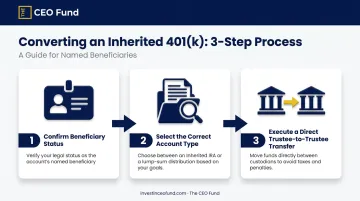
Step 1: Confirm Your Beneficiary Status
Not all beneficiaries are treated equally. The IRS recognizes several categories, each with different rules and timelines:
- Spouse – the most flexible category
- Non-spouse individual – generally subject to the 10-year rule
- Minor child of the deceased – gets special treatment until reaching age 21
- Eligible designated beneficiary – includes disabled or chronically ill individuals, and those less than 10 years younger than the deceased
This classification stems from the SECURE Act of 2019, which set the 10-year withdrawal window for most non-spouse heirs. Your status determines everything downstream, from which account type you can use to how quickly you must withdraw the funds.
Step 2: Select the Correct Account Type
Spouses can choose to roll inherited 401(k) funds into their own personal IRA, effectively treating it as if it were always theirs. They can also move the funds into an Inherited IRA instead, which preserves penalty-free withdrawal options a personal IRA doesn't offer.
Non-spouse beneficiaries don't have that choice. They must use an Inherited IRA, titled to show both the deceased and the beneficiary. The IRS prohibits non-spouses from rolling inherited funds into their own personal IRA; doing so triggers immediate taxation on the full balance.
Step 3: Execute a Direct Trustee-to-Trustee Transfer
Always request a direct rollover. Never let the plan cut a check made out to you personally. Under IRS guidance on eligible rollover distributions, a payment made directly to a non-spouse beneficiary isn't eligible for rollover treatment at all, meaning it becomes taxable immediately and can't be fixed later. Confirm the receiving account is titled correctly before initiating the transfer. Most custodians complete this transfer within 5–10 business days once paperwork is confirmed.
Key Rules and Factors That Affect Your Conversion Decision
Several variables shape whether conversion makes sense and how it plays out tax-wise:
- Spousal status changes everything. A surviving spouse can treat the account as their own, removing the 10-year deadline entirely and using standard RMD calculations based on their own life expectancy.
- The 10-year rule applies to most non-spouse beneficiaries. Per SECURE Act rules, the account must be emptied by year 10, with exceptions for minor children, disabled or chronically ill beneficiaries, and those close in age to the deceased.
- Whether the original owner had started RMDs matters. If the owner died on or after their required beginning date, beneficiaries must take annual withdrawals during the 10-year window—not just a final lump sum.
- Traditional vs. Roth changes the tax bill. Traditional 401(k) withdrawals are taxed as ordinary income. Qualified Roth withdrawals are typically tax-free, provided the five-year holding requirement was already met.
- Trusts named as beneficiary follow different rules. A trust isn't automatically treated as an individual; it must qualify as a "see-through" trust with identifiable beneficiaries to access favorable stretch options.
Investment flexibility opens up after conversion. Once inside a self-directed Inherited IRA, beneficiaries aren't limited to stocks, bonds, and mutual funds. Some custodians allow alternative, income-producing assets such as real estate-backed mortgage notes.
Funds like The CEO Fund structure their offerings to work with self-directed IRA and 401(k) accounts for accredited investors. That means an inherited account can generate monthly or quarterly passive income backed by real property, rather than sitting entirely in traditional securities.
Common Mistakes and When Conversion May Not Be the Right Choice
The single costliest mistake is taking an indirect distribution, meaning a check made out to you rather than a direct custodian-to-custodian transfer. Once that happens, the entire distribution becomes taxable in that year, and you lose the ability to roll it over into an Inherited IRA. There's no fixing it after the fact.
Another widespread misconception: beneficiaries often assume they can treat any inherited account as their own. That option is reserved exclusively for spouses. Non-spouse beneficiaries who try this end up with an improperly titled account and potential tax consequences.
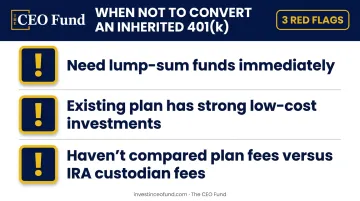
Conversion isn't always the right move immediately. Consider skipping or delaying it if:
- You need lump-sum funds right away for expenses like medical bills or estate costs
- The existing 401(k) already has strong, low-cost investment options
- You haven't yet compared plan fees against what a new IRA custodian would charge
One clear red flag: converting by default, without comparing plan rules, fees, or investment menus first, signals the decision wasn't made deliberately. Take the time to compare before moving anything.
Final Thoughts
Converting an inherited 401(k) into an IRA is a trustee-to-trustee transfer that preserves tax-deferred growth while giving you more control over how the money is invested.
The single most important factor in avoiding a costly mistake is knowing whether you qualify for spousal treatment or fall under non-spousal rules. That distinction shapes your account options, deadlines, and tax exposure.
Given how unforgiving the IRS is about indirect rollovers and missed 10-year deadlines, consult a qualified financial or tax advisor before initiating any transfer.
Once the rollover is complete, a self-directed IRA can open doors to alternative investments, such as the real estate-backed mortgage notes offered through The CEO Fund.
Frequently Asked Questions
Can I roll an inherited 401(k) into an IRA?
Most beneficiaries can move inherited 401(k) funds into an Inherited IRA through a direct trustee-to-trustee transfer. Only spouses have the additional option of rolling funds into their own personal IRA.
What is the best way to handle an inherited 401(k)?
The right approach depends on your beneficiary status, tax bracket, and timeline. A direct transfer into an Inherited IRA preserves the most flexibility and keeps growth tax-deferred.
Do beneficiaries pay taxes on an inherited 401(k)?
Withdrawals from a traditional inherited 401(k) or IRA are taxed as ordinary income. Qualified Roth withdrawals are typically tax-free, assuming the five-year holding rule was already satisfied.
Is it better to inherit a 401(k) or an IRA?
Tax rules are largely the same for both. IRAs tend to offer more investment flexibility, while 401(k)s sometimes carry lower fees or unique employer-negotiated fund options.
What happens if I don't convert my inherited 401(k) within the required time frame?
Missing the 10-year withdrawal deadline, or skipping required annual RMDs during that window, can trigger an IRS excise tax on the amount that should have been distributed.
Can I invest my inherited IRA in alternative assets like real estate or mortgage notes?
Yes. A self-directed Inherited IRA can hold alternative investments such as mortgage notes, offered by fund managers like The CEO Fund, giving beneficiaries passive income backed by real estate collateral instead of traditional stocks and bonds.