

Introduction
You apply for a credit limit increase. Denied. The reason code reads "amount of revolving balances is too high." Or maybe your score drops 15 points and you haven't missed a single payment.
The reason code targets your revolving accounts (credit cards and personal lines of credit), not installment loans like your mortgage or car loan. It measures how much of that available credit you're actually using.
Lenders and scoring models treat revolving debt differently from installment debt because revolving balances can spike or shrink month to month, making them a more immediate signal of financial strain. A high mortgage balance is expected. A high credit card balance relative to your limit is a red flag.
This article breaks down what actually causes this flag, what it costs you if you ignore it, and the specific habits that keep your utilization in check.
TL;DR
- High balances often stem from monthly debt, maxed cards, or shrinking limits
- Credit utilization matters most — stay under 30%, ideally below 10%
- Ignoring high balances risks loan denials, higher APRs, and blocked limit hikes
- Paying early and spreading spend across cards fixes utilization fast
- Reducing revolving debt frees up cash for other income strategies
Common Causes of High Non-Mortgage Account Balances
Non-mortgage account balances refer specifically to revolving credit — credit cards and lines of credit — not installment loans like auto loans, student loans, or mortgages. Scoring models weigh these two debt types differently, which is why your revolving balances get singled out even when your other loans are in good standing.
High balances rarely come from one bad decision. They usually stack up from a mix of spending habits, reporting timing, and shifts in how much credit you actually have available.
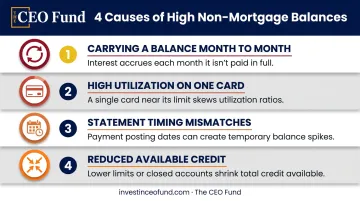
Cause 1: Carrying a Balance Month to Month
When you don't pay your statement in full, the remaining balance accrues interest and stays elevated relative to your limit. A common pattern: using a card for a larger purchase, paying only the minimum, and watching utilization stay stubbornly high for several billing cycles in a row.
Cause 2: High Utilization on One or More Individual Cards
Scoring models look at both your total utilization and the utilization on each individual card. One maxed-out card can trigger a "balances too high" flag even if your other cards sit untouched.
This often happens when someone concentrates spending on a single rewards card to earn points, unknowingly spiking that account's individual ratio while other available credit goes unused.
Cause 3: Statement Timing Mismatches
Issuers report your balance as of the statement closing date — not the day you pay it off. This means a large purchase made right before your statement cuts can show up as a high balance on your credit report. Even if you pay it off in full a few days later, before the due date, that higher balance is already locked in.
Cause 4: Reduced Available Credit
Closing an old account or having an issuer lower your credit limit shrinks the denominator in your utilization ratio. That means your ratio can rise without any new spending at all.
Consider this scenario: closing an unused card to "simplify" your wallet instantly raises utilization across every remaining account.
What Happens If High Balances Are Ignored
Unresolved high utilization drags your score down, and the fallout compounds from there. Lenders don't just use your score for approval decisions.
According to the Consumer Financial Protection Bureau (CFPB), they also use it to set your interest rate and credit limit. A lower score doesn't just cost you approvals; it costs you better pricing too.
The gap between score bands tells the story. Experian's Q3 2024 data shows:
| FICO Score Band | Average Utilization |
|---|---|
| Good (670–739) | 38.6% |
| Exceptional (800–850) | 7.1% |
That's a 31.5-point spread between good and exceptional credit, a clear signal that low utilization consistently accompanies stronger scores.
Once utilization climbs into that danger zone, certain warning signs tend to appear first.
Warning Signs You're About to Get Flagged for High Balances
Catching these early can prevent a ding to your score before it happens:
- A sudden score drop with no missed payments usually means utilization crept up unnoticed.
- A denied credit limit increase or new card application that cites "balances too high" as the reason.
- Utilization sitting above 30% across multiple statement cycles, not just one.
If you're seeing any of these signs, act now. Don't wait for your next statement to confirm it.
How to Prevent High Non-Mortgage Account Balances
Preventing high balances takes a handful of repeatable habits, applied every billing cycle.
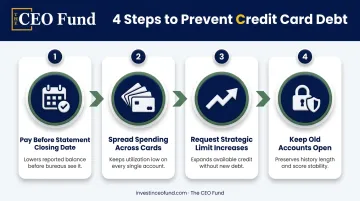
Prevention Measure 1: Pay Before the Statement Closing Date
Make an extra payment a few days before your statement cuts, not just before the due date. This directly counters the statement-timing issue by ensuring issuers report a lower snapshot balance to the bureaus in the first place.
Prevention Measure 2: Spread Spending Across Multiple Cards
Rotate larger purchases across cards with available room instead of loading up one account. This keeps any single card's utilization from spiking, even while your total spending stays the same.
Prevention Measure 3: Request Strategic Credit Limit Increases
Ask your issuer for a limit increase on accounts you've managed well. This instantly lowers your utilization ratio without adding new debt. According to myFICO's credit utilization guide, keeping utilization below 30% helps, and staying under 10% tends to help scores even more.
- Best requested after 6–12 months of on-time payments
- Often doesn't require a hard inquiry, depending on the issuer
- Many issuers process requests online or by phone within minutes
Prevention Measure 4: Keep Old Accounts Open and Active
Don't close unused cards. Instead, run a small recurring bill through them (a streaming subscription works fine) to keep them active. This preserves your total available credit, which keeps overall utilization low even as balances shift elsewhere.
Tips for Long-Term Prevention and Control
Beyond the immediate fixes, a few ongoing habits keep balances from creeping back up:
- Set utilization alerts through your bank or a credit monitoring app to catch spikes before they hit your report
- Review your credit report periodically to confirm reported balances and limits match reality, and dispute any discrepancies right away
- Track per-card and total utilization separately : a clean total ratio can still hide one problem card
For some, the goal is more fundamental: reducing reliance on revolving credit altogether. That's where alternatives like mortgage note investing come in.
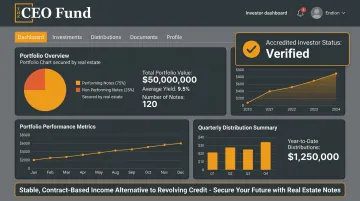
Through funds like The CEO Fund, accredited investors purchase performing and non-performing mortgage notes secured by real estate. Rather than carrying revolving balances to fund lifestyle spending, they collect monthly payments as the lender.
This model works because mortgage note cash flow is contractually fixed by the loan's terms; it doesn't fluctuate with anyone's credit utilization.
The fund is open to:
- Individuals earning $200,000+ annually ($300,000 with a spouse)
- Those with a net worth of $1 million or more, excluding a primary residence
It offers quarterly distributions and compatibility with self-directed IRAs and 401(k)s.
Conclusion
High non-mortgage balances aren't random. They come from identifiable, fixable causes: carrying debt month to month, uneven spending across cards, statement timing, and shrinking credit limits.
Consistent monitoring and proactive payments (made before your statement closes, not just before the due date) stop the "balances too high" flag from recurring. That protects your ability to qualify for future loans, mortgages, or credit lines when you actually need them.
Frequently Asked Questions
What does it mean when the balance on revolving accounts is too high?
It's a credit report risk factor indicating your revolving balance-to-limit ratio is elevated. This can lower your score even if every payment has been made on time.
Is $20,000 a lot of credit card debt?
It depends on your total available credit and income, but $20,000 is well above the average per-consumer card balance nationally. It likely pushes utilization above recommended thresholds unless your credit limits are very high.
How rare is an 830 FICO score?
Scores in this range are uncommon. According to myFICO's score distribution data, the 800–850 bracket accounts for about 22.8% of consumers, and reaching the top requires very low utilization and a long, flawless payment history.
How is my credit utilization ratio calculated?
Divide total revolving balances by total revolving credit limits, then multiply by 100. For example, $2,000 in balances across $10,000 in limits equals 20% utilization.
Will my balance still show as high if I pay in full every month?
Possibly. Issuers typically report the statement closing balance, not your balance after payment. Even a full monthly payoff can show as "high" until the next reporting cycle updates.
What's considered a good credit utilization percentage?
Under 30% is the common guideline. For those aiming toward excellent credit, staying under 10% is considered ideal.