Introduction
An after-tax (non-deductible) IRA contribution is money you've already paid income tax on, deposited into a Traditional IRA instead of a Roth or a pre-tax account. It sounds simple. It rarely is.
The results depend on three moving parts: your existing IRA balances, where your income falls relative to the deduction phase-out ranges, and whether you're planning to convert those dollars to a Roth. Get any of those wrong, and you can end up paying tax twice on the same money.
This guide walks through the exact steps for funding an IRA with after-tax dollars, plus the IRS rules that govern the process—including Form 8606 and the pro-rata rule. It also flags the mistakes that trip up even careful savers and a few alternatives worth comparing before you commit.
Key Takeaways
- Anyone with earned income can make a non-deductible Traditional IRA contribution, regardless of income level
- This strategy works best as a bridge to a backdoor Roth conversion, not a permanent parking spot
- The pro-rata rule combines all Traditional, SEP, and SIMPLE IRA dollars for tax purposes
- Skipping Form 8606 risks paying income tax twice on the same contribution
- Alternatives like taxable brokerage accounts or self-directed IRAs may better fit specific goals
How to Fund an IRA With After-Tax Money
Funding a Traditional IRA with after-tax dollars follows a specific sequence. Skip a step, and you create tax problems that can follow you for decades.
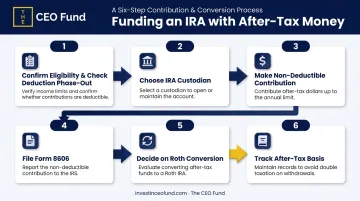
Step 1: Confirm Eligibility and Check the Deduction Phase-Out
You need taxable compensation for the year to contribute at all. There's no income ceiling on the contribution itself, only on whether you can deduct it.
If you or your spouse participate in a workplace retirement plan, your deduction phases out based on modified adjusted gross income (MAGI). For tax year 2026, the ranges are:
| Filing status | 2026 deduction phase-out |
|---|---|
| Single/head of household, active participant | $81,000 – $91,000 |
| Married filing jointly, contributing spouse active | $129,000 – $149,000 |
| Married filing separately, active participant | $0 – $10,000 |
| Married filing jointly, non-active spouse of active participant | $242,000 – $252,000 |
Above these ranges, your contribution becomes fully non-deductible, but it's still allowed.
Step 2: Choose or Confirm the Right IRA Custodian
Standard brokerages work fine if you're sticking with stocks, bonds, and funds. If you want to hold alternative assets like mortgage notes or private placements, you'll need a self-directed IRA custodian instead.
Already have a Traditional IRA? Note your current pre-tax balance now. That number determines how the pro-rata rule treats every future dollar you convert or withdraw.
Step 3: Make the Non-Deductible (After-Tax) Contribution
For 2026, the combined Traditional and Roth IRA limit is $7,500. Add a $1,100 catch-up if you're 50 or older, and the maximum rises to $8,600. This is a combined limit across all your IRAs, not a separate cap for each account type.
When you make the contribution, tell your custodian and tax preparer explicitly that it's non-deductible. This detail gets lost more often than you'd think.
Step 4: File IRS Form 8606 With Your Tax Return
Form 8606 documents your after-tax basis for the year. It's the only record the IRS keeps of money you've already paid tax on inside a Traditional IRA.
File it every year you make a non-deductible contribution. Skip it, and the IRS may treat your basis as zero when you eventually take distributions. That means paying tax again on dollars you already paid tax on once.
Step 5: Decide Whether to Convert to a Roth IRA
Many savers use this contribution as the first half of a backdoor Roth: contribute after-tax dollars, then convert them to a Roth IRA shortly after. Converting quickly limits how much taxable growth accumulates before the conversion.
One catch: if you hold other pre-tax IRA, SEP, or SIMPLE balances anywhere, the pro-rata rule applies. That can turn a supposedly tax-free conversion into a partially taxable one.
Step 6: Track Your After-Tax Basis for Future Distributions
Keep a running record of your cumulative after-tax basis across every IRA you own, for life. This matters even for your heirs, since inherited IRAs carry their own basis that doesn't automatically merge with a beneficiary's other accounts.
Update Form 8606 any year you take a distribution, so the pro-rata formula calculates the tax-free portion correctly.
When Should You Fund an IRA With After-Tax Money?
This isn't a strategy for everyone. It depends almost entirely on your income and what's already sitting in your other IRAs.
It works well when:
- Your income is too high for a deductible or direct Roth contribution
- No existing pre-tax IRA, SEP, or SIMPLE balances complicate the math
- A near-immediate Roth conversion is already part of the plan
It becomes inefficient or risky when:
- You already hold significant pre-tax IRA money, triggering pro-rata taxation on any conversion
- You're not prepared to file Form 8606 every year, potentially for decades
- Your heirs would need to untangle inherited basis records you never maintained
If you fall into the second category, the after-tax contribution route often creates more paperwork than benefit.
Key Rules That Affect Your After-Tax IRA Strategy
Outcomes here hinge on IRS rules around tracking, timing, and what else you own. Four rules do most of the heavy lifting.
The Pro-Rata Rule
The IRS treats every dollar in your Traditional, SEP, and SIMPLE IRAs as one commingled pool. You can't cherry-pick just the after-tax portion for a withdrawal or conversion.
Why it matters: Any distribution or conversion gets taxed proportionally, based on the ratio of your after-tax basis to your total IRA balance.
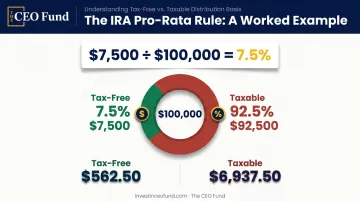
Example: Say you have $7,500 of basis and $92,500 of pre-tax value remaining after converting $7,500. Your basis percentage is $7,500 ÷ $100,000, or 7.5%. Only $562.50 of that conversion is tax-free; $6,937.50 is taxable. Splitting the money across multiple custodians doesn't change this math.
Filing, Existing Balances, and Timing Rules
Three more rules round out the picture:
- File Form 8606 annually: This form establishes and tracks your basis every year you contribute. Miss it, and you risk double taxation on the same after-tax dollars when you eventually withdraw.
- Count existing pre-tax balances: Traditional, SEP, and SIMPLE IRA funds count toward pro-rata calculations even if they sit at a completely different institution than your new contribution. A large rollover IRA from an old 401(k) can quietly wreck the tax efficiency of a backdoor Roth you thought was clean.
- Convert quickly: Growth between your contribution and your conversion becomes taxable income upon conversion, subject to the pro-rata split. Converting within days, rather than months, minimizes the taxable gain.
Common Mistakes When Funding an IRA With After-Tax Money
Even disciplined savers stumble here. Watch for these three errors:
- Forgetting Form 8606 in the contribution year: the most common mistake, and it leads directly to overpaying tax on future distributions
- Skipping the pre-tax balance check: attempting a backdoor Roth without verifying existing IRA, SEP, or SIMPLE balances, which triggers an unexpected pro-rata tax bill
- Losing track of cumulative basis over time: common after switching custodians, changing jobs, or passing an IRA to heirs unaware a basis record even exists
Each of these is preventable with one simple habit: keep every Form 8606 you've ever filed, forever, in one folder.
Alternatives to Funding an IRA With After-Tax Money
Non-deductible Traditional IRA contributions aren't always the most efficient path. Depending on your goals, one of these three options might serve you better.
Direct or Backdoor Roth IRA
When it's better: You want tax-free qualified withdrawals in retirement and can convert quickly with no other pre-tax IRA balances muddying the water.
Trade-offs: Direct contributions phase out for single filers between $153,000 and $168,000 MAGI in 2026, and for joint filers between $242,000 and $252,000. Backdoor conversions still face the pro-rata rule if you hold pre-tax IRA money elsewhere.
Taxable Brokerage Account
When it's better: You want liquidity before age 59½, or you'd rather pay long-term capital gains rates than ordinary income tax.
Trade-offs: No tax-deferred growth along the way, but you generally get a basis adjustment to fair market value at death, which can reduce or eliminate capital gains tax for your heirs.
Self-Directed IRA With Real Estate-Backed Alternative Assets
When it's better: For accredited investors who want passive, collateral-backed income inside a tax-advantaged account rather than relying on stock market performance.
This is where a self-directed IRA custodian opens doors a standard brokerage IRA can't. Instead of holding index funds, your retirement dollars can hold mortgage notes secured by real property.
Funds like The CEO Fund let self-directed IRA and 401(k) investors act as the lender on Grade A–C mortgage notes. You collect income without taking on the tenant, toilet, or tile responsibilities that come with direct property ownership.

Trade-offs:
- Generally requires accredited investor status ($200,000+ individual income, $300,000+ joint, or $1 million+ net worth excluding your primary residence)
- Needs a self-directed IRA custodian, not a standard brokerage
- Less liquid than publicly traded securities, since you're holding a private note rather than a stock you can sell in seconds
Investors considering this route should also ask about unrelated business income tax (UBIT) or unrelated debt-financed income (UDFI) exposure, since these can apply when a retirement account invests in debt-financed real estate assets. Your custodian or tax advisor can walk you through whether they apply to a specific investment.
Frequently Asked Questions
Can you fund an IRA with after-tax money?
Yes. Anyone with earned income can make a non-deductible contribution to a Traditional IRA regardless of income level, but you must report it on Form 8606 every year you do it.
What is the best thing to do with after-tax money in a 401(k) when converting to an IRA?
After-tax 401(k) dollars can typically roll directly into a Roth IRA tax-free, while the pre-tax earnings on those contributions roll into a Traditional IRA, per IRS Notice 2014-54.
How much will $10,000 in a Roth IRA be worth in 20 years?
Using the S&P 500's historical average annual return of 10.4% from 1996–2025, $10,000 could grow to roughly $72,000. This is illustrative only; actual results depend on your investments and market conditions.
What is Form 8606 and why is it important?
It's the IRS form that reports non-deductible IRA contributions and tracks your after-tax basis. Without it, you risk paying income tax twice on the same dollars during future withdrawals.
What is the pro-rata rule for IRA distributions?
The IRS treats all your Traditional, SEP, and SIMPLE IRA balances as one pool. Any withdrawal or conversion is taxed proportionally between pre-tax and after-tax dollars, not selectively.
Can I contribute after-tax money directly to a Roth IRA instead?
Yes, Roth IRAs are funded entirely with after-tax dollars. Unlike non-deductible Traditional IRA contributions, though, direct Roth contributions are subject to Modified Adjusted Gross Income (MAGI) limits.