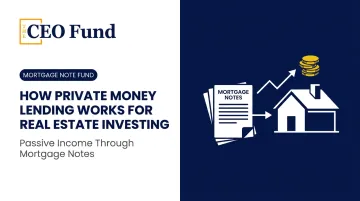
The 100 largest U.S. private lenders grew transaction volume 25.3% in 2024, completing more than 133,000 deals, according to data reported by the American Association of Private Lenders. That's not a niche corner of the market anymore.
Here's the problem: most people know private money lending exists, but few understand how the capital actually moves — from lender to borrower to collateral to repayment. That gap leads borrowers into bad terms and pushes investors toward lenders they haven't properly vetted.
This guide breaks down exactly how the process works, step by step, whether you're borrowing the money or providing it.
Key Takeaways
- Private money lending draws capital from individuals or private funds, secured by real estate—not credit
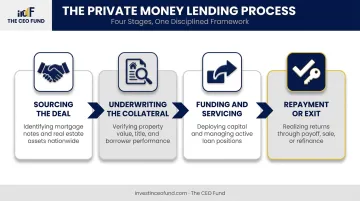
- The process runs through four stages: sourcing, underwriting, funding, and repayment/exit
- Loans typically run 6-36 months at rates above banks, via direct loans, pooled funds, or mortgage funds
- Passive investors earn fixed monthly returns by acting as "the bank," skipping property ownership entirely
What Is Private Money Lending?
Private money lending is capital sourced from private individuals, investor groups, or non-bank funds and loaned to real estate investors. The loan gets secured by a deed of trust or mortgage recorded against the property itself.
Banks exist to manage risk conservatively, which makes them slow to fund distressed properties, unconventional deals, or anything with a tight closing timeline. Private capital exists specifically to fill that gap.
Private Money vs. Hard Money vs. Bank Loans
These terms get used interchangeably, but they're not identical:
- Private money — comes from individuals or funds; underwriting often considers the borrower's track record and exit strategy, not just the property
- Hard money — a narrower subset of private lending; decisions rest almost entirely on collateral value, with less weight given to borrower history
- Bank mortgages — credit-focused, standardized, and slower, but often cheaper for borrowers who qualify
Despite the rise of crowdfunding platforms, private lending has held its ground because speed, flexibility, and relationship-based underwriting still beat what algorithms and committees can offer.
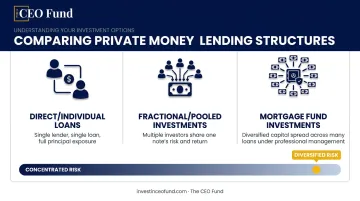
Investors and borrowers typically encounter three structures:
- Direct/individual loans — one lender funds one borrower's deal directly
- Fractional (pooled) investments — multiple investors split a single loan
- Mortgage fund investments — capital pools into a professionally managed fund that holds many loans
Each structure shifts the mechanics slightly: a direct loan means one point of risk, while a mortgage fund spreads that risk across dozens or hundreds of notes.
How Does Private Money Lending Work?
Every private money loan, whether funded by an individual or a fund, moves through the same four-stage sequence: sourcing, underwriting, funding, and repayment.
Initiation: Sourcing the Deal and the Capital
The process starts when a borrower identifies a deal, usually a distressed or undervalued property, and approaches a private lender with the loan request, property details, and intended use of funds.
This stage runs on relationships, not algorithms. Borrowers typically find lenders through:
- Real estate investor associations and local meetups
- Direct referrals from other investors or brokers
- Lender or fund marketplaces online
Lenders and funds, in turn, source borrowers through their own deal-flow networks. The common bottleneck here: borrowers without a documented track record, renovation budget, or clear exit plan struggle to get initial interest, no matter how good the property looks on paper.
Core Operation: Underwriting the Collateral
Private lending runs on asset-based lending. The lender weighs the property's current value and after-repair value far more heavily than the borrower's credit score.
During underwriting, the lender typically:
- Orders or reviews an appraisal or valuation
- Calculates loan-to-value (LTV) or loan-to-cost ratio
- Verifies clear title
- Confirms the borrower's exit strategy (sale, refinance, etc.)
Private lenders commonly cap loans at 65%-70% LTV to maintain a collateral cushion, with borrower interest rates ranging 7%-15% depending on risk, according to AAPL's private lender education materials. Origination points generally fall between 1-3% of the loan amount.
Riskier deals command higher rates and fees, including faster turnarounds, weaker exit plans, and less experienced borrowers. That's the trade-off: speed and flexibility cost more than a 30-year fixed mortgage.
Funding and Servicing: Money Changes Hands
Once terms are agreed and the borrower signs a promissory note and deed of trust, funds move fast, often within days rather than the weeks a bank might take.
Servicing depends on the loan structure:
- Direct loans: the lender collects and tracks payments personally
- Fractional/pooled deals: a servicing agent handles collection and distribution
- Mortgage funds: a fund manager administers payments across the entire portfolio
Most private loans are structured as interest-only payments with a balloon payment at term's end. That keeps the borrower's monthly cash flow predictable during renovation or lease-up, while giving the lender a steady, known income stream until the loan matures.
Output/Result: Repayment, Exit, or Default
In the intended outcome, the borrower repays through a property sale or refinance. The lender receives principal back plus the interest and fees agreed upon at closing.
If the borrower defaults, the lender's security interest allows foreclosure and recovery through sale of the collateral property. That security interest is the entire reason asset-based lending works without heavy credit underwriting.
For investors, this repayment cycle is the point. Consistent monthly interest distributions are the "passive income" outcome that draws capital into private lending in the first place.
Where Private Money Lending Fits in Real Estate Investing
Private money shows up at specific points in a deal's lifecycle, not throughout the entire holding period. Common use cases include:
- Acquisition of distressed properties that won't qualify for conventional financing due to condition
- Bridge financing to cover the gap before a long-term refinance closes
- Short-term construction or rehab funding tied to a renovation timeline
It performs best when:
- Time sensitivity rules out a bank's 45-60 day timeline
- The property doesn't meet conventional lending standards
- A credible, documented exit strategy backs the borrower's plan
The mechanics stay consistent across property types, though use cases vary. Single-family flips are the most common application, but private capital also funds multifamily acquisitions, land purchases, and small commercial deals where speed matters more than the lowest possible rate.
Passive Income Through Private Lending: Benefits and Risks for Investors
Flip the perspective, and private lending becomes an income strategy. Instead of borrowing, you're the one providing capital and collecting interest, acting as the bank without owning or repairing a single property.
Why Investors Choose This Path
- Fixed monthly returns secured by real estate collateral
- No tenants, repairs, or property management responsibilities
- Returns that often outperform traditional fixed-income options
That last point holds up under scrutiny. Trailing one-year gross returns on pooled private real estate debt funds ran 6.5%-6.8% as of mid-2025, compared to roughly 4.3%-4.5% for prime money market funds over the same period, based on NCREIF/CREFC fund index data.
Private debt isn't as liquid as a money market fund, but the yield gap is real.
The Risk Side
Private lending carries less regulatory oversight than bank lending. That places due diligence squarely on the investor. Before committing capital, vet:
- The lender's or fund's underwriting standards
- LTV discipline across their loan portfolio
- Track record through prior market cycles, including downturns
Mortgage Funds: Diversification Without the Legwork
Evaluating individual loans one by one takes time and expertise most passive investors don't have. Mortgage fund investing solves that by pooling capital across many notes under professional management.
The CEO Fund, for example, specializes in acquiring and managing pools of Grade A-C mortgage notes for accredited investors, targeting 8-12% annual returns (up to 15%). Investors skip the tenants, toilets, and turnover that come with direct property ownership.

Instead, they receive monthly cash flow deposited directly into a savings or IRA account, functioning as the lender rather than the landlord.
Access typically requires accredited investor status: $200,000+ in individual annual income ($300,000+ with a spouse), or $1 million+ in net worth excluding your primary residence.
Many of these investments, including mortgage fund positions, can be held inside a self-directed IRA or 401(k), adding a tax-advantaged layer to the passive income strategy.
Conclusion
Private money lending works because it replaces slow, credit-based underwriting with fast, asset-based decisions backed by real property. That's the entire mechanism, from initiation through repayment.
Borrowers who understand this underwriting logic negotiate better terms because they know what lenders price for. Investors who understand the same process can evaluate a lender's discipline, or a fund manager's track record, such as The CEO Fund's, with real confidence before committing capital.
Frequently Asked Questions
How do I get private money for real estate investing?
Build relationships with individual lenders, private lending companies, or mortgage funds through referrals, investor associations, and online lender marketplaces. Present a clear deal package: property value, exit strategy, and your track record.
How much do private real estate investors make?
Returns vary by structure, but passive investors in pooled private debt funds have recently earned in the range of 6.5%-8% annually, while borrower-side lenders earn additional income from points charged at origination.
Is private money lending legal?
Yes. It's a recognized, legal form of nonbank lending, though it's regulated by state usury laws and licensing rules rather than federal banking oversight. This makes due diligence on your lender or fund essential.
What's the difference between private money lending and hard money lending?
Hard money is a narrower subset of private lending, typically semi-institutional with stricter, collateral-only underwriting. Private money often comes from individuals or funds with more flexible, relationship-based terms, though the terms are frequently used interchangeably.
Do private money lenders check credit scores?
Not primarily. Private lenders focus on the property's value and the deal's viability first. Some may still review credit as part of a broader risk assessment, but it rarely drives the approval decision.
How is private lending different from investing in a mortgage fund?
Direct private lending means funding a single loan to a single borrower. Mortgage fund investing pools your capital across many loans, trading individual loan control for diversification and professional management.