
The confusion is common. Many readers mix up wealth funds with hedge funds, pension funds, or ordinary mutual funds. The reality is different: these are government-owned vehicles funded by trade surpluses, oil revenue, or foreign exchange reserves, not private capital chasing quarterly returns.
Global sovereign wealth funds now manage more than $16 trillion in combined assets, according to a July 2026 IMF analysis. That's larger than the GDP of every country except the United States and China.
This guide breaks down what a wealth fund actually is, the five main types, the largest funds worldwide, and how everyday accredited investors can apply similar principles through private, income-generating portfolios.
Key Takeaways
- A sovereign wealth fund (SWF) is a state-owned vehicle funded by trade surpluses, oil exports, or FX reserves—not taxpayer money.
- Global SWFs now manage over $16 trillion in assets, per July 2026 IMF data.
- Five main types exist: stabilization, savings, pension reserve, reserve investment, and strategic development funds.
- Norway's Government Pension Fund Global ranks as the largest SWF worldwide.
- Accredited investors can mirror SWF strategies through private mortgage note funds offering collateral-backed passive income.
What Is a Wealth Fund? Definition Explained
A sovereign wealth fund is a pool of assets a national government owns and invests, both domestically and abroad, to build long-term financial returns for its economy and citizens. Unlike a private investment fund, there are no outside shareholders. The government is the sole owner, and profits flow back into public finances rather than private pockets.
The International Forum of Sovereign Wealth Funds defines an SWF through three characteristics, established in 2008 under the Santiago Principles:
- Government ownership - the fund belongs to central or subnational government, not private shareholders.
- Foreign financial assets - it holds investments outside its home country, not just domestic infrastructure.
- Financial objectives - it exists to generate returns, not to manage day-to-day currency operations.
A wealth fund is not:
- Central bank foreign exchange reserves held for currency stabilization
- Public employee pension funds owned by and paid out to plan participants
- State-owned operating companies, such as airlines or utilities
- Traditional FX reserves used for balance-of-payments management
Funding typically comes from one of two origins:
- Commodity-based: Oil, gas, or mineral export revenue (Norway, Kuwait, Abu Dhabi)
- Non-commodity: Trade surpluses, privatization proceeds, or foreign exchange transfers (China, Singapore)
How Wealth Funds Differ From Hedge Funds and Pension Funds
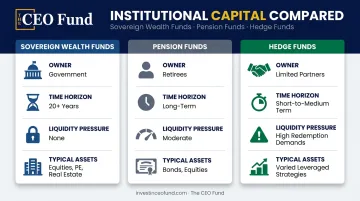
A pension fund's investment committee answers to retirees expecting a specific payout. A hedge fund answers to limited partners demanding returns within a defined window. A sovereign wealth fund answers only to its government sponsor, which is why some can hold illiquid private equity or real estate positions for 20+ years without redemption pressure.
Like large institutional investors, wealth funds spread capital across equities, bonds, real estate, private equity, and infrastructure. Norway's fund, for example, holds stakes in thousands of public companies worldwide alongside real estate and renewable energy assets.
Types of Sovereign Wealth Funds
Not every wealth fund serves the same purpose. The IMF identifies distinct functional categories, though many real-world funds blend more than one.
| Type | Primary Function | Example |
|---|---|---|
| Stabilization | Smooths budgets against commodity price swings | Chile's Economic and Social Stabilization Fund |
| Savings/Intergenerational | Converts finite resource wealth into a lasting portfolio | Norway's GPFG |
| Pension Reserve | Funds government pension-like liabilities | Australia's Future Fund |
| Reserve Investment Corporation | Pursues higher returns on FX reserves | SAFE Investment Company (China) |
| Strategic Development (SDSWF) | Funds domestic infrastructure directly | Danantara (Indonesia) |
Stabilization Funds
Commodity export revenue swings wildly with global prices. Stabilization funds absorb that volatility, smoothing government spending so budgets don't swing between boom-driven surplus and bust-driven austerity.
Savings and Intergenerational Funds
These convert non-renewable wealth, like oil in the ground, into a diversified financial portfolio that keeps generating returns long after the resource runs dry. Norway's model is the clearest example: oil revenue funds current and future generations, not just today's budget.
Pension Reserve Funds
These fund pension-like obligations, but the IMF distinguishes them from public pension funds. A pension reserve fund is owned by general government; a public pension fund is owned by and ultimately pays out to the plan's beneficiaries.
Reserve Investment Corporations
Some governments hold FX reserves far beyond what's needed for currency defense. Reserve investment corporations, like China's SAFE Investment Company, deploy that excess for higher returns while the assets often remain classified as reserves.
Strategic Development Funds
A newer category funds domestic projects directly rather than investing abroad. Indonesia's Danantara, launched February 24, 2025, under Law No. 1 of 2025, manages over Rp300 trillion (roughly $20 billion) in state assets, aiming to consolidate state-owned enterprise holdings and fund industrialization.
Most funds don't fit neatly into one box. Norway's fund behaves like a savings fund but also plays a stabilization role during oil price crashes. Treat these categories as functional descriptions, not rigid legal classifications.
Why Do Countries Create Wealth Funds?
Governments don't launch wealth funds out of thin air. They typically appear when a country runs persistent budget or trade surpluses, leaving policymakers with excess liquidity that has nowhere productive to go domestically.
Common triggers include:
- Sustained trade surpluses: Most new SWF capital historically traces back to trade surpluses, supplemented by budget surpluses, investment returns, and privatization proceeds.
- Commodity dependence: Nations reliant on oil, gas, or mineral exports face boom-bust price cycles, and a wealth fund converts today's windfall into diversified assets that don't move in lockstep with commodity prices.
- Resource depletion planning: Finite resources eventually run out. Savings-oriented funds convert underground wealth into an above-ground portfolio that outlasts the resource itself.
Beyond pure financial logic, strategic motivations matter too:
- Building a fiscal "war chest" for future downturns
- Strengthening standing as a global financial center, as Singapore has done
- Funding national development goals directly, from infrastructure to industrialization
The common thread: excess capital paired with a long time horizon, and a government willing to invest rather than simply spend or hold cash.
Largest Sovereign Wealth Funds in the World
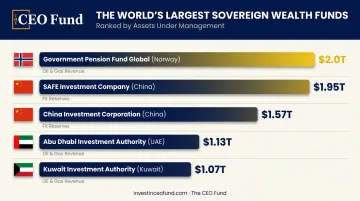
Norway's Government Pension Fund Global holds the top spot. As of its 2025 annual report, the fund's value reached NOK 21,268 billion, funded entirely by Norwegian oil and gas revenue.
Here's how the top five compare:
| Fund | Country | Approx. Assets | Funding Source |
|---|---|---|---|
| Government Pension Fund Global | Norway | ~$2.0 trillion | Oil and gas revenue |
| SAFE Investment Company | China | ~$1.95 trillion | Foreign exchange reserves |
| China Investment Corporation | China | ~$1.57 trillion | Foreign exchange reserves |
| Abu Dhabi Investment Authority | UAE | ~$1.13 trillion | Oil revenue |
| Kuwait Investment Authority | Kuwait | ~$1.07 trillion | Oil revenue |
Four of the five largest funds sit in Asia or the Middle East. This concentration isn't accidental: oil producers in the Gulf and trade-surplus economies in Asia generate the exact conditions linked to SWF growth, namely strong reserves and low public debt.
How Citizen Dividends Work
Norway doesn't hand cash directly to citizens the way Alaska does. Instead, the fund's earnings supplement the national budget under a fiscal rule tied to its expected 3% real return. That transfer is projected to cover roughly 24% of Norway's fiscal budget expenditure in 2025, funding healthcare, education, and infrastructure without raising taxes.
Global Growth Has Accelerated
- 2008: Total SWF assets sat around $3.2 trillion
- 2008-2012: SWF assets grew 59.1% in four years
- 2022-2023: The top 50 sovereign funds grew from $11.3 trillion to $11.6 trillion
- 2026 (projected): Total SWF assets expected to surpass $16 trillion
That's roughly a fivefold increase in under two decades, driven by sustained oil revenue, growing Asian trade surpluses, and newer entrants like Indonesia's Danantara.
Does the United States Have a Sovereign Wealth Fund?
Not at the federal level, at least not yet. The United States has no operating national sovereign wealth fund in the traditional sense.
That could change. On February 3, 2025, President Trump signed an executive order directing the Treasury and Commerce Departments to develop a plan within 90 days for a federal SWF.
The stated goals: promote fiscal sustainability, ease tax burdens, and strengthen U.S. economic leadership. Still, the order created a planning mandate, not an operating fund with capital already deployed.
States Already Run Their Own Funds
While Washington debates the concept, several states have run wealth funds for decades:
- Alaska Permanent Fund: The largest state fund at $91.19 billion (May 2026), funded by 25%+ of mineral lease royalties. It paid eligible residents a $1,000 dividend in 2025.
- Texas Permanent School Fund: Holds a $60.6 billion net position, backed by 13 million acres of state land and mineral royalties. It distributed $2.2 billion to public schools in fiscal year 2025.
- North Dakota Legacy Fund: Holds $13 billion, funded by 30% of the state's oil and gas extraction tax revenue.
These funds prove the sovereign wealth model works below the federal level too: take resource windfalls, invest them for the long term, and return the benefit to residents through dividends or public services.
Building Your Own "Personal Wealth Fund" Through Alternative Investments
Sovereign wealth funds take national surpluses and convert them into diversified, income-generating portfolios instead of leaving cash idle. Accredited investors can apply the same logic on a personal scale, just with private capital instead of oil revenue.
Public stocks and bonds aren't the only path. Private mortgage note funds let individual investors step into the role a bank normally plays: collecting monthly payments backed by real estate collateral, rather than betting on stock market swings.
How This Works in Practice
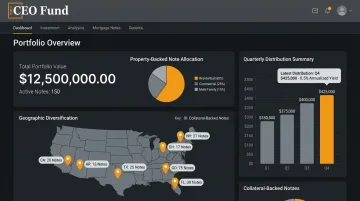
The CEO Fund, for example, acquires performing and non-performing mortgage notes secured by real estate across the United States. Instead of owning property directly, investors hold a position backed by the underlying collateral, similar in spirit to how a sovereign wealth fund like Singapore's GIC deploys capital into income-producing assets rather than idle cash reserves.
The fund's track record includes:
- 10+ years of operating history
- 500+ loans purchased across the portfolio
- 50+ states of geographic reach
Why This Model Appeals to Accredited Investors
- Diversification: Exposure spans property types and geographies, echoing the same principle that drives savings-style sovereign funds.
- Tax advantages: Notes can be held inside self-directed IRAs or 401(k) accounts, allowing tax-advantaged compounding.
- No landlord duties: Investors collect payments without managing tenants, repairs, or property tax bills, sometimes described as eliminating the "3 T's" (tenants, toilets, tiles).
- Passive structure: Quarterly cash distributions arrive without active involvement in day-to-day asset management.
None of this replicates a $2 trillion sovereign fund. But the underlying principle, turning surplus capital into collateral-backed, income-producing assets instead of letting it sit idle, is the same playbook Norway and Alaska have used for decades. It's simply available at a private, accredited-investor scale.
Frequently Asked Questions
What is the largest sovereign wealth fund in the world?
Norway's Government Pension Fund Global, valued at roughly NOK 21,268 billion (about $2 trillion) as of its 2025 annual report. It's funded entirely by Norwegian oil and gas revenue.
How do citizens benefit from a sovereign wealth fund?
Citizens benefit through direct dividends, like Alaska's $1,000 annual Permanent Fund Dividend, or indirectly through government revenue that funds schools, infrastructure, and public services without raising taxes.
Does the US have a sovereign wealth fund?
Not at the federal level. Several states, including Alaska, Texas, and North Dakota, operate their own funds, with Alaska's Permanent Fund being the largest at over $91 billion.
What's the difference between a sovereign wealth fund and a pension fund?
A pension fund is owned by and pays out to plan participants. A sovereign wealth fund is owned by general government and serves broader national financial objectives, not individual benefit claims.
Are sovereign wealth funds transparent about their investments?
Transparency varies widely. The Santiago Principles and the Linaburg-Maduell Transparency Index, a 10-point disclosure scale, were both created to push funds toward greater openness.
Can individual investors create a personal wealth fund strategy?
Yes. Accredited investors can mirror the same principles through diversified, collateral-backed alternative investments like The CEO Fund's mortgage note portfolios, which generate passive income without public market volatility.