You can't call your broker and sell a rental property in ten minutes the way you'd sell a stock. Selling real estate means finding a buyer, negotiating price, clearing financing contingencies, and closing, a process that can stretch for weeks or months. Investors who ignore this reality often discover it the hard way: forced into a rushed sale, a steep discount, or a missed opportunity because their capital was locked up.
This guide breaks down why real estate is illiquid, what risks that creates, the warning signs of overexposure, and practical solutions, including alternatives that offer real estate exposure with far more flexibility.
Key Takeaways
- Illiquidity stems from private markets, slow closings, high capital needs, and unique valuations
- Forced sales during cash crunches can lock in losses well below fair market value
- Heavy reliance on refinancing or home equity lines signals dangerous overexposure
- Liquidity reserves, diversification, and mortgage notes reduce downside risk
What Causes Real Estate Illiquidity?
Illiquidity in real estate means you can't quickly turn a property into cash without accepting a significant discount. This friction is structural, built into how the asset class works.
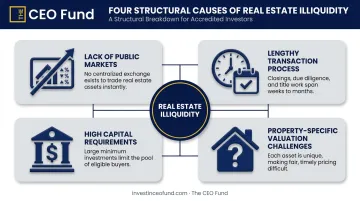
Four structural features drive this: a lack of public markets, drawn-out transactions, high capital thresholds, and valuation challenges unique to each property.
Lack of Public Markets
Stocks and bonds trade on centralized exchanges with prices updating by the second. Real estate doesn't work that way. There's no ticker for a duplex in Tampa or an office building in Denver.
Every sale is a private, one-off negotiation. A seller has to find qualified buyers, vet their financing, and negotiate terms with zero visibility into what similar properties actually sold for last week. That opacity alone extends time-to-sale far beyond what a listed security requires.
Lengthy, Complex Transaction Process
Even a straightforward residential sale involves inspections, appraisals, title searches, and financing contingencies. Commercial deals add environmental reviews and lease audits.
Real-world scenario: A seller relocating for a new job needs to close within 30 days. Standard financed purchases now average 36.8 days from application to closing, according to ICE Mortgage Technology's Origination Insight Report. That mismatch often forces sellers to accept a lower cash offer just to hit their timeline, sacrificing thousands in the process.
High Capital Requirements & Limited Buyer Pool
Real estate transactions involve large sums, which shrinks the number of buyers who can actually close. This bottleneck is especially acute in commercial and multifamily deals.
- A $5 million apartment complex has far fewer qualified buyers than a $500 stock purchase
- Institutional deals often require syndicated financing across multiple lenders
- Rate environments that tighten credit shrink the buyer pool further
An investor holding a mid-size commercial asset may sit on the market for months simply because few buyers can secure financing for the full purchase price.
Property-Specific Valuation Challenges
No two properties are identical. Location, condition, layout, and even school district boundaries change value in ways that don't apply to fungible securities like shares of a public company.
Appraisal disputes and comp mismatches are common culprits behind stalled sales. A buyer's appraisal comes in below the agreed price, financing falls through, and the deal resets, often at a lower number.
The Risks & Impact of Real Estate Illiquidity
Ignoring illiquidity risk doesn't just cost time. It costs money, and sometimes a lot of it.
When owners need cash fast, whether for a medical emergency, a business opportunity, or a margin call, illiquid real estate becomes a liability instead of an asset.
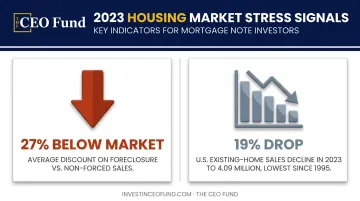
Peer-reviewed research on Massachusetts home sales found that foreclosure sales averaged 27% below comparable non-forced sales, according to a study published in the American Economic Review. That's the cost of urgency colliding with a private, slow-moving market.
Beyond forced sales, illiquidity limits portfolio flexibility. If a better investment opportunity appears, real estate-heavy investors often can't reallocate quickly. Their capital is trapped in a property, not sitting in cash ready to deploy.
This risk compounds during downturns. Buyer pools shrink, financing tightens, and days-on-market climbs. U.S. existing-home sales fell roughly 19% to 4.09 million in 2023, the lowest annual total since 1995, according to the National Association of Realtors. Fewer completed sales means fewer exits for anyone needing to cash out.
Warning Signs You May Be Overexposed to Illiquidity Risk
Watch for these red flags:
- Concentrated net worth: A large share of your wealth sits in property equity, with little liquid cash reserve to fall back on.
- Chronic refinancing dependence: Regularly tapping HELOCs, cash-out refinances, or bridge loans to cover short-term needs signals overexposure. HELOC balances hit $376 billion in Q1 2024, up $30 billion year-over-year, per the Federal Reserve Bank of New York. That's borrowed equity, not free cash.
- Thinning local demand: Comparable properties in your market are sitting unsold for extended periods, signaling a shrinking buyer pool before you even need to sell.
How to Mitigate Real Estate Illiquidity Risk
Managing illiquidity requires ongoing portfolio decisions made well before a crisis forces your hand.
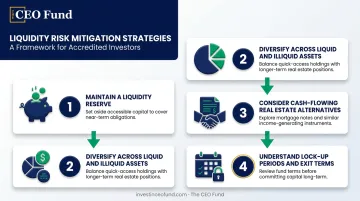
Solution 1: Maintain a Liquidity Reserve
Build a cash buffer covering several months of expenses before committing heavily to illiquid real estate, not after. This reserve gives you breathing room so a cash need never forces a property sale at the wrong time.
Solution 2: Diversify Across Liquid and Illiquid Assets
Balance real estate with more liquid instruments, such as:
- Bonds and bond funds
- Publicly traded REITs
- Cash equivalents and money market funds
This mix reduces the odds you'll ever need to force-sell a property to raise cash. Real estate can still anchor your portfolio, but it shouldn't be the only lever you can pull.
Solution 3: Consider Real Estate-Backed Alternatives That Generate Cash Flow
Mortgage note investing offers a middle path. Instead of owning the physical property, you hold the debt secured by it, collecting scheduled principal and interest payments with a shorter capital cycle than direct ownership.
This is the model The CEO Fund built its platform around. Investors take on the role of the lender, receiving monthly mortgage payments deposited directly into a savings or IRA account. That structure eliminates what the fund calls the "3 T's":
- Tenants — no screening, leases, or vacancies to manage
- Toilets — no repair bills or emergency maintenance calls
- Tiles — no renovation costs or property upkeep
A mortgage note's contractual payment schedule is a different feature from resale liquidity. A performing note generates income on a predictable timeline, but selling the note itself before maturity still depends on finding a buyer. The distinction matters when comparing it to direct property ownership.
Solution 4: Understand Lock-Up Periods and Exit Terms Before Investing
Before signing any subscription agreement, review the fund's or syndication's:
- Hold period and expected maturity timeline
- Redemption windows or early exit penalties
- Distribution schedule and how proceeds are paid out
Do this during due diligence, not after your capital is already committed. A private offering memorandum should spell out every one of these terms clearly.
Long-Term Strategies for Managing Illiquidity Risk
Beyond individual tactics, a few habits keep illiquidity risk in check over time.
- Run periodic liquidity audits. Track what percentage of your net worth sits in illiquid assets, and rebalance if that share climbs without a matching cash cushion.
- Ladder your maturities. Stagger real estate and note investments so capital frees up on a rolling basis instead of all locking up at once.
- Partner with credentialed managers. Experienced managers who diversify across property types and geographies reduce concentration risk beyond what individual investors can achieve alone.
The CEO Fund illustrates this approach: Carlo Turner, a Certified Note Investing Specialist, has helped guide the acquisition of 500+ loans across 50-plus states over the fund's 10-plus year history.
Conclusion
Real estate illiquidity is a structural, predictable feature of the asset class, not a market anomaly. It stems from private transactions, long closings, and property-specific valuation quirks.
The investors who navigate it best don't avoid real estate — they plan around its limits. That means holding liquidity reserves, diversifying holdings, and pairing direct ownership with cash-flowing alternatives like the mortgage notes available through The CEO Fund for accredited investors. That combination captures real estate's long-term stability without leaving you cornered when you need cash fast.
Frequently Asked Questions
What is illiquidity in real estate?
Illiquidity means you can't quickly convert a property into cash without accepting a significant discount. Private markets, complex closings, and limited buyer pools all contribute to this.
Are houses considered illiquid assets?
Yes. Compared to stocks or bonds, houses take weeks or months to sell, involve high transaction costs, and depend on a limited pool of qualified buyers in any given market.
What is the risk of illiquidity?
Illiquidity risk means you may not be able to access cash when you need it. In a pinch, that often forces a sale at well below fair market value.
How can investors reduce real estate illiquidity risk?
Build a liquidity reserve, diversify across liquid and illiquid assets, and consider cash-flowing alternatives like mortgage notes that offer real estate exposure with more flexible capital cycles.
What is the illiquidity premium in real estate?
It's the additional return investors expect for accepting the inability to access their capital quickly. Institutional investors often target roughly 100 to 500 basis points above liquid alternatives, though realized returns don't always meet that expectation.
Is real estate still a good investment despite being illiquid?
Yes, with proper planning. Reserves, diversification, and alternatives like mortgage note investing let you manage illiquidity's downside while still benefiting from real estate's long-term stability and income potential.