
Introduction
Some of the most valuable companies in America aren't listed on any exchange. SpaceX, Stripe, and dozens of other billion-dollar businesses stayed private for years while public market investors watched from the sidelines.
Accredited investors, however, increasingly use retirement dollars — not just brokerage accounts — to get in early.
Here's the catch most investors never realize: your IRA isn't actually limited to stocks, bonds, and mutual funds. That restriction comes from your custodian's platform, not the IRS.
This article breaks down what you need to know:
- The real legal answer on investing in private companies through an IRA
- Prohibited transaction rules that can disqualify an entire account
- UBIT tax traps tied to entity structure
- A passive alternative offering similar tax-advantaged growth without the compliance headache
Key Takeaways
- A Self-Directed IRA (SDIRA), not a standard brokerage IRA, can legally hold private company interests
- Violating IRS "prohibited transaction" rules can disqualify your entire IRA and trigger full taxation plus penalties
- UBIT exposure depends heavily on whether the company is a C-corp versus an LLC or partnership
- Passive options like mortgage note funds offer real-asset income without direct-ownership compliance risk
Can You Really Invest in a Private Company Through an IRA?
The IRS does not maintain an approved list of retirement plan investments. Current Form 5498 instructions actually require custodians to report non-exchange-traded stock and LLC or partnership interests held inside IRAs — proof that private holdings aren't some gray-area workaround. The two hard exclusions are life insurance contracts and collectibles.
So why does your brokerage IRA only offer index funds? Platform limitation, not law. Fidelity and Schwab built systems around publicly traded securities because that's what most customers want. A Self-Directed IRA custodian is different.
What Makes an SDIRA Different
An SDIRA custodian:
- Permits alternative assets like private equity, private placements, and real estate
- Doesn't provide investment advice or vet deal quality, leaving due diligence to you
- Handles custody, IRS reporting, and transaction execution only
Understanding Private Placements
Most private company investments happen through exemptions from full SEC registration:
| Offering Type | Investor Requirement | Capital Limits |
|---|---|---|
| Regulation D, Rule 506(b) | Accredited investors + up to 35 sophisticated non-accredited | Unlimited |
| Regulation D, Rule 506(c) | Accredited investors only (verification required) | Unlimited |
| Regulation A (Tier 2) | Some non-accredited investors allowed | Up to $75 million per 12 months |
The CEO Fund, for example, offers accredited investors LLC membership interests and joint-venture positions in real estate-backed mortgage notes, precisely the type of asset an SDIRA custodian is built to hold.
If you personally qualify as accredited, your IRA generally can invest too, provided the transaction is properly structured. Accredited investor status means meeting one of two thresholds: individual income of $200,000 (or $300,000 with a spouse) in each of the prior two years, with a reasonable expectation of the same this year, or net worth exceeding $1 million, excluding your primary residence.
The SEC's accredited investor criteria confirm these thresholds remain current.
This isn't a niche trend anymore. STRATA Trust's 2025 survey of nearly 700 SDIRA investors found they collectively held $3 billion in private equity, private debt, and real estate, with 71% reporting a private-equity allocation. Retirement money is moving into alternatives at a real pace.

The Prohibited Transaction Rules You Must Know
This is where most private-company IRA investments go wrong. Under IRC Section 4975, a prohibited transaction includes selling, leasing, or lending between the IRA and a "disqualified person," furnishing goods or services to one, or a fiduciary using the account for personal benefit.
The penalty isn't a slap on the wrist. If you trigger it, your entire IRA loses its tax-exempt status retroactive to January 1 of the violation year. The full balance gets treated as a distribution at fair market value, taxed as ordinary income, with a possible 10% early withdrawal penalty on top.
Who Counts as a Disqualified Person
- The IRA owner and any fiduciary
- Service providers to the IRA
- Family members: spouse, ancestors, and lineal descendants (children, grandchildren)
- Entities where a disqualified person owns 50% or more
The Sweat Equity Problem
Beyond who counts as disqualified, one relationship trips up investors constantly: your IRA owner generally cannot work for, be employed by, or draw a salary from a private company the IRA invests in. Even if the paycheck comes from a separate source, it can look like self-dealing to the IRS.
The Ownership Line
Employment isn't the only red flag; ownership percentage matters just as much. Combined IRA and personal ownership generally shouldn't reach 50% or more of the company's equity. But 49% isn't automatically safe either. Self-dealing rules can still apply below that threshold.
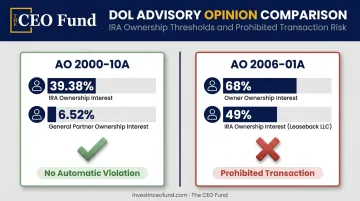
Two DOL Advisory Opinions illustrate the range:
- AO 2000-10A: IRA held a 39.38% stake while the owner held 6.52% as general partner. No automatic violation, but risk remains if the owner personally benefited.
- AO 2006-01A: Owner held 68% of a company while his IRA owned 49% of an LLC leasing a warehouse back to it. Result: a prohibited transaction, since the company was already disqualified.
Facts can change after closing, too. An IRA owner who later becomes an officer, director, or increases ownership can retroactively create a violation. This isn't a one-time compliance check — it requires ongoing monitoring for the life of the investment.
Tax Traps to Watch: UBIT and Entity Structure
IRAs are tax-advantaged, but they aren't immune to taxation in every scenario. Unrelated Business Income Tax (UBIT) applies when the IRA receives income from an active trade or business, or from debt-financed property, regardless of the retirement wrapper around it.
Entity Structure Determines Your UBIT Exposure
When your IRA holds C-corporation stock, income gets taxed at the corporate level first. What flows to the IRA (dividends and appreciation) is generally treated as investment income, not business income, and typically stays outside UBIT.
LLCs and partnerships work differently: they pass business income directly through to owners, including an IRA. That pass-through income can trigger UBIT even though the IRA never touched the operations.
One hard rule applies across the board: IRAs cannot hold S-corporation stock at all. An IRA isn't an eligible S-corp shareholder under the tax code, and attempting it can terminate the company's S election entirely.
Beyond entity type, the IRS also sets a clear dollar threshold for UBIT filing. Per IRS Publication 598, the trigger is $1,000 or more of gross unrelated business income, a gross figure rather than net profit, which requires filing Form 990-T.
IRA trusts are taxed at compressed trust rates, so even modest UBTI can get taxed steeply. Check the current-year rate schedule before assuming a number.
The Valuation Headache
Private, non-traded holdings require annual fair market value reporting on Form 5498. Early-stage companies without a recent financing round often don't have a clean valuation on hand. That gap means the account holder ends up paying for a formal appraisal, or estimating in a way that could invite IRS scrutiny down the road.
How to Set Up This Investment the Right Way
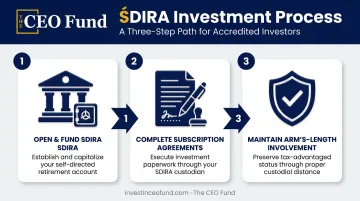
- Open and fund a Self-Directed IRA with a custodian that explicitly supports private equity and private placement transactions. Support varies a lot between providers, so confirm this before you fall in love with a deal. Funds like The CEO Fund, for instance, are structured for self-directed IRA investors.
- Complete subscription agreements and entity documentation with correct titling — typically formatted as "Custodian FBO [Account Name] IRA." Confirm your custodian reviews the deal for prohibited-transaction red flags before funds move.
- Maintain arm's-length involvement after funding. Avoid taking an operational role. Track combined ownership percentages annually, and supply updated valuations so your Form 5498 reporting stays accurate.
A Passive Alternative: Real-Asset Income Through The CEO Fund
Direct private company investing through an IRA carries real, ongoing compliance risk. Disqualified person rules, UBIT exposure, and annual valuation requirements are a lot to manage without continuous legal and tax support — especially for a single-owner investment.
The CEO Fund takes a different approach. Instead of buying equity in an operating business, investors deploy capital into mortgage notes secured by real estate collateral across the U.S.
That structure lets accredited investors put a Self-Directed IRA or 401(k) to work generating cash flow. Investors avoid the "3 T's" (Tenants, Toilets, and Tiles) that come with direct property ownership.
Investors participate as capital partners receiving mortgage payments, not as operators or majority owners of an underlying business. That structure sidesteps the sweat-equity and majority-ownership pitfalls that trip up direct private company investors:
- Skips the operational role or officer position that direct ownership demands
- Avoids landlord or property management responsibilities
- Carries no governance or voting authority requirements
That hands-off structure doesn't mean investors are flying blind, though. The fund brings a decade-plus track record, with 500+ loans purchased across 50+ states, under the leadership of Carlo Turner, a Certified Mortgage Investing Specialist with over 15 years in corporate finance. That kind of institutional oversight matters when you're evaluating who's doing the due diligence on your behalf.
If you're weighing direct private company ownership against a passive, real-asset-backed alternative, talk to your Self-Directed IRA custodian about eligibility. Then connect with The CEO Fund's team to see how monthly mortgage note income could flow directly into your retirement account.
Frequently Asked Questions
Can I use my IRA to invest in a private company?
Yes, this is legal through a Self-Directed IRA, but it requires proper custodian setup and careful avoidance of prohibited transactions involving disqualified persons. A standard brokerage IRA typically won't support it.
What investments should not be in an IRA?
Life insurance contracts, collectibles, and S-corporation stock are barred outright. Beyond that, avoid any asset involving disqualified persons or providing excessive personal benefit to the account owner.
What is UBIT and does it apply to my IRA's investment in a private company?
UBIT applies to active business income passed through from LLCs and partnerships. It generally does not apply to C-corp dividends or stock appreciation, which are typically treated as investment income.
Can a Roth IRA invest in a private company?
Yes, under the same asset and prohibited-transaction rules as a traditional IRA. Because qualified Roth gains compound completely tax-free, a successful private investment can deliver an especially powerful payoff there.
What happens if my IRA investment is considered a prohibited transaction?
The entire IRA can be treated as distributed at fair market value, effective from January 1 of the violation year. That triggers full ordinary income tax on the balance, plus a possible 10% early withdrawal penalty.
Do I need a special custodian to invest my IRA in a private business?
Yes. You need a Self-Directed IRA custodian experienced in alternative assets, since traditional brokerages don't support private placements or the required transaction documentation.