That confusion has a real cost. Skip your 401(k) match and you're walking away from free money. Misunderstand IRA deduction rules and you might overpay the IRS. Pick the wrong account for your situation, and you could miss out on investment options that better fit your goals.
This guide breaks down contribution limits, tax treatment, and investment flexibility for both accounts. We'll also cover how self-directed versions of each can open the door to alternative assets like real estate-backed mortgage notes, not just stocks and mutual funds.
Key Takeaways
- 401(k)s are employer-sponsored; Traditional IRAs are open to anyone with earned income.
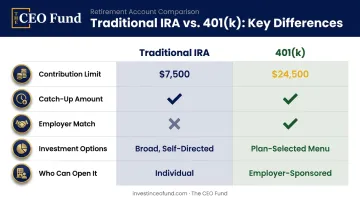
- For 2026, contribution limits are $24,500 for 401(k)s versus $7,500 for Traditional IRAs.
- Employer matching gives 401(k)s an edge, but IRAs typically offer far more investment choice.
- Self-directed IRAs and 401(k)s let investors diversify into mortgage notes and other alternative assets.
Traditional IRA vs 401(k): Quick Comparison
Here's the side-by-side breakdown for 2026, based on current IRS figures.
| Feature | Traditional IRA | 401(k) |
|---|---|---|
| Base contribution limit | $7,500 | $24,500 |
| Catch-up (age 50+) | $1,100 | $8,000 |
| Enhanced catch-up (ages 60-63) | Not applicable | $11,250 |
| Total with catch-up | $8,600 | $32,500 (or $35,750 at ages 60-63) |
| Employer match | None | Often available |
| Who opens it | Individual | Employer sponsors the plan |
| Investment options | Broad: stocks, bonds, alternative assets via self-direction | Limited to plan menu (unless self-directed) |
Contribution Limits: The gap here is significant. According to the IRS's 2026 contribution limit announcement, a 401(k) allows more than three times the base savings of a Traditional IRA.
Tax Treatment: Beyond the dollar limits, both accounts reduce taxable income today, but the mechanics differ slightly. Traditional IRA contributions may be tax-deductible, though deductibility phases out based on income if you're covered by a workplace plan. 401(k) deferrals simply skip federal withholding at the payroll level.
Employer Involvement: That tax treatment ties directly to who controls the account. A 401(k) requires an employer to sponsor the plan. A Traditional IRA doesn't need an employer at all — anyone with earned income can open one.
Investment Options: Plan sponsorship also shapes what you can actually invest in. Standard 401(k)s limit you to whatever menu your plan administrator offers, often a set list of mutual funds. Traditional IRAs (particularly self-directed ones) open up a much wider universe, including real estate-backed notes.
Access & Eligibility: Investment flexibility isn't the only differentiator; age and service requirements diverge too. There's no maximum age to contribute to a Traditional IRA. 401(k) eligibility depends on your employer's plan rules, typically requiring you to reach a minimum age and complete a year of service.
What is a Traditional IRA?
A Traditional IRA is a retirement account anyone with earned income can open, independent of an employer. Contributions may be tax-deductible depending on your income and whether you're covered by a workplace plan, and your investments grow tax-deferred until you withdraw funds in retirement.
This makes it particularly useful for:
- Freelancers and self-employed individuals without access to a company plan
- Anyone wanting more control over specific investments
- Savers who've maxed out a 401(k) and want additional tax-advantaged space
Contribution limits for 2026 sit at $7,500, with an additional $1,100 catch-up contribution available if you're 50 or older, bringing your total to $8,600.
A standard Traditional IRA usually restricts you to stocks, bonds, and mutual funds through a brokerage custodian. A self-directed IRA (SDIRA) changes that, letting you hold alternative assets, including real estate, private lending, and mortgage notes, while keeping the same tax-deferred structure.
Use Cases of a Traditional IRA
Self-employed professionals and independent contractors are natural fits for a Traditional IRA, especially when they want investment choices beyond what a typical 401(k) menu offers.
Consider an investor holding $500,000 in a Traditional IRA, previously allocated to conventional mutual funds. By converting to a self-directed structure, that investor can redirect capital into income-producing mortgage notes instead of market-correlated funds.
| Approach | Income Pattern |
|---|---|
| Traditional | Dividends and capital gains that fluctuate with the market |
| Self-directed | Contractually defined monthly interest payments backed by real estate collateral |
The CEO Fund works with accredited investors who take this route, allocating retirement dollars into Grade A-C performing mortgage notes rather than staying fully exposed to stock market swings. Interest from these notes lands directly in the investor's SDIRA and compounds tax-deferred, without the tenant, repair, or property tax responsibilities that come with owning rental property directly.
What is a 401(k)?
A 401(k) is an employer-sponsored plan funded through payroll deductions, making it the default retirement vehicle for most employed Americans. Contributions come out of your paycheck automatically, before you ever see the money.
The core appeal comes down to three things:
- Automatic savings: no manual transfers required
- Employer match: many companies contribute additional funds based on what you defer
- Higher contribution ceiling: far more room to save each year than an IRA allows
For 2026, employees can defer up to $24,500, with a standard catch-up of $8,000 at age 50+. Savers between ages 60 and 63 get an enhanced catch-up of $11,250 instead, pushing their total possible contribution to $35,750.
Solo and Self-Directed 401(k)s
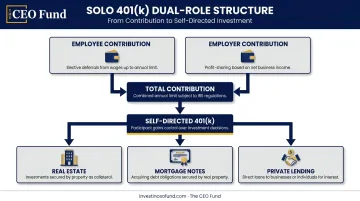
Business owners with no full-time employees (aside from a spouse) can open a Solo 401(k), which lets them contribute as both employee and employer. This dual role can push contribution capacity well beyond what a standard employee-only plan allows.
Combined with a self-directed 401(k) structure, this opens the same alternative-asset access available through SDIRAs, including real estate-backed mortgage notes. A general contractor running a one-person shop, for example, could direct part of that account into a pool of mortgage notes, collecting monthly interest payments instead of relying solely on stock market returns.
Use Cases of a 401(k)
If your employer offers a match, the 401(k) should almost always come first. Skipping it means forfeiting money your company would have otherwise handed you.
Employer match habits vary widely. Vanguard's 2025 research, based on 2024 plan data, found the average promised employer match sits at 4.6% of pay, with plan-weighted participation reaching 85%.
Here's a common scenario: an employee contributes enough to capture their full employer match every year while working. After leaving that job, they roll the old 401(k) into a self-directed IRA rather than leaving it dormant. This unlocks access to alternative assets, like mortgage notes, that weren't available in the original plan menu.
Traditional IRA vs 401(k): Which Is Better for You?
There's no universal answer here. It comes down to four factors:
- Employer match availability: is there free money on the table?
- Contribution amount desired: do you need more room than an IRA allows?
- Investment flexibility: do you want alternative assets or just the plan's fund lineup?
- Tax bracket now vs. retirement: will deferring taxes actually help you?
If your employer offers a match, prioritize the 401(k) first. Turning down a match is functionally the same as declining a raise.
If you're self-employed or lack workplace plan access, a Traditional IRA (or Solo 401(k), if eligible) makes more sense. It's also the better fit if you specifically want alternative investments like real estate-backed notes rather than a standard fund menu.
Most financial professionals recommend using both. Capture the match through your 401(k), then use a Traditional IRA to add investment flexibility.
Self-directed versions of either account matter most once you want exposure to real estate or note-backed collateral instead of assets that move in lockstep with the stock market. The CEO Fund specializes in exactly that, offering real estate-backed notes through self-directed IRA and 401(k) structures.
Can You Contribute to Both? Maximizing Retirement Savings with Self-Directed Options
Yes. Contributing to a Traditional IRA and a 401(k) in the same year is allowed, and each has its own separate limit. According to IRS guidance on IRA contributions, participating in a workplace plan doesn't prevent you from also funding an IRA, though it may affect how much of your IRA contribution is deductible.
The standard sequencing strategy most advisors recommend:
- Contribute enough to your 401(k) to capture the full employer match
- Max out your Traditional IRA contribution
- Return to your 401(k) and contribute further if you still have funds available
For accredited investors, this sequencing becomes even more powerful when self-directed accounts enter the picture. Instead of parking retirement dollars exclusively in market-correlated funds, you can diversify into real estate-backed mortgage notes.
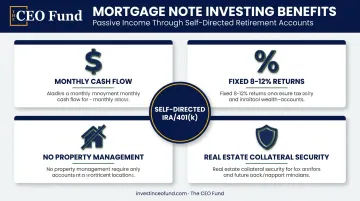
Through The CEO Fund, accredited investors direct capital from self-directed IRAs or 401(k)s into performing mortgage notes secured by real estate collateral. Rather than acting as a landlord, you effectively step into the lender's position:
- Consistent monthly cash flow deposited directly into your retirement account
- Fixed interest returns, typically 8-12%, rather than market-dependent dividends
- No tenants, toilets, or tiles — property management stays entirely off your plate
- Real estate collateral backing every note, adding a layer of security stocks don't offer
For a saver already maxing out both a 401(k) and an IRA, this kind of diversification adds an income stream that doesn't rise and fall with the S&P 500.
Frequently Asked Questions
Which is better: a traditional IRA or a 401(k)?
It depends on whether you have access to an employer match, how much you want to contribute, and how much investment flexibility you need. Most financial professionals recommend using both accounts together when possible.
Can I retire at 62 with $400,000 in my 401(k)?
Retiring at 62 with $400,000 requires modeling your withdrawal rate, retirement expenses, Social Security income, and how long the funds need to last. Run the numbers with a retirement calculator or advisor before deciding.
Can I have both a Traditional IRA and a 401(k) at the same time?
Yes. You can fund both accounts in the same year, as long as each contribution stays within its own annual IRS limit.
What happens to my 401(k) if I leave my job?
You generally have three options: leave the funds in your former employer's plan, roll them into your new employer's plan, or roll them into an IRA, including a self-directed IRA.
Can I roll over my 401(k) into a self-directed IRA?
Yes. A direct rollover avoids taxes and early withdrawal penalties while opening access to alternative assets like the real estate-backed mortgage notes The CEO Fund specializes in for accredited investors.
What are the current contribution limits for a Traditional IRA and a 401(k)?
For 2026, Traditional IRAs allow $7,500 ($8,600 with the age 50+ catch-up). 401(k)s allow $24,500, with catch-ups pushing totals to $32,500 or $35,750 depending on age.