Picking the wrong one affects more than your monthly statement. It shapes how much volatility you can stomach during a downturn, how fast your portfolio recovers, and whether you'll have enough income when you actually need it.
This isn't a small niche question either. Bond mutual funds alone held $5.1 trillion in total net assets at the end of 2024, making up 18% of the entire U.S. mutual fund market, according to the Investment Company Institute's 2025 Fact Book. Hybrid funds, which include balanced funds, added another 6%. Investors are clearly putting real money behind both strategies.
Key Takeaways
- Income funds chase steady, predictable payouts through bonds and dividend stocks
- Balanced funds mix stocks and bonds (often 60/40) to pursue income plus growth
- Your choice hinges on risk tolerance, time horizon, and growth needs
- Accredited investors often choose mortgage note funds for higher, asset-backed income
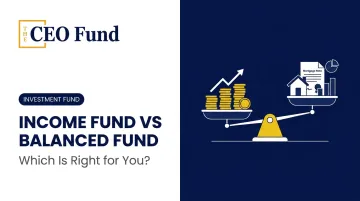
Income Fund vs Balanced Fund: Quick Comparison
Here's how income funds and balanced funds compare across the factors that matter most:
| Factor | Income Fund | Balanced Fund |
|---|---|---|
| Primary Objective | Generate steady, predictable income | Generate both income and capital growth |
| Typical Holdings | Bonds, preferred stock, dividend stocks, money market instruments | Stocks and bonds, often a fixed 60/40 ratio |
| Risk Level | Generally lower, more conservative | Moderate, due to stock exposure |
| Best Suited For | Retirees or risk-averse investors needing cash flow | Investors wanting a diversified core holding |
| Volatility in Downturns | More stable, but not immune to rate/credit risk | Can still see meaningful drawdowns |
Notice the pattern:
- Income funds prioritize stability over upside potential
- Balanced funds accept short-term volatility in exchange for growth
- Neither option eliminates risk entirely
What is an Income Fund?
An income fund invests almost exclusively in income-producing securities: think bonds, preferred stock, and dividend-paying common stock. The SEC classifies these as bond or income funds that invest primarily in debt securities, with credit, interest-rate, and prepayment risk as the main things to watch.
This structure appeals to a specific type of investor: someone who wants cash flow now, not a bet on future growth.
Core benefits include:
- Predictable monthly or quarterly payouts
- Lower volatility than equity-heavy portfolios
- A focus on capital preservation rather than aggressive returns
Common Subtypes You'll Encounter
Not all income funds are built the same way:
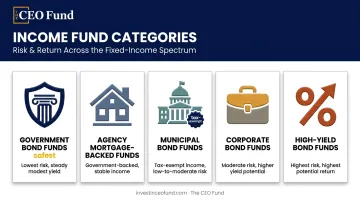
- Corporate bond funds – hold debt issued by companies, ranging from investment-grade to high-yield
- Municipal bond funds – invest in state and local government debt, often with federal (and sometimes state) tax exemption
- Government bond funds – hold Treasury securities, generally considered among the safest fixed-income assets
- High-yield bond funds – chase higher income from lower-rated corporate debt, accepting more default risk in return
- Agency mortgage-backed funds – invest in securities from Ginnie Mae, Fannie Mae, and Freddie Mac, carrying varying levels of government backing
Some accredited investors eventually look past this list entirely. They move toward private, asset-backed alternatives like mortgage note investment funds, which can offer real estate-collateralized monthly cash flow without the tenant headaches that come with owning rental property directly.
Use Cases of Income Funds
Income funds tend to show up at a specific life stage: retirement drawdown. Retirees relying on predictable bond income, or conservative institutions managing cash reserves, are the classic examples.
But income funds aren't bulletproof. In 2022, rising rates hammered the category hard. Vanguard Total Bond Market, one of the largest bond funds in the country, lost 13.3% that year, its worst calendar-year decline on record, according to Morningstar. Long-duration Treasury funds fared even worse.
That's the lesson: income doesn't mean immunity from principal loss. It just means the payouts stay relatively steady while the fund's price can still swing.
What is a Balanced Fund?
A balanced fund holds a fixed mix of stocks and bonds, commonly 60% stocks and 40% bonds, to pursue growth and income at the same time. The SEC's definition uses this exact 60/40 split as its standard example.
This structure suits investors who want a "set it and forget it" holding rather than something they actively manage.
Core benefits:
- Automatic diversification across two asset classes
- Built-in rebalancing that trims winners and adds to laggards
- Smoother returns than an all-stock portfolio
- Less need for hands-on portfolio management
Variations Worth Knowing
Balanced funds aren't a single product. Common structures include:
- Domestic index balanced funds – track broad U.S. stock and bond indexes at a fixed ratio
- Global balanced funds – blend U.S. and international stocks with U.S. and international bonds
- Target-date funds – shift toward a more conservative mix as a target retirement date approaches
- Manager-run balanced funds – actively managed with a neutral allocation target, often near 60/40
Use Cases of Balanced Funds
Balanced funds fit investors still building wealth but who want less volatility than an all-stock portfolio. Think mid-career professionals with a 6 to 10 year horizon who don't want to babysit their allocation.
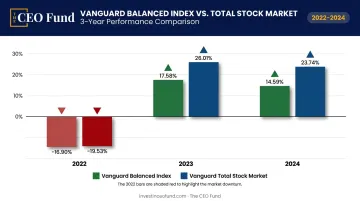
Here's the trade-off in real numbers. During 2022's bond and stock selloff, Vanguard Balanced Index fell 16.90%, compared to 19.53% for Vanguard Total Stock Market, according to Vanguard's fund performance data. The bond sleeve cushioned the blow.
But the recovery told a different story. In 2023 and 2024, the balanced fund returned 17.58% and 14.59%, while the all-stock fund posted 26.01% and 23.74%. Less downside came paired with less upside during the rebound.
Income Fund vs Balanced Fund: Which Is Better for You?
Neither fund wins outright. The right pick depends on how you answer a few questions:
- Risk tolerance – Can you handle stock-driven drawdowns, or do you need stability above all?
- Time horizon – Are you decades from retirement or already drawing down savings?
- Growth vs. pure income – Do you need your money to grow, or just to pay you consistently?
- Tax considerations – Municipal income funds and retirement account placement both matter here
Choose an income fund if capital preservation and predictable payouts top your list, especially if you're near or in retirement.
Choose a balanced fund if you want a diversified, semi-growth holding that doesn't demand constant attention.
Real-World Example: Choosing Asset-Backed Passive Income
Consider an accredited investor comparing a traditional bond income fund against something structurally different: a mortgage note fund like The CEO Fund.
Their challenge wasn't unusual. They wanted higher, more consistent monthly cash flow than a typical bond fund offered, but without becoming a landlord. No tenants, no toilets, no tile repairs, the "3 T's" that come with direct property ownership.
The decision trigger was interest rate volatility. Watching a bond fund lose double digits in 2022 while still being told rates were "protecting" their income felt contradictory. A note secured directly by real property offered a different risk profile.
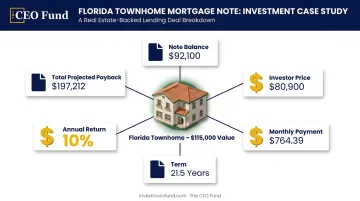
Here's how the math played out in one documented case study: a Florida townhome valued at $115,000 backed a note with a $92,100 balance, leaving an equity cushion above the loan amount.
- Investor price: $80,900
- Monthly payment: $764.39 over a 21.5-year term
- Return: 10% annually
- Total payback projected: $197,212
Compare that to typical investment-grade bond yields, which have run in the 2% to 6% range in recent years. The CEO Fund's mortgage note strategy, drawing on Grade A–C performing notes backed by multifamily, single-family, commercial, and mobile home park collateral, targets 8% to 12% annually, with some deals reaching higher.
This is also accessible inside a self-directed IRA or 401(k), letting the income flow into a tax-advantaged account rather than a taxable brokerage statement. If you're weighing this path, explore The CEO Fund's mortgage note opportunities to see whether your accredited investor status opens the door to this kind of asset-backed income.
Conclusion
There's no universal winner between income funds and balanced funds. It comes down to what you're optimizing for: stable cash flow, balanced growth, or an alternative real-asset-backed income stream (like the mortgage note investments The CEO Fund manages) that behaves differently than either.
Match the fund type to your actual financial goals, not a generic rule of thumb. Someone five years from retirement has different needs than someone accumulating wealth for the next two decades. Get clear on your cash flow needs, your tolerance for drawdowns, and your appetite for something outside traditional stocks and bonds, then build from there.
Frequently Asked Questions
What is the difference between a balanced fund and an income fund?
Income funds invest solely in income-producing securities like bonds and dividend stocks for steady payouts. Balanced funds combine stocks and bonds, typically 60/40, to pursue both income and growth.
Is an income fund a good investment?
Income funds suit conservative investors who prioritize cash flow and capital preservation over growth. Returns typically run lower than growth-oriented funds, and principal value can still fluctuate with interest rates.
Are income funds riskier than balanced funds?
These portfolios generally carry less risk thanks to their bond and dividend weighting. Balanced funds carry more risk from stock exposure but offer greater long-term growth potential in exchange.
How much of my portfolio should be in income vs. balanced funds?
It depends on your age, risk tolerance, and time horizon. Most investors shift more heavily toward income funds as retirement approaches and away from growth-oriented balanced holdings.
Can I switch between an income fund and a balanced fund over time?
Yes, and many investors should as goals and risk tolerance evolve. A common pattern is starting with more balanced fund exposure early on, then rebalancing toward income funds closer to retirement.
What are alternatives to traditional income funds for accredited investors seeking higher yield?
Accredited investors sometimes turn to private, asset-backed options like mortgage note investment funds. The CEO Fund, for example, offers real estate-collateralized quarterly income targeting 8% to 12% annually for qualified investors.