
That scenario plays out in some form almost every downturn cycle, for public pensions and private 401(k) holders alike. Pension funds now manage trillions in assets globally, and the investment landscape keeps getting more complicated: alternative assets, volatile rate environments, and political pressure over where money gets invested.
The OSFI consultation on pension investment risk management makes a simple point: as portfolios grow more complex, risk management practices have to evolve with them. This guide breaks down the main categories of pension investment risk, how funds manage them, and how individual investors can diversify their own retirement exposure.
Key Takeaways
- Pension risk spans market, interest rate, longevity, liquidity, valuation, and political factors, each affecting funded status differently
- Defined benefit plans push risk onto sponsors and taxpayers; defined contribution plans push it directly onto account holders
- Regulators increasingly expect independent risk oversight and stronger valuation policies from plan administrators
- Individual investors can reduce public market dependence by adding asset-backed alternatives, such as mortgage notes, to a self-directed retirement account
What Is Pension Fund Investment Risk?
Pension fund investment risk is the possibility that a plan's assets won't grow fast enough, or will shrink outright, relative to what the plan owes its members. It's a mismatch problem: obligations are largely fixed (or grow predictably), while investment returns are anything but.
Because that mismatch can't be eliminated, plan administrators carry a fiduciary duty to manage it. Under ERISA's prudent-investor standard, sound risk management is how a plan fulfills its legal obligation to invest prudently on behalf of members and beneficiaries.
Who actually absorbs the fallout depends on plan structure:
- Defined benefit (DB) plans: Employers and, for public plans, taxpayers cover any shortfall
- Defined contribution (DC) plans: The individual account holder eats the loss directly, since there's no promised benefit to fall back on
The scale here is not small. Equable Institute's January 2026 State of Pensions update projects $1.27 trillion in unfunded liabilities across U.S. state and local pension systems for FY2025, with an average funded ratio of 82.5%. That's an improvement from the finalized FY2024 figure of $1.54 trillion, but it still represents a massive gap between promises made and assets on hand.
Types of Investment Risk Pension Funds Face
Pension risk isn't one thing. It's a cluster of distinct exposures that can compound each other during a bad cycle.
Market & Equity Volatility Risk
When equity markets drop, plan assets shrink while liabilities generally hold steady or keep climbing. Cambridge Associates research points to 2001-03 and 2007-09 as the classic "perfect storm" periods for DB plans, when falling stock prices coincided with falling discount rates, hitting funded status from both sides at once.
Exposure varies a lot by plan type:
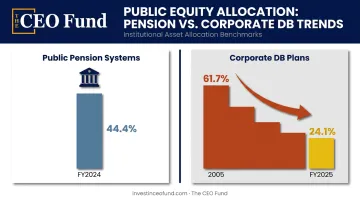
- U.S. public pension systems held an average 44.4% in public equities in FY2024
- Large corporate DB plans moved the opposite direction, cutting equity allocations from 61.7% in 2005 to just 24.1% by FY2025, shifting toward fixed income instead
- Plans still leaning heavily on public equities face greater exposure to a sudden crash than those using liability-hedging strategies
Interest Rate & Liability Risk
Here's the part that surprises a lot of people: falling interest rates can hurt a pension plan even if the stock market does nothing. Liabilities are discounted using market rates tied to high-quality corporate bonds. When those rates drop, the present value of future benefit payments rises automatically.
Milliman's research illustrates the sensitivity: liabilities with a 14.2-year duration can shift by roughly 14.2% for every 100-basis-point move in rates. If plan assets don't have a matching duration profile, that mismatch becomes a direct driver of funded-status swings, independent of how investments actually perform.
Longevity Risk
Pension math depends on estimating how long people will live. Get that wrong, and liabilities are understated for decades. U.S. life expectancy at birth ticked up from 78.4 years in 2023 to 79.0 in 2024, and life expectancy at age 65 rose to 19.7 years. Small shifts like these compound across millions of members.
It gets more complicated for married participants. A qualified joint-and-survivor annuity continues paying 50% to 100% of the benefit to a surviving spouse, meaning actuaries have to model two lifespans, not one, for a huge share of the member base.
Liquidity & Alternative Asset Valuation Risk
Public pensions have been steadily shifting into private equity, real estate, and other illiquid holdings. Pew found alternatives grew from 27% of public pension assets in 2019 to 35% in 2022. Combined with public equities, that's 77% of assets exposed to either market swings or valuation uncertainty.
The problem: illiquid assets don't get priced daily, and appraisal-based valuations often lag real market conditions.
Canada Pension Plan Investment Board offers a real example: it disposed of a 29% stake in a Manhattan office tower for $1 in 2024 and sold a Santa Monica business park for $38 million, 75% below its 2018 valuation. Its overall property portfolio posted a 5% loss in FY2024 during the broader commercial real estate downturn.
Inflation, Political & Regulatory Risk
Unexpected inflation erodes purchasing power for retirees, especially when cost-of-living adjustments don't keep pace. CalPERS' 2025 inflation measure came in at 2.63%, yet many retirees with contracted 2% COLA caps received only 2.00%, a real, compounding gap over a 20-year retirement.
Political interference is a newer, less-discussed category. An Oklahoma judge blocked a state law barring pension systems from working with firms that limit oil and gas investment, ruling it conflicted with fiduciary duty.
At the federal level, the proposed RETIRE Act would restrict ERISA fiduciaries to considering only pecuniary factors: a direct shot at ESG-based investing mandates. Either direction of political pressure can push plan administrators away from purely risk-optimal decisions.
How Pension Plans Manage and Mitigate Investment Risk
Good pension governance isn't reactive. It's built around structure, testing, and clearly defined boundaries.
Governance & Independent Risk Oversight
OSFI's (Canada's pension regulator) core principle: separate risk oversight from operational management. When the same team that takes investment risk is also the one monitoring it, conflicts of interest creep in. Independent oversight functions are expected to maintain:
- A documented risk appetite statement: concrete and measurable, not vague aspiration
- Defined risk limits the plan should not exceed
- Ongoing monitoring against both
Diversification & Liability-Driven Investing (LDI)
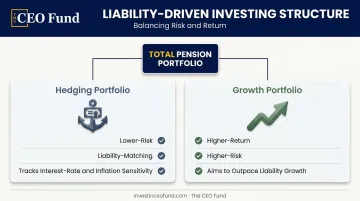
LDI splits a portfolio into two functional pieces:
- Hedging portfolio: lower-risk, liability-matching assets designed to track the interest-rate and inflation sensitivity of what the plan owes
- Growth portfolio: higher-return, higher-risk assets meant to outpace liability growth and reduce future sponsor contributions
Diversification across asset classes, geographies, and strategies limits how much any single risk factor can damage total performance. No single bad quarter in one sector should sink the whole plan.
Some plans diversify their growth allocation further with real-estate-backed vehicles, such as mortgage-note funds like The CEO Fund, as an alternative to traditional equities.
Stress Testing, Risk Limits & De-risking
Plans increasingly run scenario tests, modeling how a shock (say, a 15% equity decline) would ripple through funded status. OSFI notes plans can use either deterministic scenarios or stochastic modeling to combine multiple market-risk factors at once.
When sponsors want to shed risk entirely, pension risk transfer is the tool of choice: offering lump sums or purchasing annuities from insurers to offload both investment and longevity risk. This market is growing fast: according to LIMRA's Secure Retirement Institute, U.S. single-premium PRT sales hit $51.8 billion across 500 contracts in 2024, up 14% from the prior year.
Can You Lose Your Pension If the Market Crashes?
The honest answer depends entirely on plan type.
Defined benefit plans: Sponsors absorb most market risk, since the plan sponsor promises a fixed benefit regardless of investment performance. Private-sector single-employer DB plans are backed by the PBGC up to statutory limits, currently a maximum of $7,789.77 per month at age 65 for plans terminating in 2026. Government and church plans aren't PBGC-covered, but taxpayer backing typically fills that same protective role for state and local public systems.
Defined contribution plans: Your account value falls directly and immediately with the market, since there's no insurance layer standing between you and a bad quarter.
A crash rarely wipes out a pension entirely, but it typically does the following:
- Reduce funded status, sometimes for years
- Delay or shrink benefit increases
- Cut DC account balances in real time
Timing matters more than most people realize. A downturn decades before retirement gets time to recover. A downturn right before or during retirement — known as sequencing risk — can permanently reduce how long retirement savings last, because withdrawals continue even as the portfolio is down.
Diversifying Beyond Traditional Pensions: Alternative Income Strategies
Given how tightly DC balances track public markets, a lot of investors look for ways to reduce that correlation without abandoning tax-advantaged accounts altogether. One common approach: allocate a portion of a self-directed IRA or 401(k) into asset-backed alternatives that don't move in lockstep with stocks.
Mortgage note investing is a straightforward example. Instead of owning equity in a company or a property, you effectively act as the bank, collecting monthly payments backed by real estate collateral, rather than betting on where the stock market goes next.
This is the space The CEO Fund operates in. A few specifics worth knowing:
- Delivers a 10+ year track record, with 500+ loans purchased across 50+ U.S. states
- Focuses on Grade A–C mortgage notes secured by residential and commercial real estate, structured for quarterly cash distributions
- Built for self-directed IRA and 401(k) compatibility, so returns can compound in a tax-advantaged account rather than a taxable one
- Eliminates what the fund calls "the 3 T's" (Tenants, Toilets, and Tiles), since investors hold a lender position rather than direct property ownership
Eligibility and Return Expectations
Access is limited to accredited investors, meaning individual income above $200,000/year ($300,000 with a spouse) or net worth exceeding $1 million excluding a primary residence. Target returns run 8% to 12% annually, with some opportunities reaching up to 15%, figures that depend on note grade and structure, not guaranteed outcomes.
For someone whose 401(k) balance is entirely exposed to the next equity downturn, this kind of allocation doesn't eliminate risk. It just moves part of the portfolio into a different risk category, one tied to real estate collateral and borrower payment behavior instead of daily market sentiment.
Frequently Asked Questions
What are the risks associated with pension funds?
Pension funds face market, interest rate, longevity, liquidity/valuation, inflation, and political/regulatory risks. Each affects a plan's ability to meet future benefit obligations differently, and they often compound during economic stress.
Can you lose your pension if the stock market crashes?
Defined benefit plans are largely insulated by sponsor backing and PBGC guarantees, while defined contribution balances fall directly with the market. The practical impact comes down to which plan type you hold.
What is the biggest risk facing pension funds today?
Valuation risk from the growing share of illiquid alternative assets, combined with ongoing market uncertainty, is a rising concern among pension researchers as private allocations account for an increasingly large share of total assets.
How do pension funds reduce investment risk?
Plans combine independent governance, diversification, liability-driven investing, and regular stress testing. Some sponsors also use pension risk transfer to offload investment and longevity risk to insurers entirely.
Are private pensions riskier than public pensions?
Private DB plans face PBGC-insured payout limits and pressure to de-risk through annuity buyouts. Public pensions instead deal with political influence over investment decisions and generally larger unfunded liability trends.
Can alternative investments help reduce pension portfolio risk?
Adding asset-backed alternatives like mortgage notes to a self-directed IRA or 401(k) can diversify savings away from public market volatility. The CEO Fund offers accredited investors this type of mortgage note investment as a real estate-backed alternative to traditional holdings.