
Introduction
How much can you earn in 2026 and still fund a Roth IRA? The answer hinges on Modified Adjusted Gross Income (MAGI), not your salary, and most people have never calculated their own MAGI.
Many high earners assume they're automatically locked out once their income climbs past six figures. That's rarely the full picture. Partial contributions, IRS phase-out ranges, backdoor conversions, and updated thresholds keep the door open far longer than most assume.
This guide covers what you need to know:
- 2026 MAGI thresholds by filing status
- Updated contribution caps for the year
- How to calculate your MAGI correctly
- What to do if your income exceeds the limit
Key Takeaways
- Full Roth contributions in 2026 require MAGI below $153,000 (single) or $242,000 (married filing jointly).
- The 2026 contribution cap is $7,500 under age 50, or $8,600 at 50+
- Partial contributions are still possible within the phase-out range before eligibility disappears
- High earners still have options: backdoor Roth conversions, Roth 401(k)s, or self-directed IRAs
2026 Roth IRA Income Limits by Filing Status
The IRS adjusts Roth IRA MAGI thresholds every year to keep pace with inflation. The figures below reflect the official 2026 numbers, confirmed by the IRS for the upcoming tax year.
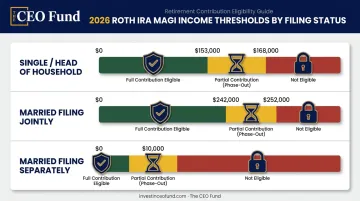
Single Filers and Head of Household
- Full contribution: MAGI under $153,000
- Phase-out range: $153,000 to just under $168,000
- No contribution allowed: MAGI of $168,000 or more
Married Filing Jointly or Qualifying Widow(er)
- Full contribution: MAGI under $242,000
- Phase-out range: $242,000 to just under $252,000
- No contribution allowed: MAGI of $252,000 or more
Married Filing Separately
This filing status allows far less flexibility. If you lived with your spouse at any point during the year:
- Partial contribution possible: MAGI under $10,000
- No contribution allowed: MAGI of $10,000 or more
Spouses who lived apart the entire year can instead use the Single/Head of Household thresholds above — a detail many separated couples miss.
For a quick side-by-side comparison, here's how all three filing statuses stack up:
| Filing Status | Full Contribution | Phase-Out Range | Fully Ineligible |
|---|---|---|---|
| Single / Head of Household | Under $153,000 | $153,000–$167,999 | $168,000+ |
| Married Filing Jointly | Under $242,000 | $242,000–$251,999 | $252,000+ |
| Married Filing Separately (lived together) | N/A | $0–$9,999 | $10,000+ |
2026 Roth IRA Contribution Limits (By Age)
Income eligibility is only half the equation. The other half is how much you're actually allowed to put in.
- Under age 50: $7,500 maximum
- Age 50 and older: $8,600 maximum (includes the $1,100 catch-up contribution)
A few clarifications that trip people up:
- This limit is combined across all your Traditional and Roth IRAs — not $7,500 per account.
- You also can't contribute more than your taxable compensation for the year, regardless of the dollar limit.
- If your MAGI falls inside the phase-out range, your allowed contribution shrinks proportionally. The IRS formula rounds up to the nearest $10, with a $200 floor for any positive result.
Rather than doing this math by hand, most filers near the threshold use the IRS's contribution limit worksheet or work with a tax preparer. Self-directed IRA investors should confirm the reduced amount with their custodian before funding alternative-asset contributions.
How to Calculate Your MAGI for Roth IRA Eligibility
MAGI isn't the number on your pay stub, and it isn't quite your AGI either. Here's the actual sequence:
- Start with your Adjusted Gross Income (AGI) from your tax return.
- Subtract any income from Roth conversions or qualified rollovers included in that AGI.
- Add back specific deductions: the Traditional IRA deduction, student loan interest deduction, and foreign earned income or housing exclusions.
For most taxpayers, MAGI and AGI are nearly identical. The differences show up mainly for people claiming foreign income exclusions or student loan interest deductions: items that get added back into the MAGI calculation even though they reduced AGI.
If your income sits anywhere near a threshold, don't eyeball it. Use IRS Publication 590-A's Worksheet 2-1 or consult a tax professional. A miscalculation of even a few thousand dollars can trigger an excess contribution — and the penalty for that mistake compounds every year it goes uncorrected.
What Counts as Income for Roth IRA Contributions?
Only earned income counts toward your eligibility to contribute. That includes:
- Wages, salaries, and tips
- Self-employment income
- Commissions and bonuses
- Taxable alimony (for divorce agreements executed before 2019)
What does not count, even if it pushes your MAGI comfortably under the limit:
- Rental income
- Dividends and interest
- Social Security benefits
- Pension or annuity income
- Capital gains
One catch: you need earned income to contribute at all. A retiree with $140,000 in dividend and rental income but zero wages can't fund a Roth IRA, even though their MAGI is well under the threshold.
What Happens If You Exceed the Roth IRA Income Limit?
Two things disqualify you from a direct Roth contribution: MAGI above your filing status's phase-out ceiling, or having no taxable compensation at all. If either applies, you still have several solid alternatives to consider.
The Backdoor Roth IRA. Contribute to a nondeductible Traditional IRA, then convert those funds to a Roth. Simple in theory. The complication is the pro-rata rule: if you already hold pre-tax IRA balances anywhere, Form 8606 forces you to prorate the conversion across all your Traditional IRA money, not just the new contribution. That can make part of your "backdoor" conversion unexpectedly taxable.
The Roth 401(k). If your employer offers one, there's no income limit at all. The 2026 employee deferral cap is $24,500, with catch-up contributions pushing that to $32,500 for those 50-59 and 64+, or $35,750 for the 60-63 window under the new designated Roth account rules.
A Traditional IRA. You can still contribute, though your deduction may phase out at higher incomes. The money still grows tax-deferred until withdrawal.
Self-directed IRAs and alternative assets. This is where a lot of high earners redirect capital once the direct Roth door closes. Instead of parking retirement funds in stocks or bonds, a self-directed IRA or 401(k) lets you hold real estate-backed assets, including mortgage notes.
At The CEO Fund, accredited investors use this structure to hold mortgage notes inside a self-directed IRA or 401(k). They collect monthly payments as passive income without taking on the "3 T's" of direct property ownership: tenants, toilets, and tiles. You take on the lender's role instead of the landlord's, and your retirement account still gets the tax-advantaged treatment.

Before executing any conversion or self-directed strategy, talk to a tax advisor. Your specific MAGI, existing IRA balances, and retirement timeline all affect which path actually makes sense.
Avoiding Excess Contribution Penalties
Contribute more than you're allowed, and the IRS doesn't just ask for the money back. It charges a 6% excise tax on the excess amount, applied annually for every year the excess stays in the account.
Two ways to fix it:
- Withdraw the excess plus earnings before your tax filing deadline, including extensions. Do this correctly and the penalty never applies.
- Recharacterize the contribution by converting the ineligible Roth amount into a Traditional IRA contribution, through a trustee-to-trustee transfer completed by the filing deadline.
One exception: recharacterization only works for original contributions. Roth conversions made after 2017 can't be converted back to Traditional.
Frequently Asked Questions
What disqualifies you from a Roth IRA?
Two things: MAGI above your filing status's phase-out ceiling for 2026, or having no taxable compensation for the year. Either condition alone is enough to block a direct contribution.
What counts as income for Roth IRA?
Earned income only — wages, self-employment income, commissions, bonuses, and tips. Passive income like dividends, rental income, and capital gains doesn't count toward eligibility.
Does a Roth IRA generate income?
Not on its own. A Roth IRA is a tax-advantaged wrapper: growth comes from whatever investments you hold inside it, such as stocks, bonds, or alternative assets, all growing tax-free.
Can I still save for retirement tax-efficiently if I earn too much for a Roth IRA?
Yes. Backdoor Roth conversions, employer Roth 401(k) plans, and self-directed IRAs invested in real estate-backed assets like mortgage notes all remain viable paths for high earners.
What is the deadline to contribute to a Roth IRA for the 2026 tax year?
The federal tax filing deadline, typically April 15, 2027. This deadline does not extend even if you file for a tax extension.
Do Roth IRA income limits change every year?
Yes. The IRS adjusts MAGI thresholds and contribution limits annually for inflation, so it's worth checking the current-year figures before assuming last year's numbers still apply.