
The choice affects everything from your monthly time commitment to how your income gets taxed. Direct ownership means control, but it also means tenant calls at midnight. Indirect vehicles mean passive income, but you give up day-to-day decision-making.
This shift is showing up in the data. Institutional investors' target allocation to real estate climbed to 10.1% in 2024, while target allocations to real estate debt rose to 6.3%, according to the 2024 Investor Trends Survey from Institutional Real Estate Inc. More sophisticated capital is flowing toward indirect, debt-backed strategies. This guide breaks down both approaches so you can decide which fits your capital, time, and income goals.
Key Takeaways
- Direct investing means owning property directly; indirect investing gains exposure through REITs, funds, or mortgage notes
- Control, capital requirements, liquidity, and tax treatment are the main differences between the two approaches
- Hands-on investors who want maximum control gravitate toward direct ownership
- Passive income seekers avoid the "3 T's" (Tenants, Toilets, Tiles) through indirect vehicles
- Your available capital, time, and risk tolerance ultimately determine which path fits
Direct vs. Indirect Real Estate Investing: Quick Comparison
Here's how the two approaches stack up across the factors that matter most to accredited investors.
| Factor | Direct Investing | Indirect Investing |
|---|---|---|
| Control | Full authority over tenants, financing, and improvements | Passive role; professional managers handle acquisitions and operations |
| Capital Requirements | Significant upfront capital: down payment, closing costs, and reserves | Lower minimums; many funds and REITs allow entry with modest capital |
| Liquidity | Illiquid; selling can take months with high transaction costs | Generally more liquid, especially publicly traded REITs; private funds vary |
| Tax Treatment | Deductions for mortgage interest, depreciation, and 1031 exchange deferral | Dividend/interest income often taxed as ordinary income; IRA/401(k) accounts help offset this |
| Management | Investor handles or hires for maintenance, screening, and repairs | Managed entirely by fund managers or REIT operators |
A quick note on tax treatment: roughly 78% of annual REIT dividends were taxed as ordinary income in 2024, with only 9% qualifying as long-term capital gains, according to Nareit's 2024 REITWatch report. That's a meaningful difference from direct ownership's depreciation shelter, though structures vary: mortgage note funds, for instance, often pass through similar depreciation benefits. Discuss the specifics with your tax advisor before committing capital.
What Is Direct Real Estate Investing?
Direct real estate investing means purchasing physical property and personally managing it for rental income or appreciation. You're the one signing the mortgage, screening tenants, and deciding whether to renovate the kitchen. Control over financing and operations sits entirely with you, and that's both the appeal and the burden.
Core benefits of direct ownership:
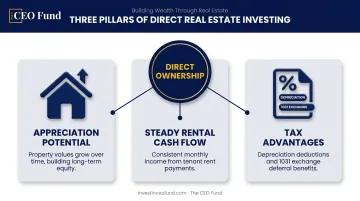
- Appreciation potential: property value grows over time, building equity alongside your mortgage paydown
- Steady rental cash flow: monthly rent checks can cover the mortgage and generate surplus income
- Tax advantages: depreciation deductions and mortgage interest write-offs reduce taxable income, and 1031 exchanges defer capital gains on qualifying sales
Direct investing spans several subtypes, including residential rentals, commercial property, raw land, and short-term or vacation rentals, each with distinct risk and management profiles.
Use Cases of Direct Investing
Direct ownership fits investors who have capital reserves, time to spare, and a willingness to act as landlord (or hire a property manager who does). It's the natural fit for:
- Small multifamily buyers scaling a portfolio duplex by duplex
- Long-term buy-and-hold landlords prioritizing equity growth over decades
- House-hackers using rental income to offset their own mortgage
These use cases work best when the numbers support long-term equity growth, and the appreciation case is strong right now. More than 80% of U.S. metro areas (189 of 228 tracked markets) posted home price gains in Q1 2025, per the National Association of Realtors.
That said, direct property isn't something you convert to cash overnight, even in strong markets. Existing-home sales showed a median time on market of 28 days in June 2025.
What Is Indirect Real Estate Investing?
Indirect real estate investing means gaining exposure to real estate income and appreciation through vehicles like REITs, real estate funds, crowdfunding platforms, or mortgage note funds — without ever holding title to a property or fielding a maintenance call.
Core benefits include:
- Passive monthly income without landlord duties
- Diversification across property types and geographic markets
- Professional due diligence handled by fund managers, not you
- Reduced operational burden: no repairs, no tenant screening, no 3 a.m. plumbing emergencies
Common subtypes include publicly traded REITs, real estate mutual funds and ETFs, crowdfunding platforms, and private mortgage note funds. Specialized funds like The CEO Fund take this a step further, allowing accredited investors to act as "the bank," collecting monthly mortgage payments backed by real estate collateral instead of owning property directly. That means no tenants, no toilets, no tiles.
Use Cases of Indirect Investing
This approach suits busy professionals, high-net-worth individuals, and self-directed IRA or 401(k) investors who want real estate-backed income without operational headaches. Self-directed retirement accounts, in particular, face strict IRS rules around "self-dealing" in directly owned property. Mortgage notes sidestep that issue entirely while keeping the tax-advantaged wrapper intact.
Mortgage note investing is a niche worth understanding on its own. Instead of owning equity in a property, the investor's return is secured by a lien on real property. Borrower payments, not rent checks, generate the monthly income. This is functionally closer to being a lender than a landlord.
The scale of this market is growing quickly. Preqin projects global private debt assets under management could reach $2.8 trillion by 2028, with direct lending climbing toward $1.4 trillion, according to Preqin's private debt research. Real estate-backed lending strategies are a meaningful piece of that expansion.
Direct vs. Indirect: Which Is Better for You?
There's no universal winner here. The right answer depends on five factors:
- Available capital: direct ownership demands more upfront cash for down payments and reserves
- Time commitment: landlording is a part-time job; note investing generally isn't
- Risk tolerance: vacancy and repair costs are unpredictable; note payments follow a fixed schedule
- Liquidity needs: property sales take months; many indirect vehicles offer faster exit paths
- Desired control: direct owners make every decision; indirect investors delegate it
Choose direct investing if you want maximum control and tax leverage through depreciation and 1031 exchanges, and you're prepared to manage property (or hire someone who will).
Choose indirect investing if you want predictable passive income, diversification, and freedom from property management altogether.
Real-World Example: Passive Income Through Mortgage Notes
Picture a landlord who owns a single rental property. The mortgage is manageable, but tenant turnover keeps creating gaps in cash flow, and a surprise HVAC replacement wipes out a quarter's worth of profit. The math still works on paper. It just doesn't feel predictable in practice.
That unpredictability is exactly what drives many direct owners toward mortgage note investing. Instead of chasing rent and absorbing repair bills, they shift into a lender position: collecting fixed monthly payments backed by real estate collateral, with none of the landlord responsibilities.
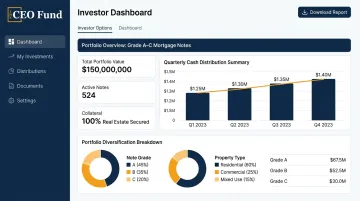
This is the model behind The CEO Fund's approach. Investors gain exposure to Grade A–C mortgage notes secured by diversified real estate collateral across the U.S., with quarterly cash distributions and a pass-through structure. No tenants. No toilets. No tiles.
If unpredictable maintenance costs and tenant turnover sound familiar, explore how mortgage note investing through The CEO Fund can convert your real estate exposure into consistent, collateral-backed passive income.
Conclusion
Neither direct nor indirect real estate investing is universally better. Direct ownership rewards investors who have the capital and time for hands-on control. Indirect vehicles reward investors prioritizing cash flow reliability and diversification without the management burden.
What matters is matching the vehicle to your capital, risk tolerance, and income goals. For accredited investors who want real estate-backed passive income without becoming a landlord, mortgage note strategies like The CEO Fund provide a practical middle ground. You get real property collateral and professional management, delivering monthly cash flow without the 3 T's.
Frequently Asked Questions
What is a direct real estate investment?
A direct real estate investment involves purchasing and personally managing physical property for rental income or appreciation. The investor retains full control over financing, tenants, and operational decisions.
What is an indirect real estate investment?
Indirect investments provide real estate exposure through REITs, funds, or mortgage notes without direct ownership. Investors earn income and potential appreciation while professional managers handle all operations.
Can I invest $1,000 in a REIT?
Many publicly traded REITs can be purchased for under $1,000 through a standard brokerage account. Private REITs and funds, however, often require much higher minimum investments.
Is indirect real estate investing safer than direct ownership?
Indirect investing can reduce operational and vacancy risk through diversification and professional management. That said, it still carries market risk and platform-specific risk depending on the vehicle chosen.
Do I need to be an accredited investor for mortgage note funds?
Many private funds, including mortgage note funds, restrict access to accredited investors, generally those earning $200,000+ annually ($300,000+ with a spouse) or holding $1 million+ in net worth excluding a primary residence. Publicly traded REITs, by contrast, remain open to all investors regardless of accreditation status.
Which type of real estate investment offers better passive income?
Indirect investments, particularly mortgage note funds, are typically structured for more predictable passive income since they eliminate landlord responsibilities entirely. Monthly payments come from borrowers, not rent collection.