
For accredited investors, understanding this split isn't academic. It shapes your risk exposure, your income predictability, your level of control, and even how the IRS taxes your returns. This guide breaks down both strategies so you can figure out which one — or what blend of both — actually fits your income goals and risk tolerance.
Key Takeaways
- Lending against real estate generates fixed interest income, while equity ownership shares in property appreciation.
- Senior position in the capital stack means debt gets paid first, typically carrying lower risk.
- Equity offers greater upside but more volatility, since it depends on property performance.
- Many experienced investors blend both for diversification rather than picking one exclusively.
- Calculating debt-to-equity ratios reveals how much leverage risk sits inside any deal or fund.
Debt vs. Equity in Real Estate: Quick Comparison
Before comparing the two strategies in detail, here's how they stack up side by side.
| Factor | Debt | Equity |
|---|---|---|
| Capital stack position | Senior, repaid first | Subordinate, repaid last |
| Return type | Fixed interest, predictable | Variable, tied to appreciation and cash flow |
| Control | None — no ownership or management role | Ownership stake, sometimes with decision-making rights |
| Liquidity | Often shorter terms; notes can trade on secondary markets | Typically longer hold periods tied to property cycles |
| Tax treatment | Interest taxed as ordinary income | Potential depreciation benefits and long-term capital gains rates |
A few of these deserve more context. On the tax side, interest income from mortgage notes is generally reported as ordinary income under IRS rules, per IRS Publication 550.
Equity investors, meanwhile, can often benefit from depreciation pass-through. If they hold the asset for more than a year, they may also qualify for long-term capital gains rates, which top out at 15% to 20% for most individuals depending on income bracket.
The bottom takeaway from this table: debt investors trade higher potential returns for predictable income, while equity investors accept less certainty for greater upside. Neither approach is inherently better; the right choice depends on what you need your capital to do.
What Is Debt Investing in Real Estate?
Debt investing means lending capital that's secured by a specific property. Instead of buying the asset, you hold a note, such as a mortgage, private loan, or similar instrument, and collect fixed interest payments in return. If the borrower defaults, the collateral (the property itself) backs your position.
This structure appeals directly to passive income seekers. There's no leasing, no maintenance calls, no vacancy risk to manage. You're the lender, not the landlord.
Core benefits of debt investing:
- Capital preservation through real property collateral
- Predictable monthly or quarterly income potential
- Reduced exposure to market value swings compared to ownership
- Senior position in the capital stack, meaning you're paid before equity holders
Types of Real Estate Debt
Debt investing isn't a single product. It comes in several tiers:
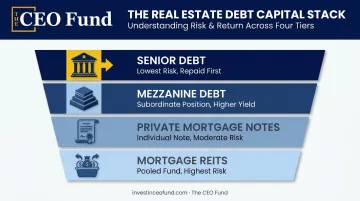
- Senior debt: the first-priority secured loan, generally the lowest-risk debt position
- Mezzanine debt: subordinate to senior debt but senior to equity, often carrying higher yields to compensate for that added risk
- Private mortgage notes: individual promissory notes secured by a mortgage or deed of trust on a specific property
- Mortgage REITs: publicly traded vehicles that hold pools of mortgage assets, funded by a mix of debt and equity
Use Cases of Debt Investing
Debt investments tend to fit best as a fixed-income alternative inside a diversified portfolio, particularly for investors who want passive cash flow without the operational headaches of ownership. Many accredited investors hold these positions inside self-directed IRAs or 401(k)s, since interest income compounds tax-deferred (or tax-free, in a Roth structure).
This is exactly the model behind private mortgage note funds like The CEO Fund. Investors effectively step into the role of the bank, collecting monthly loan payments secured by real estate collateral without ever dealing with tenants, toilets, or tiles.
The fund acquires Grade A–C performing and non-performing notes across single-family, multifamily, mobile home park, and commercial properties, spreading risk across more than 500 loans in 50-plus states.
Demand for this kind of structure is growing. Preqin reported $1.5 trillion in global private-debt assets under management at the close of 2023, with projections pushing toward $2.6 trillion by 2029. That growth signals institutional and accredited capital alike leaning harder into private credit as a fixed-income substitute.
What Is Equity Investing in Real Estate?
Equity investing means taking an actual ownership stake in a property or project. Instead of collecting fixed interest, you participate directly in rental income and, critically, in appreciation when the asset sells or refinances.
This is the growth-oriented side of real estate investing. Returns aren't guaranteed, but the ceiling is much higher than what debt can offer, since equity holders capture whatever value the property creates beyond covering its debt obligations.
Core benefits of equity investing:
- Upside participation in both cash flow and appreciation
- Potential tax advantages through depreciation pass-through
- Influence over asset strategy in some structures, like joint ventures
- Long-term wealth-building potential tied to real market growth
Types of Real Estate Equity
- Common equity — the residual ownership position; paid last but captures the most upside
- Preferred equity — sits above common equity in priority, often with a fixed distribution rate before common holders see a dollar
- Direct ownership — you or your entity holds the property outright
- Equity REITs — publicly traded companies that own income-producing property
- Syndications/joint ventures — pooled investor capital, managed by a sponsor, used to fund larger projects
Use Cases of Equity Investing
Equity fits investors who are comfortable with illiquidity and market risk in exchange for capital appreciation. It shows up most often in multifamily development, ground-up construction, and JV syndications where the payoff comes from building something new rather than collecting a fixed return.
The CEO Fund's $20 million SUNRISE Construction Syndication is a good real-world illustration: a Florida development delivering 1,000 homes alongside a marina and golf course. It's structured for accredited investors willing to take an equity-style position in a large-scale build rather than a fixed-income note.
Equity doesn't always outperform debt, even over long stretches. Nareit's June 2025 REITWatch data shows equity REITs delivered a 20-year annualized return of 7.10% through May 2025, compared to just 0.27% for mortgage REITs over the same period. Equity REITs also posted steeper losses in downturns, dropping 37.73% in 2008 versus mortgage REITs' 31.31%.
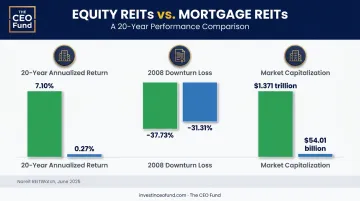
Total equity REIT market capitalization sat at $1.371 trillion, versus $54.01 billion for mortgage REITs as of May 2025. Equity simply commands a much larger share of the public market.
Debt vs. Equity: Which Is Better for You?
There's no universal winner here. The right answer depends on four factors: risk tolerance, income needs, time horizon, and how involved you want to be.
Choose debt if you:
- Want predictable monthly or quarterly cash flow
- Prioritize capital preservation over maximum upside
- Prefer a fully passive role (no ownership decisions, no operations)
- Like the idea of mortgage note investing as a bond-like alternative
Choose equity if you:
- Want exposure to long-term appreciation, not just income
- Can tolerate valuation swings and illiquidity
- Are comfortable holding for 5+ years through a full property cycle
- Want a genuine ownership stake, potentially with some input on strategy
Understanding Debt-to-Equity Ratios
A deal's or fund's debt-to-equity ratio tells you how much leverage is baked into the structure. Generally, lower leverage signals lower risk for lenders and investors alike, since there's a thicker equity cushion absorbing losses before debt holders feel any pain.
For context, CBRE reported an average underwritten loan-to-value ratio of 62.2% for non-agency commercial real estate loans in Q1 2025, down slightly from the prior quarter. That dip signals lenders have been underwriting more cautiously. LTV and debt-to-equity aren't identical metrics, but they move in the same direction: less leverage typically means more room for error.
Blending Both Strategies
Debt-to-equity ratios matter most in isolation, but few sophisticated investors stop at one lane. Most blend debt and equity deliberately, pairing steady income with selective upside: the fixed income smooths out volatility while the equity slice adds growth potential.
There's data supporting the resilience side of that pairing. PGIM's comparison of institutional core real estate debt versus core equity from Q1 2012 through Q4 2023 found debt returned 6.1% annualized with a maximum drawdown of just -1.4%, versus 9.5% annualized and a -13.4% drawdown for equity.
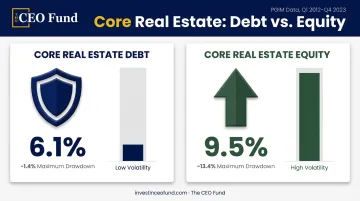
Debt investments, such as those offered through mortgage note funds like The CEO Fund, have historically shown this kind of resilience during downturns. Every market cycle differs, though, so research current conditions before allocating capital.
Conclusion
Neither debt nor equity is inherently the "better" choice — the right mix comes down to your income needs, risk appetite, and time horizon. Many diversified portfolios lean on both.
Debt offers steady, collateral-backed income that suits investors who want passive cash flow without ownership headaches. Equity offers growth potential for those willing to take on more volatility and, often, more involvement. If reliable, real estate-backed income sounds like the missing piece in your portfolio, The CEO Fund's accredited-investor mortgage note offerings are worth a closer look. Our team can show you how this debt-based strategy fits alongside what you already hold.
Frequently Asked Questions
What is the difference between debt and equity in real estate?
Debt involves lending capital against a property for fixed interest payments, while equity involves owning a stake in the property and sharing in its profits and appreciation. Debt gets paid first; equity takes on more risk for more potential upside.
Why use debt instead of equity?
Debt offers predictable income, a senior position in the capital stack, and none of the property management burden that comes with ownership. It's a fit for investors prioritizing capital preservation and passive cash flow.
What is a good debt-to-equity ratio in real estate?
There's no single universal number, but lower leverage generally signals lower risk since there's more equity cushion absorbing potential losses. Recent commercial real estate lending data puts underwritten loan-to-value ratios at around 62% on average, though healthy ranges vary by property type and deal structure.
Can investors combine debt and equity in real estate?
Yes, blending both is a common diversification strategy. Many accredited investors pair steady debt income with selective equity positions to balance predictability with growth potential.
Is real estate debt safer than real estate equity?
Debt's senior capital stack position and collateral backing typically make it lower-risk than equity, since lenders get repaid before equity holders. That said, debt isn't risk-free — default and collateral-value risk still apply.
How can accredited investors access real estate debt investments?
Common access points include private mortgage note funds, direct lending programs, and self-directed IRA or 401(k) accounts, which allow monthly note income to grow tax-deferred or tax-free depending on account type.