
The order you fund your retirement accounts in can mean the difference between capturing thousands in free employer money or leaving it on the table entirely. It affects how much you pay in taxes today versus in retirement, and how much control you have over your investments for the next 20, 30, or 40 years.
Here's the uncomfortable truth: only about 14% of workers with a 401(k) actually max out their contributions in a given year, according to Investopedia's reporting on Vanguard data. Most people aren't even close to hitting the ceiling on either account, which makes the "max out" question feel abstract. But the sequencing decision matters long before you ever get near a contribution limit.
Key Takeaways
- Capture your full employer 401(k) match first — it's a guaranteed return
- IRAs typically offer more investment options and lower fees than 401(k)s
- Contribution order shifts with income, tax bracket, and future tax outlook
- Maxed both accounts? Self-directed IRAs add real estate exposure beyond stocks and bonds
401(k) vs. IRA: Quick Comparison
Before deciding what to fund first, it helps to see the two accounts side by side.
| Feature | 401(k) | IRA |
|---|---|---|
| 2026 Contribution Limit | $24,500 | $7,500 (combined Traditional + Roth) |
| Catch-Up (age 50+) | $8,000 | $1,100 |
| Employer Involvement | Sponsored by employer, may include a match | Opened independently at a bank or brokerage |
| Tax Treatment | Pre-tax (Traditional) or after-tax (Roth 401(k)) | Deductible now (Traditional) or tax-free later (Roth) |
| Investment Control | Limited to the employer's fund menu | Nearly unlimited, including alternative assets |
| Income Limits | None for participation | Roth eligibility phases out at higher incomes |
These figures come from the IRS's 2026 contribution limit update. Note the gap: a 401(k) lets you shelter more than triple what an IRA allows.
Income Eligibility Can Change Everything
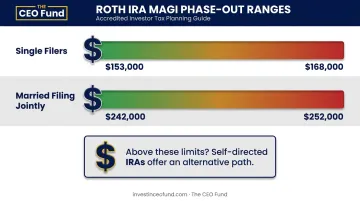
High earners need to pay close attention here. Roth IRA contributions phase out at these modified adjusted gross income (MAGI) levels:
- Single filers: $153,000–$168,000
- Married filing jointly: $242,000–$252,000
Above these thresholds, direct Roth IRA contributions aren't available — though backdoor Roth strategies may still apply. This is where self-directed IRAs open new doors: they let you hold alternative assets like real estate-backed mortgage notes, the kind of tax-advantaged income vehicle The CEO Fund specializes in, giving high earners another path to keep building wealth even when direct Roth contributions are off the table.
What is a 401(k)?
A 401(k) is an employer-sponsored retirement plan funded through automatic payroll deductions. Money comes out of your paycheck before you see it, which makes saving nearly effortless. For most working Americans, it's the first retirement account they ever open, and often the only one their employer directly supports.
Why it's usually the starting point:
- Contributions happen automatically, removing the temptation to skip a month
- Many employers match a portion of your contributions — free money
- Payroll integration means no separate transfers or reminders required
There are a few variations worth knowing:
- Traditional 401(k): Contributions are pre-tax, lowering your taxable income now; withdrawals in retirement are taxed as ordinary income
- Roth 401(k): Contributions are made after-tax, but qualified withdrawals in retirement are completely tax-free
- Solo 401(k): Designed for self-employed individuals with no employees, allowing both employee and employer contributions under one plan
What is an IRA?
An Individual Retirement Account, or IRA, is opened independently — no employer required. You choose the brokerage, you choose the investments, and you're not limited to whatever fund menu someone else selected for you.
That independence is exactly why many savers gravitate toward IRAs once they've secured their employer match:
- Broader investment selection, from index funds to individual stocks to alternative assets
- Often lower account fees compared to employer plan administrative costs
- A Traditional IRA may offer a tax deduction now; a Roth IRA grows completely tax-free
Three main types exist:
- Traditional IRA: pre-tax contributions, taxed on withdrawal
- Roth IRA: after-tax contributions, tax-free growth and withdrawals
- Self-Directed IRA: allows alternative assets beyond typical stocks and bonds, including real estate-backed mortgage notes
That third category matters for savers who've outgrown conventional portfolios. Firms like The CEO Fund help accredited investors deploy retirement funds into passive, collateral-backed income streams instead of relying solely on public market volatility.
Which Should You Max Out First?
There's a clear hierarchy here, and it starts with one non-negotiable rule.
Rule #1: Always capture the full employer match first. According to Vanguard's How America Saves report, the average employer match sits at roughly 4.7% of pay. Skipping this is turning down guaranteed money — no investment anywhere offers that kind of immediate, risk-free return.
Once you've secured the match, here's the logical sequence:
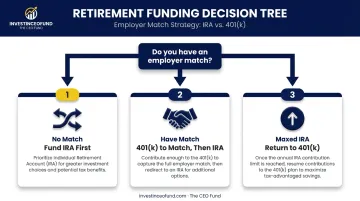
- No employer match at all? Prioritize an IRA first. You'll get more investment flexibility and typically lower fees than a plan with no matching incentive to offset its restrictions.
- Have a match? Fund the 401(k) up to the match, then shift to your IRA for greater control.
- Maxed the IRA? Return to the 401(k) and push toward its higher contribution ceiling.
Factor In Your Tax Bracket
Your current versus expected future tax bracket should influence where extra dollars go:
- Lower bracket now, expect higher later: favor Roth contributions (401(k) or IRA)
- Higher bracket now, expect lower later: favor Traditional pre-tax contributions
- Unsure which way rates will move: split contributions between Roth and Traditional to hedge both scenarios
A useful rule of thumb: consider splitting contributions between pre-tax and Roth accounts, weighting more toward Roth the further you are from retirement.
Some planners use an "age plus 20" heuristic: the older you are, the more you lean pre-tax to reduce current tax burden, since future tax uncertainty matters less the closer you get to retirement.
High earners often lose Roth IRA eligibility entirely due to the income phase-outs mentioned earlier. If that's you, a backdoor Roth conversion or simply maximizing your 401(k) becomes the practical path forward.
Eventually, disciplined savers max out both accounts entirely. At that point, self-directed IRAs let you extend tax-advantaged growth into assets like real estate-backed mortgage notes, a strategy increasingly popular among high earners looking to diversify beyond public markets.
Real-World Scenario: Putting the Strategy Into Action
Consider a mid-career professional earning $220,000 a year with a 4% employer 401(k) match. She follows the cascade: match first, then IRA, then back to the 401(k).
For three years, she follows this cascade:
- Contributes enough to capture her full 4% employer match
- Maxes her Roth IRA at $7,000 annually
- Redirects remaining savings into her 401(k) until she hits the $23,500 ceiling
The challenge is balancing limited monthly cash flow across two accounts while still chasing better risk-adjusted returns than a standard target-date fund offers.
By year four, she's maxing both accounts consistently. That's when she hits a new problem: where does the next dollar go?
She opens a self-directed IRA and rolls a portion of her existing IRA balance into real estate-backed mortgage notes through a fund like The CEO Fund. Instead of chasing stock market swings, she now receives monthly mortgage payments deposited directly into her IRA, collateralized by actual property, not just a ticker symbol.
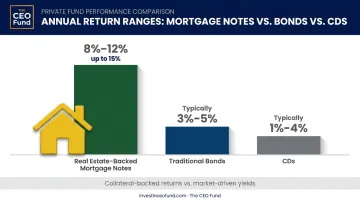
The return profile matters here: The CEO Fund's mortgage note investments typically target 8% to 12% annual returns (up to 15% in some cases), often outperforming traditional fixed-income instruments like bonds or CDs, while remaining backed by tangible real estate collateral rather than market sentiment.
The takeaway: maxing your 401(k) and IRA builds the foundation. But once you've hit those ceilings, self-directed accounts unlock diversification that a standard brokerage IRA simply can't offer.
If you've already maxed your retirement accounts and you're looking for the next move, it might be worth exploring how a self-directed IRA with The CEO Fund can generate monthly, real estate-backed passive income — without tenants, toilets, or tiles.
Conclusion
There's no universal winner in the 401(k) versus IRA debate. The right order depends on:
- Whether your employer offers a match
- Where you sit on the tax bracket spectrum today versus in retirement
- How much investment flexibility you want along the way
What stays constant is the priority: capture free employer money first, then decide between tax-now or tax-later based on your specific situation.
This decision compounds over decades, quite literally. Getting the sequence right means more guaranteed match dollars captured and lower lifetime taxes paid.
For those who eventually max both accounts, the payoff extends further: a more diversified, resilient stream of retirement income built through vehicles like self-directed IRAs and real estate-backed mortgage notes.
Frequently Asked Questions
Can I retire at 62 with $400,000 in my 401(k)?
It depends heavily on your other income sources. Using a 4% withdrawal rate, $400,000 generates roughly $16,000 per year, which likely needs supplementing from Social Security or passive investments to cover typical expenses.
How much will $20,000 in a 401(k) be worth in 20 years?
Using a historical stock market average return of around 10-11% annually, $20,000 could grow to roughly $135,000 to $150,000 in 20 years, assuming no additional contributions and consistent market performance.
At what age is a Roth IRA not worth it?
There's no strict cutoff, but the closer you are to retirement, the less time you have for tax-free growth. The 5-year rule matters most here, since it requires the account to stay open five years before withdrawals become tax-free.
Can I contribute to both a 401(k) and an IRA in the same year?
Yes. Both accounts have separate, independent contribution limits, though your ability to deduct Traditional IRA contributions may be reduced if you're also covered by a workplace plan and your income exceeds certain thresholds.
What should I do if my employer doesn't offer a 401(k) match?
Prioritize funding an IRA first for its greater investment flexibility and lower fees. Once you've maxed the IRA, redirect savings into your 401(k) to capture its higher contribution limit and tax deferral.
What retirement account options do self-employed individuals have?
Self-employed savers can use a Solo 401(k) or a SEP IRA, both offering higher contribution limits than a standard IRA. These accounts can also be self-directed to include alternative assets like real estate-backed mortgage notes for accredited investors.