MBS are exactly what they sound like: pooled mortgage debt packaged into a tradable security. Investors buy a slice of thousands of home loans and collect monthly payments, similar to a bond coupon. This isn't a niche corner of the market, either. As of 2021, 65% of U.S. home-mortgage debt had been securitized into MBS, up from 60% a decade earlier, according to a New York Fed staff report.
This guide breaks down what MBS actually are, the main types you'll encounter, how the income works, the risks that matter most since 2008, and how they stack up against direct mortgage note investing.
Key Takeaways
- MBS pool thousands of mortgages into one security, paying monthly income much like a bond coupon
- Pass-throughs and CMOs form the two core MBS categories, each with distinct risk profiles
- Agency MBS carry lower credit risk than private-label MBS, yet prepayment risk remains
- Prepayment, interest rate, and liquidity risk are the biggest threats to MBS returns
- Direct mortgage notes offer real estate-backed income without pooled-security complexity
What Are Mortgage-Backed Securities?
An MBS is an asset-backed security created by bundling residential (or commercial) mortgage loans and converting them into a tradable bond. Instead of one bank holding a 30-year loan on its books, that loan gets pooled with thousands of others and sold to investors worldwide.
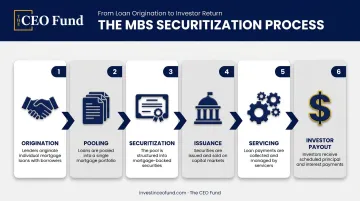
The securitization process follows a consistent path:
- Origination – A lender issues the mortgage to a homebuyer
- Pooling – Thousands of similar loans get grouped together
- Securitization – The pool is converted into a security with defined payment terms
- Issuance – The security is sold to investors through brokers or exchanges
- Servicing – A servicer collects monthly payments from borrowers
- Investor payout – Principal and interest flow to security holders, minus fees
This differs sharply from owning a mortgage note directly. With an MBS, you own a fractional interest in a massive, diversified pool managed by a third party. With a direct note, you own (or fund) one specific loan tied to one specific property. We'll dig into that distinction further down.
Who Issues MBS?
Not all MBS carry the same backing, and the differences matter more than most first-time investors realize.
- Ginnie Mae guarantees timely principal and interest payments, and its securities carry the full faith and credit of the U.S. government
- Fannie Mae and Freddie Mac guarantee their own MBS, though these certificates aren't U.S. government obligations. Both remain under FHFA conservatorship, with ongoing Treasury support
- Private institutions issue "private-label" MBS with no government backing at all, relying on structural subordination to allocate credit risk among investors
Key Types of Mortgage-Backed Securities
MBS split into two structural families, and understanding the difference shapes how you should think about risk.
Pass-through securities work exactly as the name implies. Mortgage payments flow pro-rata to every bondholder in the pool, typically with maturities of 5, 15, or 30 years. If the pool collects $10 million in payments this month, each investor gets their proportional share, no priority tiers.
Collateralized mortgage obligations (CMOs) are more engineered. Cash flows get split into tranches with different maturities, credit ratings, and prepayment protections. Some tranches get paid first; others absorb prepayment risk so senior tranches don't have to.
Agency vs. Non-Agency MBS
| Feature | Agency MBS | Non-Agency MBS |
|---|---|---|
| Backing | Government or GSE guarantee | Private issuer, no guarantee |
| Credit risk | Low | Higher, structurally allocated |
| Yield | Lower | Higher |
| Liquidity | Deep TBA market | Thin, harder to trade |
The liquidity gap here isn't small. Agency MBS trade at an average daily volume of $384.1 billion year-to-date through June 2026, while non-agency MBS trade at just $1.96 billion over the same period, according to SIFMA's mortgage-backed securities statistics. That's roughly a 200-to-1 difference in trading activity.
This liquidity divide shapes real trading decisions. Wide bid-ask spreads on non-agency paper often mean holding a position to maturity, while the deep TBA market lets institutions adjust agency exposure within minutes. That distinction matters as you move from this broad comparison into the more granular categories below.
RMBS, CMBS, and Stripped MBS
For investors wanting more nuance beyond agency versus non-agency:
- RMBS – backed by single-family residential mortgages
- CMBS – backed by commercial properties like office buildings, retail centers, and multifamily complexes
- Stripped MBS – split into interest-only (IO) and principal-only (PO) classes, each with very different sensitivity to prepayment speeds
How Investors Earn Money From MBS
Every month, MBS holders receive a distribution built from three components: scheduled interest, scheduled principal, and prepaid principal from borrowers who refinance or sell.

Why do MBS typically pay more than comparable government bonds? Because investors are absorbing two risks Treasuries don't carry: prepayment risk and credit risk. That extra yield is compensation, not a free lunch.
That risk-reward tradeoff also shapes how you access the market, since entry points vary depending on how deep your pockets go:
- Brokers – buy individual pass-through certificates, though minimums like Fannie Mae's $1,000 denomination on standard pass-throughs apply
- Mutual funds – professionally managed pools with lower entry points
- ETFs – exchange-traded, liquid, easy to buy and sell intraday
| Access Point | Typical Minimum Investment |
|---|---|
| Brokers (pass-throughs) | $1,000 (Fannie Mae standard) |
| Mutual funds | Varies, often below fund minimums |
| ETFs | Single share price |
| Stripped MBS (SMBS) | $100,000 |
Beyond these standard entry points, stripped MBS require deeper pockets. Fannie Mae's SMBS certificates carry a $100,000 minimum denomination, putting them out of reach for most retail buyers.
Key Risks of Investing in Mortgage-Backed Securities
MBS risk isn't one thing. It's a bundle of interconnected pressures that behave differently depending on where interest rates are headed.
Prepayment risk shows up when rates fall. Borrowers refinance en masse, returning your principal early, right when reinvestment options pay less. Your bond's expected life shortens exactly when you didn't want it to.
Interest rate risk works in reverse. MBS prices move inversely to rates, but they also exhibit negative convexity. Price gains are capped when rates fall because of prepayments, while losses can accelerate when rates rise because borrowers stop refinancing and duration extends.
Credit and default risk varies sharply by issuer:
- Minimal for Ginnie Mae-backed MBS (full government guarantee)
- Low but present for Fannie Mae/Freddie Mac MBS (GSE guarantee, not government)
- Materially higher for private-label MBS, where investors absorb losses directly
Liquidity risk matters more than most new investors expect. Agency MBS trade in the highly liquid TBA forward market. Private-label MBS and individual CMO tranches often lack that liquidity, making them far harder to exit quickly.
The 2007-2008 financial crisis remains the cautionary tale here. Subprime loans got pooled into MBS, sold as investment-grade, and collapsed in value once defaults spiked. The Federal Reserve ended up purchasing $1.25 trillion of agency MBS between January 2009 and March 2010 just to stabilize the market, according to the Federal Reserve's agency MBS purchase program records.
That intervention worked, but the lesson stuck: pooled mortgage risk can escalate fast enough to require trillion-dollar interventions to contain it.
MBS vs. Direct Mortgage Note Investing
MBS pool mortgages into securities managed by large institutions. You own a slice of a diversified pool, but you rarely know the specific loans backing your investment.
Direct mortgage note investing flips that model. Instead of buying into a pool, investors fund or own individual loans backed by specific real estate collateral. The CEO Fund's approach reflects this: accredited investors step into the lender's seat, receiving monthly payments without the "3 T's" (tenants, toilets, and tiles). There's no tranche complexity to track either, unlike the CMO structures common in agency MBS.
Why this appeals to income-focused investors:
- Direct visibility into the collateral backing each note, rather than a diversified pool you can't inspect line-by-line
- No pass-through servicing layers between the borrower's payment and your account
- Real estate-backed passive income with professional underwriting, minus the securitization machinery
The CEO Fund focuses specifically on Grade A–C mortgage notes, both performing and non-performing, applying rigorous underwriting and conservative loan-to-value ratios on each acquisition. It's a different risk conversation than agency versus non-agency MBS, but the underlying appeal is similar: real estate collateral generating monthly cash flow without you having to manage a property.

For investors who want the income mechanics of MBS but more transparency into what's actually backing their returns, direct note investing fills that gap.
Are Mortgage-Backed Securities Still a Good Investment Today?
The MBS market hasn't gone anywhere. Total U.S. MBS outstanding reached $12.1 trillion in 2023, per SIFMA data, and agency single-family MBS alone stood at $9.21 trillion by December 2025. This remains one of the largest fixed-income segments in the world.
Post-crisis reforms changed the underwriting landscape meaningfully:
- The CFPB's Ability-to-Repay rule (effective January 2014) requires lenders to verify borrowers can actually repay their loans
- FHFA limited Fannie Mae and Freddie Mac purchases to Qualified Mortgages, tightening what gets pooled into agency MBS
- Representation-and-warranty frameworks moved quality-control reviews earlier in the loan lifecycle
These reforms improved agency MBS credit quality since 2008, but they didn't eliminate prepayment or rate risk. Rising rates increase extension risk, meaning loans stay outstanding longer than expected. Falling rates increase prepayment risk, meaning loans get paid off faster than expected.
Timing and issuer selection still matter. Whether you buy agency pass-throughs or explore an alternative like direct note investing through a fund such as The CEO Fund, weigh both risks before committing capital.
Frequently Asked Questions
What are fixed-income MBS?
Fixed-income MBS are bonds backed by pooled mortgage loans. They pay investors periodic interest and principal, similar to a traditional bond coupon, but sourced from thousands of individual homeowner payments.
How do fixed-income MBS make money?
Investors earn income from three sources each month: scheduled interest, scheduled principal, and prepaid principal collected from underlying borrowers. The mix shifts depending on refinancing activity and interest rate trends.
Are fixed-income MBS a good investment?
MBS can offer attractive yields and diversification versus Treasuries or corporate bonds. However, they carry prepayment, interest rate, and credit risks that vary sharply between agency and non-agency issues.
Are fixed-income MBS still used today?
Yes. The MBS market remains a multi-trillion-dollar segment, with agency MBS in particular widely held by institutional and retail investors through funds, ETFs, and direct purchases.
What's the difference between a CMO and a pass-through MBS?
A pass-through distributes payments pro-rata to every holder in the pool. A CMO divides cash flows into tranches with prioritized payment schedules, giving some investors more prepayment protection than others.
How does direct mortgage note investing differ from buying MBS?
Direct note investing (similar to The CEO Fund's approach) means owning individual loans with visible, specific collateral. MBS pool thousands of loans into one security managed by a third-party servicer, limiting visibility into any single loan's performance.