The problem? Most investors have no framework for separating a legitimate fund from a slick-looking pitch built on projections and promises. You're handed a proposal full of numbers, and you're supposed to just... know?
This guide breaks down what an investment fund proposal actually is, the components a strong one always includes, how to evaluate one before wiring a dollar, and how to calculate what it takes to hit a real income target — like $10,000 a month.
Key Takeaways
- A fund proposal is a terms-led document, not a business plan or pitch deck
- Legitimate proposals disclose track record, fees, and risk mitigants in plain language
- Asset-backed funds let you verify real collateral instead of trusting projections alone
- The capital needed for target income depends entirely on net yield, not just deal size
- Always pair a proposal review with the PPM and subscription agreement before funding
What Is an Investment Fund Proposal?
An investment fund proposal is a formal presentation a fund manager (the General Partner, or GP) creates to communicate an investment opportunity to prospective investors (Limited Partners, or LPs). It covers the fund's strategy, structure, minimum investment, and expected terms.
Who sends these: fund managers and syndicators actively raising capital into a pooled vehicle.
Who receives them: accredited investors, family offices, and institutions evaluating where to place capital for the next 3-10 years.
Investment Fund Proposal vs. Business Plan vs. Pitch Deck
These three documents get confused constantly, but they serve different purposes:
| Document | Purpose | Depth |
|---|---|---|
| Fund proposal | Terms and numbers for a specific capital raise | Detailed, deal-specific |
| Business plan | Maps full company or fund operations | Comprehensive, long-term |
| Pitch deck | Visual teaser to open a conversation | Short, high-level |
A fund proposal pools investor capital across many underlying assets, loans, properties, or notes, spreading risk across the portfolio. That's the key structural difference from a startup investment proposal, which bets everything on one company's equity. If one borrower defaults in a note fund, it's a rounding error. If the one startup you backed fails, you're out entirely.
Legitimate fund proposals also arrive alongside formal legal paperwork. The SEC notes that private placement memoranda introduce the offering and disclose risk information. These documents are typically not reviewed by a regulator, though, so the burden of scrutiny falls on you.
Must-Have Components of a Strong Investment Fund Proposal
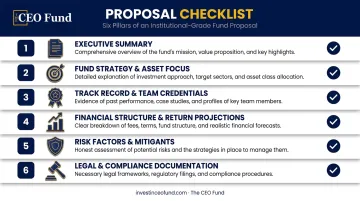
A proposal that's actually built to inform (not just impress) will include six things. Missing any of these is a reason to ask harder questions.
1. Executive summary A one-page snapshot: investment thesis, minimum investment, target returns, and asset class. If you can't understand the deal from this page alone, something's off.
2. Fund strategy and asset focus What does the fund actually invest in: mortgage notes, multifamily development, construction syndications? And why does that niche generate consistent returns? Vague answers here are a warning sign.
3. Track record and team credentials Years in business, total deals or loans closed, geographic spread, and sponsor bios. Research on 448 private debt funds found that a 10% increase in a predecessor fund's IRR correlated with a 2.31% increase in the current fund's IRR. This means sponsor history matters, though the data measures returns, not default rates specifically.
4. Financial structure and return projections
- Preferred return (the hurdle rate before profit-sharing kicks in)
- Distribution waterfall
- Fee structure (management fees, carried interest)
- Minimum investment threshold
- Projected cash yield or IRR
5. Risk factors and mitigants Liquidity risk, market risk, and specifically how the fund protects your capital: collateral, loan-to-value limits, diversification across states and asset types.
6. Legal and compliance documentation What to expect alongside the proposal: the Private Placement Memorandum (PPM), subscription agreement, and accredited investor verification.
How to Evaluate an Investment Fund Proposal Before You Commit Capital
Reading a proposal is one thing. Verifying it is another. Here's the actual due diligence sequence.
Verify the Track Record Independently
Don't take marketing claims at face value. Request:
- Historical performance data across multiple fund cycles
- Number of deals or loans closed
- Default and loss history, not just successful exits
Check the Collateral or Asset-Backing
For mortgage note or real estate funds, confirm investments are secured by tangible property, not unsecured projections. Collateral position matters enormously at recovery time.
S&P found first-lien loans averaged a 77.9% discounted recovery rate, compared to just 46.5% for second-lien and unsecured loans, according to S&P Global's default and recovery study. Lien position doesn't lower default risk, but it changes what you get back if something goes wrong.
Scrutinize Fees, Alignment, and Liquidity Terms
Ask directly:
- What are the management fees and carried interest splits?
- Does the sponsor invest their own capital alongside investors?
- Are there additional fees, such as acquisition, disposition, or administrative charges, beyond the stated management fee?
Lock-up periods and redemption policies matter for planning, too. So does distribution frequency — monthly versus quarterly changes how you budget around the income.
Watch for Red Flags
- Guaranteed-return promises (nothing in private markets is guaranteed)
- Vague, unverifiable claims about performance
- Unlicensed or unregistered sponsors
- Pressure to sign quickly, before you've reviewed the PPM
How Much Do You Need to Invest to Make $10,000 a Month?
The math is simpler than it looks, but the assumptions do the heavy lifting.
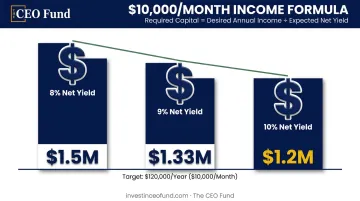
The formula: Required capital = Desired annual income ÷ Expected net yield.
$10,000 a month equals $120,000 a year. At an 8-10% annualized net yield, you'd need roughly $1.2 million to $1.5 million invested to generate that income.
Here's how required capital shifts as yield changes:
| Annual Net Yield | Capital Needed for $120K/Year |
|---|---|
| 8% | $1,500,000 |
| 9% | $1,333,000 |
| 10% | $1,200,000 |
This is illustrative, not a guarantee. Yields vary by fund, asset class, and market conditions.
A real-world case study from a Florida mortgage note investment showed a 10% annual ROI, generating $764.39 in monthly cash flow on an $80,900 purchase. The math holds up in practice, though results differ deal to deal.
Why Fixed-Payment Structures Make This More Predictable
Appreciation-dependent real estate requires the market to cooperate. Mortgage note funds don't. Borrowers make monthly contractual payments whether the market is up or down that quarter, which makes projecting income far more reliable than betting on future property values.
Diversifying across multiple notes within a fund also matters. If one borrower pays late or defaults, it barely dents your monthly check because the income is spread across dozens or hundreds of underlying loans instead of concentrated in one.
Why Asset-Backed Mortgage Note Funds Are Gaining Ground With Accredited Investors
Direct property ownership comes with what industry veterans call the "3 T's": Tenants, Toilets, and Tiles. Mortgage note investing removes all three:
- Tenants: No leasing, screening, or evictions to manage
- Toilets: No maintenance calls or repair costs
- Tiles: No property upkeep or capital improvements
You're the lender, not the landlord. You collect payments instead of fielding maintenance calls, while remaining backed by the same real estate collateral.
There's also a tax angle. Many accredited investors deploy capital into note funds through self-directed IRAs and 401(k) accounts, letting income grow tax-deferred or tax-free depending on account type.
The CEO Fund applies these exact principles. The fund has built a 10+ year track record, acquiring 500+ loans across 50+ states, with fund management led by Carlo Turner, a Certified Mortgage Investing Specialist. The team also oversees the $20 million SUNRISE Construction Syndication in Florida, expanding beyond notes into ground-up development.
Strategy, track record, fee transparency, and risk mitigants all come together in an actual proposal. Request The CEO Fund's investment proposal and review it against everything covered here.
Frequently Asked Questions
What is an investment fund proposal?
It's a formal document a fund sponsor uses to present strategy, terms, and expected returns to prospective investors before they commit capital. It's distinct from marketing materials because it's meant to support an actual investment decision.
How much money do I need to invest to make $10,000 a month?
It depends on the fund's net yield. At an 8-10% annualized yield, generating $120,000 a year takes roughly $1.2 million to $1.5 million invested. Treat this as illustrative math, not a promise.
What's the difference between an investment fund proposal and a pitch deck?
A pitch deck is a short visual teaser meant to spark initial interest. A fund proposal is a detailed, terms-led document built to support an actual capital commitment decision.
What documents should accompany a fund's investment proposal?
Expect a Private Placement Memorandum (PPM), a subscription agreement, and accredited investor verification forms. These are standard companions to a properly structured, compliant fund offering.
What qualifies someone as an accredited investor?
Under current SEC thresholds, that means individual income above $200,000 (or $300,000 jointly with a spouse) for two consecutive years, or net worth exceeding $1 million excluding your primary residence.
Are mortgage note funds riskier than direct real estate ownership?
No. Note funds spread capital across many loans and borrowers, spreading risk instead of concentrating it. Direct ownership, by contrast, ties your capital to a single property you must also manage yourself.