
It's a fair question. Most investors know that losses in a regular brokerage account can offset gains and shave a few thousand dollars off their tax bill. So it seems logical that a losing IRA would work the same way.
It doesn't.
IRAs operate under a completely separate set of rules, and most account holders are surprised to learn they can't simply deduct a falling balance. This article breaks down how IRA losses actually work, what the IRS currently allows (and doesn't), why your account might be down in the first place, and what to do about it going forward.
Key Takeaways
- IRA losses aren't deductible like stock losses in a taxable brokerage account
- Claiming a deduction requires liquidating all accounts of one type and having after-tax basis
- This deduction is suspended through 2025 and permanently disallowed after
- Better moves: rebalance within the IRA, convert to Roth during downturns, or diversify into income-generating alternatives
How IRA Losses Work: Why They're Not Like Regular Investment Losses
Here's the core distinction that trips people up: unrealized versus realized losses.
An unrealized loss is just a decline in value while you still hold the investment — it's a number on a screen, nothing more. A realized loss happens when you actually sell below your purchase price. In a taxable account, that realized loss can offset your taxes. Inside an IRA, it can't.
According to IRS rules governing traditional and Roth IRAs, you don't report IRA gains or losses on your federal return while the account stays open. Even selling a losing position inside the IRA doesn't create anything reportable. That's the entire point of tax deferral: nothing counts until money actually comes out of the account.
Tax-Loss Harvesting Doesn't Work in an IRA
Tax-loss harvesting (selling a losing stock to offset a gain elsewhere) is a popular strategy in taxable accounts. But because trades inside an IRA aren't taxable events, there's nothing to harvest. Selling a loser and buying something else inside your IRA is purely a portfolio decision, not a tax one.
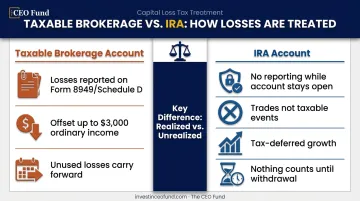
Compare that to a taxable brokerage account, where:
- Losses and gains are reported on Form 8949 and flow to Schedule D
- Net capital losses offset up to $3,000 of ordinary income per year ($1,500 if married filing separately)
- Unused losses carry forward to future tax years
None of that machinery exists inside an IRA. It's simply not designed to interact with your annual tax return.
Watch the Wash-Sale Trap
There's one place where your IRA can mess with your taxable account: the wash-sale rule. If you sell a stock at a loss in your taxable account and then buy a "substantially identical" security inside your IRA within 30 days before or after that sale, the trade triggers a wash sale.
The IRS disallows that loss entirely under IRS Revenue Ruling 2008-5. Worse, your IRA's basis isn't adjusted upward to compensate, so the loss simply vanishes for tax purposes.
A falling IRA balance is a paper loss. It has zero tax consequence unless and until you withdraw or fully liquidate the account.
Are IRA Investment Losses Tax-Deductible? Current IRS Rules
Historically, there was a narrow path to deduct an IRA loss. It fell under "miscellaneous itemized deductions" on Schedule A, the same category as things like unreimbursed employee expenses.
The problem: the Tax Cuts and Jobs Act (TCJA) suspended miscellaneous itemized deductions for tax years 2018 through 2025 under IRC Section 67(g). And in 2025, Public Law 119-21 removed the 2026 expiration date entirely, making that suspension permanent. In other words, this deduction isn't coming back.
Traditional IRA Losses: Why They're Rarely Deductible
Most Traditional IRA holders made deductible contributions, meaning they got a tax break going in. That creates no after-tax basis, so there's nothing to "lose" for tax purposes. A smaller distribution later just means less taxable income when you withdraw, simple as that.
If you made nondeductible contributions at some point, you do have basis. Technically, a loss could be claimed — but only by:
- Liquidating every single Traditional IRA you own (not just one)
- Confirming your total distributions are less than your remaining basis
- Claiming it as a miscellaneous itemized deduction
Step three is where it falls apart. That deduction category is disallowed, so this path is currently a dead end.
Roth IRA Losses: The (Limited) Exception
Roth IRAs work slightly differently because contributions are already after-tax, meaning basis is baked in from day one. Here's the mechanics, walked through with numbers:
Say you've contributed $25,000 to Roth IRAs over the years. If you closed every Roth IRA you own and only got back $15,000, you'd theoretically have a $10,000 loss to claim.
Two problems, though:
- Early withdrawal penalties. If you're under 59½, cashing out could trigger the 10% additional tax on any portion tied to a Roth conversion within its 5-year window.
- The deduction itself is unavailable. Just like the Traditional IRA scenario, this loss is a miscellaneous itemized deduction, suspended through 2025 and permanently disallowed afterward under the same Section 67 changes.
So while the math works on paper, the tax code currently offers no way to actually use it.
Why Am I Losing Money on My IRA? Top Causes
Before jumping to solutions, it helps to know why the balance dropped in the first place. Three causes show up again and again:
- Market volatility: Broad downturns in stocks, mutual funds, and ETFs are the most common driver. These are almost always temporary paper losses that recover as markets do, assuming you don't withdraw during the dip.
- Overconcentration: Holding too much in one stock, sector, or employer stock amplifies losses when that specific holding drops. Diversification exists to prevent this.
- Fee drag: Invisible month to month, this one quietly erodes returns over decades, often worse than investors realize.
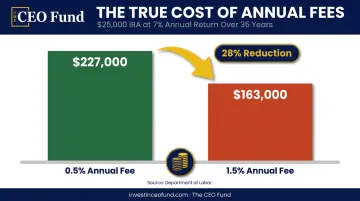
Here's why: the Department of Labor ran the numbers on a $25,000 IRA earning 7% annually over 35 years.
| Annual Fee | Ending Balance (35 yrs) |
|---|---|
| 0.5% | ~$227,000 |
| 1.5% | ~$163,000 |
That one extra percentage point in fees produces a 28% reduction in your ending balance. That's not a market crash; it's just paying more in expense ratios, year after year, without noticing.
Solutions: What To Do About IRA Losses
Since selling at a loss inside your IRA offers no tax benefit right now, the priority shifts entirely to strategy, not tax harvesting. Locking in a loss just to "do something" accomplishes nothing on the tax side and can permanently forfeit any chance of recovery.
Avoid Panic-Selling: Rebalance Instead of Realize
Rebalancing inside the IRA wrapper lets you sell underperformers and buy other assets within the same account, preserving tax deferral the entire time. You're adjusting risk exposure without triggering a taxable event.
Say a tech-heavy allocation dropped 30% while your bond position held steady. Shifting new contributions toward bonds rebalances that risk without locking in the loss on paper. Bailing out entirely at the bottom, by contrast, forfeits any chance of catching the recovery that typically follows a downturn.
Consider a Roth Conversion During a Downturn
A depressed account balance is actually one of the better times to convert a Traditional IRA to a Roth. You pay ordinary income tax on the converted amount, but that amount is lower because your account value is down. Any recovery growth that follows happens inside the Roth, tax-free.
Two things to watch:
- You still owe tax on the full converted amount in the year of conversion
- Each conversion starts its own 5-year clock for penalty-free withdrawal purposes
Diversify Into Lower-Volatility, Income-Generating Alternatives
Stock market exposure is only one way to grow retirement savings. A self-directed IRA or 401(k) can also hold asset-backed investments that don't move in lockstep with the S&P 500, such as real estate-backed mortgage notes rather than equities.
This is the model The CEO Fund runs for accredited investors. Instead of chasing stock price appreciation, investors act as the lender, collecting monthly interest payments backed by real estate collateral, deposited directly into their self-directed IRA or 401(k).
The fund has purchased 500+ loans across more than 50 states, spreading risk across geography and property type rather than concentrating it in a handful of tickers.
What makes this appealing for retirement accounts specifically:
- No "tenants, toilets, or tiles": you're not managing property, just collecting contractual interest
- Monthly cash flow, not quarterly or annual guesswork
- Collateral-backed positions, so returns aren't tied to daily market swings
- Managed by a team including Carlo Turner, a Certified Note Investing Specialist with over 15 years in corporate finance
Eligibility is limited to accredited investors, generally $200,000+ in annual individual income ($300,000 with a spouse) or $1 million+ in net worth excluding your primary residence. It's not for everyone, but for qualifying investors looking to reduce dependence on stock market performance inside an IRA, it's worth a conversation.

When Full Liquidation Might Still Make Sense
There's a rare case where fully cashing out a badly underwater Roth IRA still makes sense, even without any tax benefit. If you need the capital for a genuinely better opportunity and the account has minimal remaining upside, redeploying elsewhere can outweigh the cost of staying put.
This isn't a decision to make solo. Talk to a CPA or financial advisor before liquidating anything, since the penalty exposure and lost future growth can easily outweigh whatever you're chasing.
Frequently Asked Questions
Are IRA investment losses tax-deductible?
Generally, no. The one narrow exception, a Roth basis loss after full liquidation, requires closing every Roth IRA you own. Federal tax law currently suspends that deduction category, permanently after 2025.
Why am I losing money on my IRA?
The three most common causes are market volatility, poor diversification (overconcentration in one stock or sector), and high fund fees eating into returns over time. Unless you withdraw funds, these are typically unrealized paper losses.
Can I claim a loss on my Traditional IRA?
Only if you made nondeductible contributions (creating basis) and fully liquidate every Traditional IRA you own. Even then, the deduction itself is currently unavailable under the permanent TCJA suspension.
What happens if my Roth IRA loses money?
If you leave the funds in place, it's simply a paper loss with no tax impact. Claiming an actual deduction would require liquidating all your Roth IRAs, and that deduction path is currently unusable.
Does tax-loss harvesting work inside an IRA?
No. Trades inside an IRA aren't taxable events, so selling a loser to offset a gain has no tax effect the way it would in a brokerage account. Traditional loss-harvesting strategies simply don't apply.
Should I move money out of my IRA if it's losing value?
Avoid panic withdrawals. Rebalancing within the account or diversifying into lower-volatility alternatives, such as mortgage-note-backed income investments, typically makes more sense. Talk to a financial advisor before pulling money out.