
This decision affects more than your retirement date. It shapes your monthly cash flow, your tax bill, how much liquidity you have in an emergency, and how much control you actually have over your own money.
The scale of this debate is massive. U.S. 401(k) plans held roughly $10.1 trillion in assets at the end of 2025, according to the Investment Company Institute. That's trillions of dollars parked in employer-directed funds, while an entirely separate wealth-building world exists in real estate. So which one actually builds wealth faster?
Key Takeaways
- Both build wealth, but liquidity, control, and tax treatment set them apart
- 401(k)s win on automation and employer matches; real estate wins on cash flow
- Mortgage notes deliver monthly income without landlord duties like tenants or repairs
- Self-directed IRAs blend retirement tax perks with direct real estate exposure
- Your best fit hinges on timeline, risk tolerance, and desired involvement level
Real Estate vs 401(k): Quick Comparison
Before covering definitions, here's how the two vehicles stack up across the factors that matter most to investors.
| Factor | 401(k) | Real Estate |
|---|---|---|
| Barrier to entry | Low — automatic payroll deductions, no large upfront capital | Higher for direct ownership (down payment, closing costs, mortgage approval); note funds often require $50,000–$100,000 minimums |
| Historical returns | S&P 500 has posted about 10% annualized total return since 1957, per S&P Dow Jones Indices | Varies widely by asset type: commercial property, residential price growth, and note funds each track differently, with no single blended benchmark |
| Tax treatment | Pre-tax contributions, tax-deferred growth, taxed as ordinary income at withdrawal | Depreciation deductions, long-term capital gains rates, potential 1031 exchange deferral |
| Liquidity | Illiquid until 59½ without penalty; RMDs begin at 73 or 75 | Sellable anytime; can generate monthly or quarterly cash flow or be borrowed against |
| Management effort | Fully passive once contributions are set | Ranges from hands-on landlording to fully passive structures like notes or funds |
Notice the pattern: 401(k)s reduce effort and complexity. Real estate trades some of that ease for greater control and tax leverage, backed by tangible collateral.
Understanding the Two Wealth-Building Vehicles
What Is a 401(k)?
A 401(k) is an employer-sponsored retirement plan that invests contributions primarily in stocks, bonds, and mutual funds. Its biggest advantage is automation, not the investment menu.
Money leaves your paycheck before you see it, which removes the temptation to skip saving. Add an employer match, and you're getting an immediate, guaranteed return on every dollar contributed, something almost no other investment can promise.
Use Cases of a 401(k)
The typical 401(k) saver is an employee automatically enrolled by HR, contributing a fixed percentage of salary toward a retirement decades away. It requires zero ongoing decisions once set up.
The tradeoff: most plans restrict you to a limited menu of mutual funds chosen by the plan administrator. Unlike a self-directed account, you can't pick individual properties, notes, or alternative assets.
What Is Real Estate Investing?
Real estate investing generates wealth two ways: appreciation (the property's value rising over time) and rental income (ongoing cash flow while you hold it). Beyond direct ownership, investors access real estate through:
- REITs — publicly traded shares in real estate portfolios
- Crowdfunding platforms — pooled capital for specific projects
- Mortgage notes — debt instruments secured by real property
Mortgage note investing, an area The CEO Fund specializes in, lets investors act as the bank rather than the landlord. Instead of buying a property, you acquire the loan behind it and collect monthly mortgage payments backed by real estate collateral. No tenants, no toilets, no tiles.

Use Cases of Real Estate Investing
Accredited investors increasingly use self-directed IRAs or 401(k)s to gain this exposure without ever touching a property title. Performance data supports this approach. The NCREIF Property Index tracks commercial real estate returns, while the Case-Shiller Index tracks residential prices. Both show that returns vary significantly by property type, income component, and holding period, explaining why professionally managed structures appeal to hands-off investors.
Real Estate vs 401(k): Which Builds Wealth Faster?
The honest answer: it depends on four factors.
- Time horizon: decades away from retirement, or approaching it?
- Liquidity needs: do you need access to capital before 59½?
- Management appetite: do you want to be involved, or completely hands-off?
- Current tax bracket: does deferring income now help you, or does a real estate tax strategy fit better?
Here's how those factors translate into a decision:
- Choose a 401(k) if you want "set it and forget it" investing with employer matching and zero direct involvement.
- Choose direct real estate ownership if you have capital, time, and want hands-on control over appreciation and rental cash flow.
- Choose passive real estate-backed investments, such as mortgage notes and private funds like The CEO Fund, if you want asset-backed returns and regular cash flow without landlord duties.
Most high-net-worth investors don't pick one lane. They diversify across both, often using self-directed retirement structures to hold real estate-backed assets alongside traditional market investments, treating the choice as a matter of allocation rather than exclusivity.
Real-World Example: Blending Both Strategies
Consider a common scenario among accredited investors nearing retirement. An investor in their late 50s has spent 25 years maxing out a 401(k), watching it grow into a seven-figure balance concentrated almost entirely in stock and bond mutual funds.
As retirement approaches, a new concern surfaces: sequence-of-returns risk. A market downturn in the years right before or after retirement can permanently damage a portfolio's longevity, even if long-term averages look fine on paper. This investor also has no tangible, cash-flowing assets outside the market.
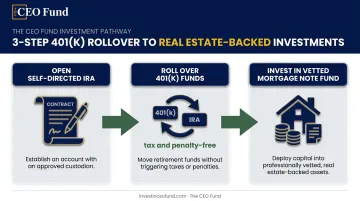
Many address this gap by rolling a portion of retirement funds into a self-directed IRA to access real estate-backed mortgage note investments, such as those offered through The CEO Fund. The process typically involves:
- Opening a self-directed IRA with a qualified custodian
- Rolling over funds from the existing 401(k) without triggering taxes or penalties
- Directing the custodian to invest in a vetted mortgage note fund
The outcome that matters most: consistent quarterly cash distributions backed by real estate collateral, spread across multifamily, single-family, and commercial notes, without becoming a landlord.
This approach layers real estate-backed income on top of an existing 401(k) for a more resilient retirement plan. If you're exploring passive, real estate-backed retirement income, The CEO Fund helps accredited investors deploy self-directed IRA and 401(k) funds into mortgage note investments designed for this kind of diversification.
Conclusion
Neither vehicle is universally "better." A 401(k) excels at automation and employer-matched growth. Real estate offers tangible collateral, cash flow, and tax advantages that a mutual fund can't replicate.
The most resilient wealth-building strategies rarely pick a side. They combine both, holding real estate-backed mortgage notes inside self-directed IRAs or 401(k)s, an approach The CEO Fund specializes in, to layer passive income on top of traditional market growth.
Frequently Asked Questions
How much will $20,000 in a 401(k) be worth in 20 years?
It depends on contribution consistency and market performance. Using an illustrative 7-8% annual return, $20,000 could grow to roughly $77,000–$93,000 in 20 years with no further contributions, though actual results vary.
Can I retire at 62 with $400,000 in my 401(k)?
Retirement readiness at this level hinges on your withdrawal rate, other income sources like Social Security, and expected expenses. A financial advisor can build a personalized projection based on your specific situation.
Can I use my 401(k) to invest in real estate?
Most standard employer 401(k)s restrict you to a limited fund menu that excludes direct real estate. However, eligible funds can often be rolled into a self-directed IRA to gain real estate exposure.
Is real estate a better investment than a 401(k)?
"Better" depends on your liquidity needs, involvement level, and tax situation. Each vehicle has distinct strengths, and many investors benefit from holding both rather than choosing one.
What is the average return on real estate compared to a 401(k)?
According to historical S&P 500 return data, the index has posted roughly 10% annualized total returns since 1957. Real estate returns vary significantly by property type and structure, with no single comparable long-term average available.
Can I combine real estate and 401(k) investing in one strategy?
Yes. Self-directed IRAs and 401(k)s allow investors to hold real estate-backed assets, such as mortgage notes, alongside traditional retirement savings within the same tax-advantaged structure.