

Introduction
Real estate has a reputation for delivering stable income, but that reputation only holds when the portfolio is actually diversified.
Commercial property values can swing hard during downcycles: Green Street's Commercial Property Price Index fell 19% from its March 2022 peak through October 2023.
Many investors assume owning three or four rental properties means they're diversified. It doesn't. If those properties sit in the same city, or the same asset class, one local recession or one sector-specific shock can hit every one of them at once.
True diversification spreads risk across property type, geography, strategy, and even how you hold the investment.
This article breaks down proven diversification strategies, compares REITs, direct ownership, and mortgage notes, and answers the allocation questions investors ask most, including the 70/20/10 and 25-25-25-25 frameworks.
Key Takeaways
- Diversifying across property type, location, and strategy protects income from localized downturns
- Mortgage note funds deliver diversified income without the tenant management burden of direct ownership
- Real estate typically shows low or negative correlation to stocks and bonds, strengthening a portfolio
- Allocation frameworks like 70/20/10 and 25-25-25-25 offer a starting point, not a rigid formula
- Pooled mortgage note funds add built-in diversification across loans, states, and property types
Why Real Estate Diversification Matters for Stable Income
Concentration Risk Is Real, Even With Multiple Properties
Owning five rental houses in the same suburb still ties your exposure to one local economy. A factory closing, a major employer relocating, or a new zoning law can hit every property in that city at the same time.
This is why property values react so differently across cycles. During the 2008 financial crisis, the all-property index tracked by Green Street fell nearly 39%, a sharper drop than most residential markets saw. Institutional-quality commercial assets often carry more leverage and trade in thinner markets, which amplifies those swings.
Diversification smooths this out. Residential, commercial, and industrial tenants respond to different triggers:
- Residential demand holds relatively steady because people always need housing, even in a downturn
- Industrial and logistics space surges when e-commerce accelerates, as it did through 2020-2022
- Office and retail are more sensitive to remote-work trends, consumer spending, and local vacancy
When one sector cools, income from another can offset the drag, keeping overall returns steadier even as individual property types struggle.
Mortgage note funds apply this same principle by spreading capital across multifamily, single-family, mobile home park, and commercial notes rather than concentrating in one property type or region.
The Correlation Advantage
Real estate's value in a broader portfolio goes beyond its own returns. What matters just as much is how little it moves with stocks and bonds.
The NCREIF Transaction Based Index found a correlation of just 0.07 with the S&P 500 and -0.15 with the U.S. Aggregate Bond Index. That's across a 34-year study period, according to research published by the Pension Real Estate Association. Private real estate often zigs when equities zag.
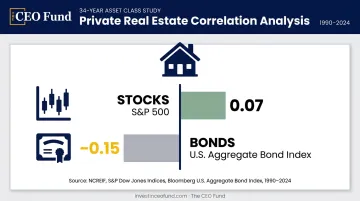
That matters because low correlation actually reduces portfolio-level volatility. Simply adding another asset class doesn't achieve the same effect on its own.
There's also a lending angle. Federal banking regulators specifically flag commercial real estate concentration as a portfolio risk factor for banks. That's one reason lenders scrutinize borrowers with heavy exposure to a single market or asset type. Diversified investors tend to present a cleaner risk profile at the underwriting table, even without a guaranteed rate discount.
Proven Strategies to Diversify Your Real Estate Portfolio
Diversification breaks down into four separate levers you can pull independently.
Diversify by Property Type
Different property types respond to entirely different demand drivers. Blending them balances your income against sector-specific downturns.
The dispersion can be dramatic. Through late November 2024, listed apartment REITs returned 28.77% while industrial REITs returned -10.06% over the same period, according to Nareit's REITWatch data. Retail sat in between at 21.24%.
A blended portfolio might include:
- Residential (single-family and multifamily) for steady, recession-resistant demand
- Industrial and logistics for exposure to e-commerce and supply chain growth
- Retail for income tied to consumer spending cycles
- Mobile home parks for lower-cost housing demand that tends to hold up in downturns
- Commercial office selectively, given its sensitivity to remote-work trends
No single type is "safe" forever. The point is owning enough variety that no one sector's bad year sinks your whole income stream.
Diversify by Geography
Real estate markets rarely move in sync. Some regions post double-digit annual price gains while others barely budge, driven by local job growth, migration patterns, and housing supply, not any single national trend.
A portfolio concentrated in one state carries:
- Natural disaster exposure: hurricanes, wildfires, and flooding affect insurance costs and values
- Regulatory risk: rent control, zoning changes, and property tax hikes vary widely by jurisdiction
- Single-market dependency: a local job loss event can depress rents and occupancy across an entire portfolio
Spreading capital across multiple states, or investing through a vehicle that already operates nationwide, reduces dependency on any one region's economy, tax code, or weather pattern.
Diversify by Investment Strategy
Each strategy behaves differently depending on market conditions:
| Strategy | Income Style | Liquidity | Best Fit When |
|---|---|---|---|
| Buy-and-hold rental | Monthly rent | Low | Rates are stable, tenant demand is strong |
| Fix-and-flip | Lump sum at sale | Low during project | Prices are appreciating quickly |
| Publicly traded REITs | Dividends | High | You want liquidity and market exposure |
| Crowdfunding platforms | Distributions | Restricted | You want smaller-check access to deals |
| Private mortgage lending | Fixed interest | Low to moderate | You want contractual, collateral-backed income |
No single strategy wins in every cycle. Buy-and-hold owners felt real pain when financing costs spiked in 2022-2023, while private lenders collecting fixed-rate interest payments were largely insulated from that same rate shock.
Diversify by Risk Tier
Not every dollar needs the same risk-return profile. A tiered approach might look like:
- Low-risk tier: Stabilized, fully leased properties or performing mortgage notes with conservative loan-to-value ratios
- Medium-risk tier: Value-add properties, growth markets, or moderately leveraged funds
- High-risk tier: Ground-up development, distressed notes, or emerging markets with higher upside and higher volatility
The split depends on time horizon and appetite for volatility. An investor five years from retirement will likely weight toward the low-risk tier, while someone in their 30s might accept more high-risk exposure for higher potential returns. The goal is sizing each tier so no single bad outcome derails your overall income.
Mortgage Notes: An Overlooked Path to Passive, Diversified Income
Most diversification conversations stop at property type and geography. There's a third lever that gets less attention: how you hold the investment itself.
You Become the Bank, Not the Landlord
When you invest in a mortgage note, you're purchasing the debt secured by a property, not the property itself. The borrower makes monthly principal and interest payments to you, backed by real estate collateral, much like a bank collecting on a mortgage.
This eliminates what's often called the "3 T's" of rental ownership:
- Tenants: no leasing, screening, or eviction risk
- Toilets: no maintenance calls, repairs, or capital expenditures
- Tiles: no renovation costs or property condition liability
You still hold asset-backed security. If a borrower defaults, the underlying property remains the collateral. You just skip the day-to-day management that comes with direct ownership.
Built-In Diversification Through Note Funds
A single mortgage note still carries concentrated risk: one borrower, one property, one state. A mortgage note fund solves that by pooling capital across many loans, property types, and geographies at once.
The CEO Fund is a real-world example of this model. The Miramar, Florida-based fund has built a 10+ year track record, purchasing 500+ loans across 50+ states, spanning multifamily, single-family, mobile home park, and commercial mortgage notes.

Rather than an investor sourcing and underwriting dozens of individual loans, the fund's leadership team, with 40+ combined years of real estate and corporate finance experience, handles acquisition, underwriting, and ongoing management. Investors receive monthly cash flow deposited directly into a savings or retirement account.
A Tax-Advantaged Angle for Accredited Investors
Once mortgage note income starts flowing, accredited investors can often go a step further and hold these investments inside a self-directed IRA or 401(k), letting interest income grow tax-deferred or tax-free depending on the account type.
The SEC cautions that self-directed IRA custodians typically administer these assets rather than vet them. Diligence on a fund's track record, underwriting standards, and collateral quality still falls to the investor. That's a fair trade for an income stream not tied to leasing markets or maintenance cycles.
Common Diversification Mistakes to Avoid
Mistaking Quantity for Diversification
Owning eight rental properties sounds diversified, until you realize they're all single-family homes in the same metro area. That's concentrated risk wearing a diversified costume. Real diversification requires different property types, different markets, or different income mechanisms, not just more of the same.
Ignoring Correlation Between Holdings
Holding five different REITs might look diversified on paper. But research from S&P Dow Jones Indices found that traditional office, industrial, and residential REIT sectors tend to move together more closely than specialty sectors do. The same trap applies to multiple crowdfunding deals from the same sponsor or market; they often rise and fall in tandem. Mortgage notes avoid this trap since payments depend on borrower performance, not property market cycles.
Skipping Rebalancing
A portfolio that was well-diversified five years ago may not be today. Markets shift, and some holdings grow faster than others, quietly concentrating risk without you noticing. A simple rebalancing checklist:
- Review allocation annually: check property type, geography, and strategy weightings
- Compare against goals: has your risk tolerance or time horizon changed?
- Trim overweight positions: redirect new capital toward underweighted categories
- Reassess correlation: confirm your holdings still respond to different market triggers
Frequently Asked Questions
How do you diversify real estate investments?
Mix property types (residential, commercial, industrial), geographies, and investment vehicles like direct ownership, REITs, and mortgage notes. Simply acquiring more of the same asset in the same market isn't diversification.
What is the 70/20/10 rule of investing?
Originally a budgeting rule (70% spending, 20% saving, 10% debt or giving), investors have adapted it for portfolios: roughly 70% in stable core assets, 20% in moderate-growth holdings, and 10% in higher-risk or speculative positions.
What is the 25-25-25-25 portfolio?
This is Harry Browne's Permanent Portfolio: 25% stocks, 25% long-term bonds, 25% cash or Treasury bills, and 25% gold. Some investors adapt it by swapping a quarter into real estate for added diversification.
What is the 2% rule for properties?
It's a rough screen suggesting monthly rent should equal at least 2% of the purchase price for strong cash flow. In today's higher-price markets, qualifying properties are rare, so it works better as a quick filter than a firm requirement.
What percentage of a portfolio should be allocated to real estate?
There's no universal number. Academic literature cited by Morningstar suggests a 5% to 20% range for mixed-asset portfolios, depending on liquidity needs, risk tolerance, and existing property exposure.
Are mortgage notes a good way to diversify real estate holdings?
Yes, for accredited investors. Mortgage notes offer contractual, collateral-backed income and remove the tenant, maintenance, and vacancy risks of direct ownership, making them a solid complement to a broader real estate portfolio.