
Fund managers juggle entity classification, carried interest rules under Section 1061, trading elections, and investor-specific exposure to UBTI, ECI, and PFIC regimes. Get any layer wrong, and after-tax returns take the hit — not the fund's performance numbers.
This guide breaks down how hedge funds are structured for tax purposes, how carried interest actually gets taxed, what investors need to watch for based on their tax status, and where the IRS is focusing its attention heading into 2026.
Key Takeaways
- Hedge funds use partnership or LLC structures to pass income directly to investors, avoiding entity-level tax.
- Carried interest qualifies for capital gains treatment under Section 1061 after the three-year holding threshold.
- Offshore blocker entities shield foreign and tax-exempt investors from ECI and UBTI exposure, though corporate-level tax still applies.
- IRS scrutiny of partnership allocations and fee waivers has intensified as OBBBA makes Section 707(a)(2) self-executing.
- Investors tired of K-1 complexity and UBTI risk increasingly seek non-leveraged, real estate-backed alternatives.
Hedge Fund Structures and Their Tax Treatment
Nearly every U.S. hedge fund organizes as a limited partnership or LLC taxed under Subchapter K. This structure is deliberate: it's the only practical way to avoid paying tax twice on the same dollar of gain.
Pass-Through Partnership Structure: The Core Building Block
In this model, income, gains, and losses flow through directly to investors, who report their share on Schedule K-1. The fund itself pays no federal income tax.
The general partner (or investment manager) typically earns two things:
- A management fee, usually 1-2% of assets under management
- A carried interest, a profits allocation tied to fund performance
Most managers keep the management company as a separate entity from the fund itself. This isolates self-employment tax exposure and keeps Section 1061 planning cleaner, since carried interest and management fees are taxed under completely different rules.
Master-Feeder Arrangements and Blocker Corporations
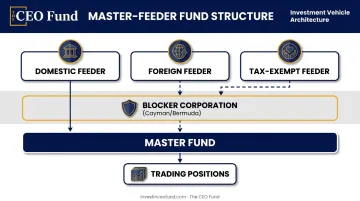
Larger funds rarely use a single vehicle. Instead, they run a master-feeder structure: domestic, foreign, and tax-exempt capital flows into separate feeder funds, which then invest into one master fund that executes the actual trading.
The IRS's own guidance on hedge fund basics confirms this master fund is usually a foreign entity or a domestic LP/LLC taxed as a partnership.
A blocker corporation sits between the master fund and foreign or tax-exempt feeders, absorbing income at the corporate level so it never passes through as taxable to the underlying investor. Cayman Islands and Bermuda entities are the industry standard for this role.
Offshore Feeders for Foreign and Tax-Exempt Investors
Foreign investors and pension or endowment funds gravitate toward offshore feeders for a simple reason: it keeps them out of U.S. tax filing obligations entirely.
That said, offshore structuring doesn't eliminate withholding. Two provisions matter here:
- Section 1441: imposes up to 30% withholding on U.S.-source dividend and FDAP income paid to foreign persons
- Section 1446(f): requires 10% withholding on amount realized when a foreign partner disposes of a partnership interest tied to a U.S. trade or business
Treaty documentation can reduce these rates, but only when filed correctly and in advance.
Carried Interest, Section 1061, and Fee Waivers
Carried interest is a profits allocation, not a fee. Managers typically only receive it after investors get their capital back plus a preferred return, which aligns manager pay with actual fund performance rather than assets gathered.
What Section 1061 Means for Fund Managers
Section 1061 recharacterizes long-term capital gains allocated through an "applicable partnership interest" (API) as short-term gains unless the underlying asset was held for more than three years. According to the IRS's Section 1061 reporting guidance, this rule has stayed intact: the One Big Beautiful Bill Act made no changes to carried interest taxation.
For managers, that means planning around:
- Multiyear performance targets that naturally extend holding periods past three years
- Capital account documentation that clearly tracks API allocations separately from ordinary carry
- Clawback and vesting terms that demonstrate genuine entrepreneurial risk, not guaranteed compensation
Management Fee Waivers and IRS Scrutiny
Some managers waive their fixed management fee in exchange for an increased profits interest, converting ordinary income into capital gains. This only works if the waiver satisfies Rev. Proc. 93-27's safe harbor; otherwise, it risks being treated as disguised compensation under Section 707.
The IRS hasn't backed off here. Poorly documented waiver arrangements can trigger accuracy-related penalties. 2024 commentary from major accounting firms specifically flags renewed scrutiny of whether these arrangements carry real entrepreneurial risk or are just fee income wearing a different hat.
Hurdles, Waterfalls, and Clawbacks
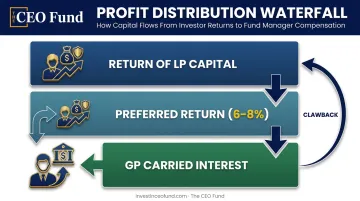
Distribution waterfalls determine the order in which profits flow between limited partners and the general partner:
- LPs typically receive capital back first, then a preferred return (often 6-8%)
- The GP then receives carried interest on remaining profits
- Clawback provisions require the GP to return carry already paid if the fund underperforms in later years
These mechanics matter for tax planning because they directly affect when and how carried interest is recognized.
Investor-Level Tax Exposure: UBTI, ECI, and PFIC Rules
An investor's tax status determines which regime applies — and it's rarely straightforward for institutional or foreign capital.
Unrelated Business Taxable Income (UBTI) for Tax-Exempt Investors
Pension funds, endowments, and IRA investors are generally tax-exempt. That changes once leverage enters the picture. Under Section 514, income from debt-financed property loses its normal tax-exempt status, even for a retirement account.
This means a leveraged hedge fund strategy can force an IRA to file Form 990-T and pay tax, despite the account's tax-advantaged wrapper. It's one of the most common surprises for self-directed IRA investors who assume "tax-exempt" means "no filing required."
Effectively Connected Income (ECI) and Withholding for Foreign Investors
Foreign investors face a different problem: Effectively Connected Income (ECI), which arises when a fund's activities rise to the level of a U.S. trade or business. Foreign corporate investors also face branch profits tax at 30% on ECI, subject to treaty reduction.
Fortunately, Section 864(b) provides trading safe harbors: foreign investors can trade stocks and securities for their own account without triggering trade-or-business status, even through a U.S. broker. Activities outside that safe harbor, however, can pull a fund into ECI territory fast.
PFIC Rules and the QEF Election
U.S. taxpayers who invest through offshore corporate feeders may run into Passive Foreign Investment Company (PFIC) rules. A foreign corporation qualifies as a PFIC if:
- 75% or more of gross income is passive, or
- 50% or more of average assets produce passive income
Without an election, PFIC taxation is punitive, with deferred tax plus interest charges on excess distributions. Two elections avoid this:
- QEF election: include pro rata share of ordinary earnings and capital gain annually
- Mark-to-market election: available for marketable PFIC stock, treating annual appreciation as ordinary income
Form 8621 governs the reporting and election mechanics for both.
Trading Tax Rules Hedge Funds Must Navigate
Active, leveraged, derivative-heavy trading strategies intersect with several IRC provisions that can defer losses or change how gains are characterized.
| Rule | What It Does |
|---|---|
| Wash sale (Sec. 1091) | Disallows loss if substantially identical securities are bought within 30 days before or after the sale |
| Straddle rule (Sec. 1092) | Defers loss recognition to the extent it exceeds unrecognized gain on an offsetting position |
| Section 475(f) election | Marks positions to market annually; gains/losses become ordinary income |
| Section 1256 contracts | Marked to market with automatic 60% long-term / 40% short-term treatment |
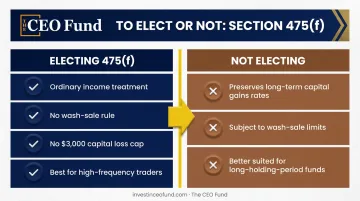
The Section 475(f) election carries the biggest trade-off in this table. Qualifying traders who make it escape wash-sale headaches and the $3,000 capital loss limitation entirely.
The catch: they give up long-term capital gains treatment on positions that would otherwise qualify. That trade-off usually pays off for high-frequency or short-holding-period funds, since few of their positions would qualify for long-term rates anyway. Funds building long-term positions typically lose more than they gain by electing.
Compliance, IRS Scrutiny, and Simpler Alternatives for Investors
2026 has brought sharper IRS focus on partnership basis, allocations, and disguised service payments. OBBBA's amendment to Section 707(a)(2) made the provision self-executing rather than dependent on future Treasury regulations, effective for services performed after July 4, 2025.
Enforcement capacity tells a more complicated story, though. A March 2026 TIGTA report found that large partnerships filed 334,686 returns for tax year 2023, with an examination rate that fell below 0.1%, even as the IRS's pass-through entity workforce shrank more than 20% during 2025.
Translation: audit risk is model-driven and real, but broad-brush enforcement remains thin. Documentation still matters more than ever, since a flagged return gets far more scrutiny than it used to.
On the state side, Passthrough Entity Tax (PTET) elections now exist in 38 states plus New York City as a SALT cap workaround. OBBBA also raised the federal SALT cap to $40,000 through 2029 before it reverts to $10,000.
A Simpler Path for Some Investors
Not every accredited investor wants multi-tiered blocker structures, K-1 complexity, or UBTI risk baked into their portfolio. That's part of why mortgage note and real estate-backed income funds have gained traction as a more straightforward alternative.
The CEO Fund, for example, structures its mortgage note strategy around a lender-not-landlord model:
- Investors collect a share of income generated as borrowers make their monthly mortgage payments
- Distributions to investors are paid on a quarterly basis
- Investments are compatible with self-directed IRAs and 401(k)s
- Assets are backed by real estate collateral rather than leveraged trading positions
For investors specifically worried about UBTI from debt-financed strategies, it's worth asking any fund directly whether its acquisitions use leverage — the answer changes the tax analysis significantly. Non-leveraged, note-based income structures sidestep the Section 514 debt-financed income problem that trips up many retirement account investors in hedge funds.
Frequently Asked Questions
How is a hedge fund taxed?
Most hedge funds are pass-through partnerships. Gains and losses flow to investors, who report their share on Schedule K-1 and pay tax based on the income's character — ordinary, short-term, or long-term.
What capital gains tax rate will I pay on hedge fund investments?
Rates depend on holding period and income character. Standard long-term gains require a one-year holding period, but carried interest under Section 1061 needs three years to qualify for the same reduced rates. Short-term trading gains are taxed as ordinary income.
What is carried interest and why is it taxed favorably?
Carried interest is a manager's profits allocation, paid after investors receive their capital and preferred return. It qualifies for long-term capital gains treatment under Section 1061 if held beyond three years.
What is a blocker corporation and why do hedge funds use them?
A blocker corporation sits between investors and the fund's investments, absorbing income at the corporate level. This shields foreign and tax-exempt investors from ECI and UBTI exposure they'd face investing directly.
Can retirement accounts like IRAs invest in hedge funds without tax penalties?
IRAs can invest, but leveraged strategies can trigger UBTI under Section 514, forcing the account to file and pay tax. That's why many self-directed IRA investors prefer non-leveraged vehicles like mortgage note funds.
What is the Section 475(f) mark-to-market election?
It lets qualifying traders treat gains and losses as ordinary income annually, removing wash-sale rules and the $3,000 capital loss limit. In exchange, the trader forfeits long-term capital gains treatment on those positions.